

Neat Finds #07: Firehose Toys, Fediverse Games and Small Machines
Issue seven: the Bluesky firehose as Matrix rain, a Windows 95 screensaver and a Star Fox level, chess and Pokémon played with posts, a book club in your e-reader's margins, a website over SSH, a DOS-style C IDE, an ESP32 that adds AirPrint to old printers and endless drop caps.

Contents
Issue seven leans on the social web, but not in the usual way. The first half is people playing with the Bluesky firehose and the fediverse as if they were toys: rain, screensavers, arcade games, chess by toot and a book club living in the margins of an e-reader. The second half is smaller machines and smaller programs, from a website you open with ssh to a C compiler with a DOS-era IDE and a cheap board that teaches an old printer new tricks. As usual, no AI projects.
Same deal as always: I haven't tested everything here, and the last lines of each entry are what I'd be tempted to build, not promises.
01. Bluerain #
The Bluesky firehose falling down the screen as Matrix-style digital rain. Bluesky runs on the AT Protocol, which streams every new post in real time, and Bluerain listens to that stream through a Jetstream server, a relay that turns it into plain JSON over a WebSocket. Every string of characters you see falling is a real post being written at that moment. It started as a fork of an old CodePen, wears a CDE theme from the classic-stylesheets project, and the author tells the story in a blog post. It would look right on an old monitor in a corner of the room.
02. Bluesky Firehose in 3D #
github.com/theosanderson/firehose
The same firehose, now in the style of a Windows 95 screensaver. You fly down an endless corridor while live posts, in every language, cover the walls in bright colors, the way the old 3D screensavers filled the screen while nobody was at the desk. The README is one line long, and the live version is all the documentation it needs. Leave it running for a minute and you get a strange, honest picture of what the network is talking about.
03. SkyFox64 #
A Star Fox 64 level made of the Bluesky firehose. You pilot an Arwing through a tunnel of real-time posts and shoot at them, with WASD to move, Shift to boost, Space to fire and a double tap on A or D for the barrel roll, of course. Crash into three posts and it's game over. Underneath it's React and Babylon.js, with a small Node server relaying Jetstream to the browser. You can play at skyfox.social.
04. PokéSky #
Catch Pokémon straight from the Bluesky firehose. Every post that mentions Pokémon shows up live, and the creatures appear on a 3D recreation of Poké Pelago, from the Sun and Moon games, where you click to catch them and fill a Pokédex of more than a thousand. The README makes two things clear: the sprites and sounds belong to The Pokémon Company, Game Freak and Nintendo, and the code is "vibe code free". Play it at pokesky.idreesinc.com. The author is also behind Pocket Bird, from issue five.
05. Hose Race #
A betting game without money: you guess which words will appear the most on English-language Bluesky, and the firehose decides in real time. To make the races fair, the author took "sips" from the firehose, counted the top words and grouped the ones that show up at about the same rate into leagues, which live in a JSON file anyone can read. It was a learning project for React and isn't maintained anymore, which doesn't make it any less fun. A version that races the words of a single account would be a fun twist.
06. place #
An r/place-style canvas where every pixel is placed by replying to a Bluesky post. You reply with something like pixel 12,30 #ff00aa, the server reads the reply from the Jetstream, checks the coordinates and sends the new pixel to everyone watching. It's React and Vite on the front, Hono on the server, and very little else. A tiny version of this for a pubnix, with replies from the fediverse instead, would fit runv.club.
07. castling.club #
github.com/stephank/castling.club
Chess over the fediverse. castling.club is an ActivityPub server with a single actor, the King, who works as the arbiter. To start a game you toot @king@castling.club I challenge @someone, sides are picked at random, and on your turn you reply with your move in standard algebraic notation, followed by any trash talk you like. You can also put yourself on a list of people open for challenges. It runs on Node.js and PostgreSQL, uses chess.js for the rules and is MIT licensed. The author asks only one thing: if you use the code, send them a toot.
08. MastodonPlays #
github.com/TomCasavant/MastodonPlaysGameboy
Twitch Plays Pokémon, but with Mastodon polls. The bot posts the current screen of a Game Boy game, followers vote on the next button, and the winning option gets pressed. There's a Pokémon Gold run at @pokemon@tomkahe.com. It's a work in progress, and the README admits it only really works with slow, turn-based games, which is exactly the charm. The goal is to let anyone turn a ROM into a Mastodon bot.
09. Fedi-Games #
A small framework in Go for building games that live on the fediverse. Each game implements one interface, and the server handles the ActivityPub side, the SQLite database and the media. The public instance, games.rerere.org, has tic-tac-toe, where you reply with a number from 1 to 9, rock paper scissors and a game called bunkers. In local development it never sends anything to other servers, which is a thoughtful touch. A turn-based game for a small community could start from this.
10. koatsync #
"A book club in the margins." It's a KOReader plugin that mirrors your highlights and notes to your own atproto PDS, the place your Bluesky-style data lives, and shares them with your book club through atproto permissioned spaces. When a friend underlines something, it shows up over your page, even if their copy of the book is a different file. The rules it plays by are good ones: KOReader's own files stay the source of truth, there's no server in the middle, private notes never leave the device, and it only syncs when the Wi-Fi is already on. It's early, and for now everyone in a club needs a PDS that runs the spaces alpha.
11. ssh.yorukot.me #
github.com/yorukot/ssh.yorukot.me
A personal website you visit with ssh ssh.yorukot.me. You land on the author's intro, browse the blog from a terminal-friendly index, and can jump straight into a post by passing its slug as the SSH command. The content comes from the same source as the regular website, so there's nothing to keep in sync by hand. It's Go with Charm's Wish and Bubble Tea, and the reason given in the README is simple: the author wanted a version of the site that lives where they actually like to work. An SSH door to this blog would make a fun weekend project.
12. term-maze-raycast #
github.com/httpspycharmhelpers/term-maze-raycast
A 3D maze in your terminal, drawn with ray casting the way Wolfenstein 3D did it, but in characters: walls outlined with | and _, slanted with / and \ when you look up or down, and a floor of dots. The maze is huge, a random 1000 by 1000 grid where every path connects, with extra walls knocked down so you can wander in loops. There's no exit and no victory screen, only exploring, and a minimap in the corner. It's written in Go with almost no dependencies, and it has a special build for Termux on Android. The README is in Chinese, but the game doesn't need words.
13. Flash C #
A small C compiler and a full-screen, text-mode IDE for Linux, laid out like the DOS-era C environments. The compiler, fcc, reads C and writes a native ELF64 executable directly, with no assembler, linker or C library involved. The IDE, fc, has pull-down menus, overlapping edit windows, a source-level debugger with breakpoints and watches, and hyperlinked help for every library function. It compiles ANSI C89 with a few C99 conveniences, has 48 switchable optimizations, and runs on x86-64 and on AArch64, Raspberry Pi 4 included. Even the error messages look like 1991: Error hello.c 5: Undefined symbol 'x' in function main. A Pi with this and a CRT would make a lovely little workstation.
14. ESP32 USB to AirPrint #
github.com/ngxson/esp32-usb-to-airprint
An ESP32-S3 board that plugs into the USB port of an old printer and puts it on your Wi-Fi. From then on you can print from iPhones, iPads and Macs with AirPrint, from Android with Mopria and from Linux, with no drivers, and scan from any browser or from Image Capture on a Mac. There's also a small web app for printing PDFs and photos and putting scanned pages together. The supported list is mostly Canon PIXMA inkjets for now, and the project is looking for contributors, with one firm rule: you have to own the printer you add, because every driver gets tested on real hardware. Every house has one of these printers in a closet.
15. heron #
A self-hosted status page and uptime monitor in one small binary and one SQLite file. The download is about 10 MB and it idles at around 40 MB of RAM. It checks websites, TCP ports, ping, DNS, Postgres, Redis, SMTP, IMAP, Docker containers, gRPC, and even Minecraft and Steam servers with their player counts, plus push monitors for cron jobs and backups. The public page has 90-day uptime bars, a GitHub-style calendar for the whole year and live updates, so people watching during an outage see the moment things come back. The author's reason for writing it is very relatable: everything else needed a database server or looked like an admin template from 2014.
16. Skiff #
Replacement firmware that turns the M-VAVE FM-1, a cheap little synth, into a six-track groovebox, and it now runs on the SMK-37 Pro keyboard too. It has synth and drum engines, a step sequencer with patterns and songs, effects, live performance controls, and a screen that shows what every knob does. The release notes read like a craftsman's diary, with fixes for a squealing phaser and clicks in the sub bass, sync out for Pocket Operators, and an editor that mirrors the unit's screen, large, on a computer or a tablet. It's a good reminder that cheap hardware often has a lot more in it than its stock firmware shows.
17. INITIĀLIS #
An endless field of ornamental drop caps, those big decorated letters at the start of old book chapters. Every one is drawn in your browser from parts: a letter, a frame and a ground, an ornament that grows out of it, a texture and two or three inks printed onto paper. Nothing is a picture made in advance. You drag to wander, click a letter you like and ask for more like it, bookmark favorites and download them as a zip, in four sizes on a transparent ground and as an animated WebP of the letter growing in. Try it at initialis.azlen.me. It's the cover of this issue, and noctem.art would wear these well.
18. Pixel Plays #
github.com/amirmushichge/pixel-plays
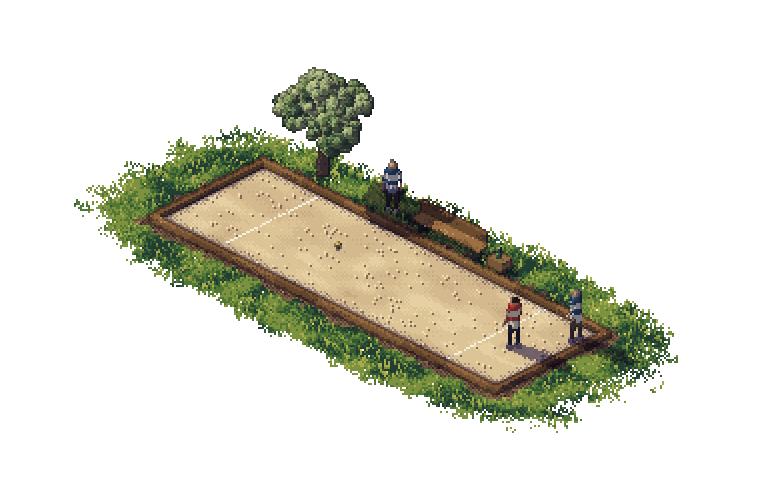
Small browser games shown as isometric pixel dioramas. Each game is one page of plain JavaScript with its own software rasterizer: no build step, no dependencies, no sprites and no image files. You can play bocce against a bot, dive off the old bridge in Mostar, rescue the laundry from a rooftop before the storm, play a clay-court tie-break or pump for height on a skate ramp. Play it here. Every scene fits on one page of code, which makes them perfect for reading on a slow afternoon.
Bonus tabs #
A few more I refuse to close:
Tiny5 Mono · A 5-pixel monospaced variable font for terminals and editors, with taller-than-wide pixels like the old text modes and axes for CRT glow and dot-matrix ink.
at://2048 · The 2048 puzzle, with your games stored on the AT Protocol. Heavily a work in progress, as the README warns.
rolld · Log your board game plays and ratings as records on your own atproto account, with almost no server behind it.
tmon · A full-screen terminal status monitor for home servers and NAS boxes that can take over the monitor plugged into the machine.
Cap · A self-hosted, privacy-first CAPTCHA with no puzzles: the browser quietly solves small proof-of-work challenges in the background.
That's issue seven. Half of it turns a social network into a playground, and the other half fits in a pocket, a closet or a terminal window.
Found a strange repository, a forgotten tool or a small piece of software I should see? Send it my way. Reader suggestions are welcome for issue eight. And if you make something with any of these, I'd like to see it.
Happy wandering!
Pablo