


The Right Claude
Claude Shannon studied bits, built mechanical mice and juggled on a unicycle. A biography with a sense of humor about the Bell Labs researcher, his ideas and the link between his name and Anthropic's Claude.
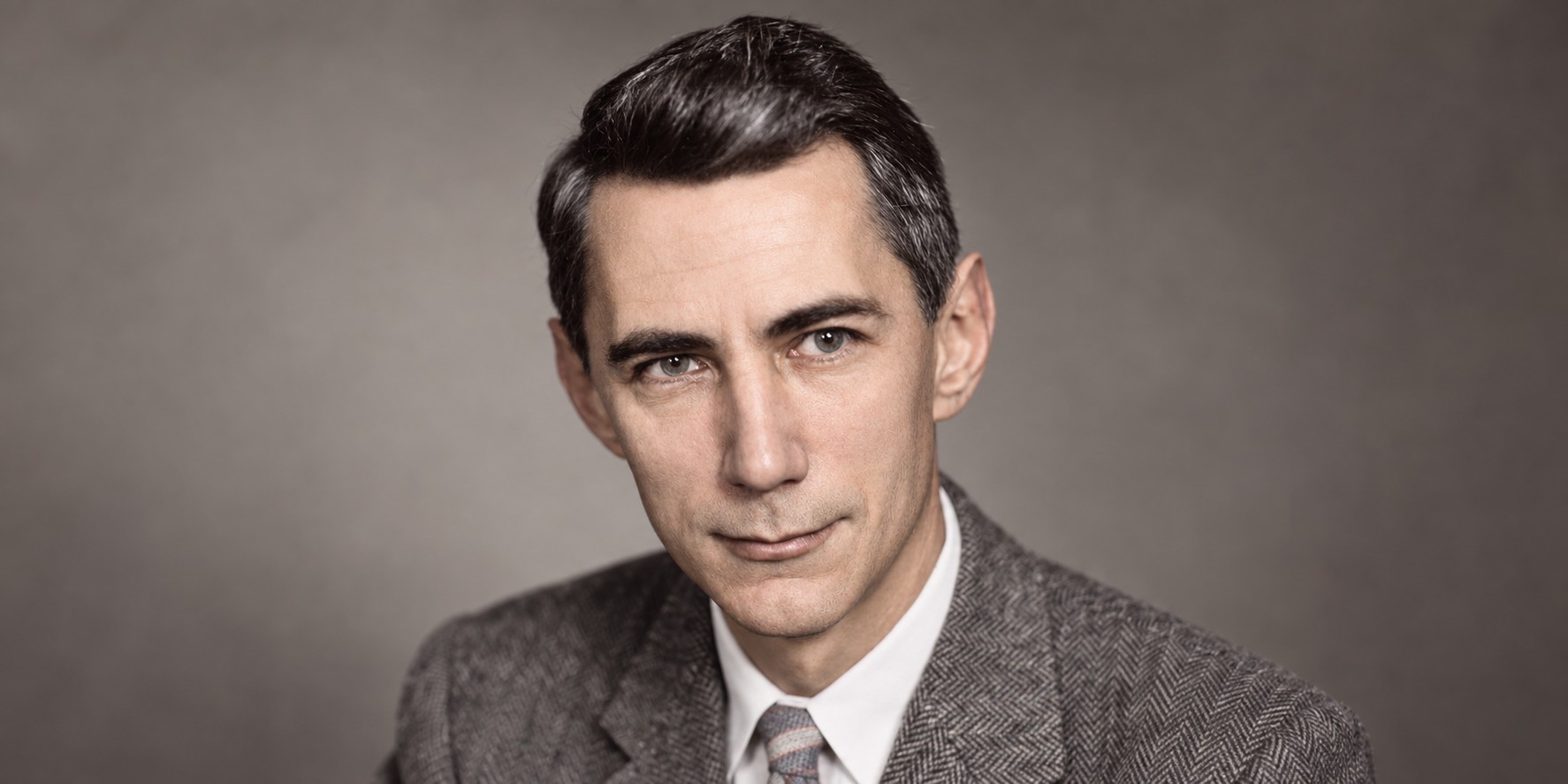
Claude Shannon between bits and unicycles
Claude Shannon helped build the foundations of the digital world and still found time to juggle on a unicycle down the hallways of a lab. I like that detail because it ruins a very convenient image: the one where brilliant people have to spend their lives wearing an important-meeting face.
The guy studied how to transmit information, how machines could play chess and how a little mechanical mouse could learn a path. He also built a box that switched itself off whenever someone switched it on. A machine with an admirably clear customer service policy. Today, a lot of people meet his first name in a chat window: Claude, Anthropic's assistant. There's a link to Shannon in that choice, according to reports about the company. But the man's story is much better than the naming trivia. To understand it, it's worth going back to a time when a computer could fill a room and still be unable to open forty tabs to pretend it was working.
The boy who used the fence as a network #
Claude Elwood Shannon was born in Petoskey, Michigan, on April 30, 1916, and grew up in Gaylord. He liked taking things apart, building radios and experimenting with electricity. He even made a telegraph system using the barbed-wire fences on the farms. The infrastructure was rural. The urge to send a signal far away, not so much.
In 1936, he left the University of Michigan with degrees in mathematics and electrical engineering. At MIT, he worked with the differential analyzer, a huge analog machine that solved mathematical problems with physical mechanisms. Gears and circuits lived together in that machine, and Shannon needed to understand both.
It was while looking at relays, electrically controlled switches, that he connected two things that used to live in separate departments: circuits and George Boole's algebra. True or false. Open or closed. A relationship that seems obvious after someone demonstrates it and not obvious at all before.
His master's thesis, written in 1937, showed how to use Boolean logic to analyze and simplify switching circuits. Think of two switches in series: current only flows if both allow it. That corresponds to a logical AND. In parallel, it's enough for one of the alternatives to let it through: an OR. You could reason about the circuit before building it.
You run into that logic whenever you write a condition in code. Shannon didn't single-handedly invent the computer or binary numbers. He established a fundamental bridge between logic and the construction of digital circuits. In 1940, he completed at MIT his master's in electrical engineering and his PhD in mathematics, the latter with research on theoretical genetics.
Yes, genetics. His résumé had trouble staying in a single folder.
Bell Labs and the problem of getting the message there #
Shannon joined Bell Labs in 1941. The lab, tied to the American telephone system, had a very concrete problem: getting signals to their destination with quality and efficiency. There was no point in sending a message quickly if it arrived sounding like a blender reading a contract.
There was a rare combination there of industrial problems, resources and fundamental research. The transistor came out of Bell Labs in 1947. Decades later, Unix would also be born in that environment. Shannon was part of that ecosystem, not of a story in which one man wakes up inspired and invents all of modernity before coffee.
During World War II, he worked on fire-control systems and cryptography. He also met Alan Turing at Bell Labs. What brought the two together was an interest in machines and communication, but it would be wrong to turn that meeting into a partnership responsible for everything we now call artificial intelligence.
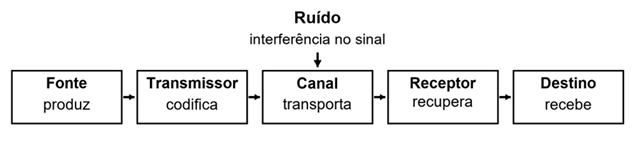
In 1948, Shannon published A Mathematical Theory of Communication in the Bell System Technical Journal. His central question was how to reproduce, at one point, a message selected at another. Telephony, text and images could be studied within the same model: a source produces the message, a transmitter turns it into a signal, a channel carries it and a receiver tries to recover it. Along the way, noise gets in.
Noise is the part nobody invited. Like a conversation where you ask the time and get a motorcycle with no muffler thrown in.
In 1949, Communication Theory of Secrecy Systems took that reasoning into cryptography. Shannon formalized perfect secrecy: looking at the encrypted message should reveal no information about which original message was sent. The theory explains the security conditions for using a truly random key, of adequate length and never reused. That doesn't turn any long password into magic. Mathematics is much harder to impress than a sign-up form.
Bits without the headache #
A bit is a binary digit, 0 or 1. It's also a unit for measuring information. A system with two distinguishable positions can store one bit. With two of those units, we have four possible combinations: 00, 01, 10 and 11.
A historical note: the word bit was suggested by John Tukey, as Shannon acknowledges in the article itself. Giving the honoree credit that belongs to his colleagues would be a pretty bad way of honoring him. Shannon's work made the relationship between information, uncertainty and transmission capacity precise. A choice between two equally likely possibilities corresponds to one bit of information. When some possibilities are more frequent, that distribution matters. Entropy measures the average uncertainty of the source, not the emotional value or the intelligence of a message.
If a machine always answers the same thing, its answer is predictable. If it can produce many alternatives with similar probabilities, there's more uncertainty. In both cases, the content can be sensible or completely idiotic. Entropy isn't a diploma.
That distinction is delightful and necessary: information, in this mathematical sense, isn't a synonym for meaning or truth. A lie can be transmitted with absolute fidelity. The channel did its job. The problem is with whoever opened their mouth.
Shannon also showed that a channel has a limited capacity. Within the model's assumptions, it's possible to transmit below that capacity with a probability of error as small as you like, using suitable coding and sufficiently long blocks. That doesn't promise a flawless internet, infinite speed or instant answers. Reliability has conditions and costs.
There are two useful ideas here. To save space, we take advantage of patterns and reduce redundancy: compression. To withstand noise, we add organized redundancy that helps detect or correct errors. It sounds contradictory, but they're different goals. It's like shrinking a package and still protecting it for the trip. Shannon proved limits and possibilities. Building practical codes and equipment able to exploit them took decades of work by a lot of people. That's why his theory shows up in the foundations of digital communication without him having invented Wi-Fi, streaming or the video your uncle just forwarded.
A mouse before the chatbot #
In 1950, Shannon created Theseus, a magnetic mouse that explored a maze and found a goal. After trial and error, the system stored information about the route and could repeat the path it had learned.
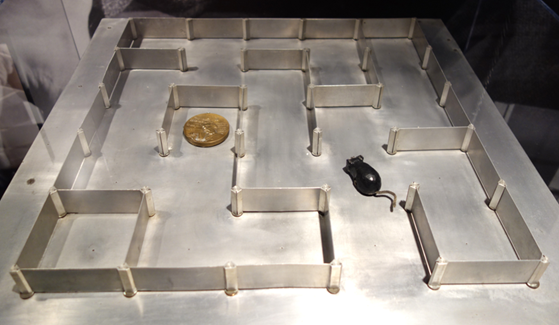
The important detail is under the table: the control and the memory were in a set of relays hidden by the maze. The little mouse didn't carry an autonomous brain in its head. The mechanism could look magical to someone looking from above, but the explanation was in the whole apparatus.
It was an early machine learning experiment. Calling Theseus the first chatbot would be absurd. Calling it a demonstration that a machine could adjust its behavior based on experience makes a lot more sense. It didn't write emails, but it didn't make up a meeting nobody scheduled either.
Betty Shannon deserves a place in this story for the work she did. Mary Elizabeth Moore was a numerical analyst at Bell Labs and married Claude in 1949. She collaborated on calculations and projects; according to the family account republished by the IEEE Information Theory Society, she did a large part of Theseus's wiring. The biography gets more interesting when the collaborator stops appearing only as the genius's wife.
In that same year, 1950, Shannon published Programming a Computer for Playing Chess. He treated choosing moves as a problem of search and evaluation. Chess offered clear rules, but an enormous number of alternatives. For a machine, trying everything indiscriminately wasn't a very promising strategy.
He was also one of the four authors of the 1955 proposal for the Dartmouth summer meeting, held in 1956, along with John McCarthy, Marvin Minsky and Nathaniel Rochester. The meeting became a landmark in organizing artificial intelligence as a field of research. So Shannon's link to AI doesn't depend on a modern company having liked his name.
So why is Claude called Claude #
Anthropic's Claude was publicly introduced on March 14, 2023. The link between the name and Shannon shows up in reports about the company's internal culture. In a piece published in February 2026, The New Yorker describes the choice as partly a reference to him and also as a preference for a friendly name.
A small caveat is in order: Anthropic's official announcement doesn't explain where the name came from. The tribute is reported in the article, not in a direct statement from the founders presented there. I prefer that precision to treating a repeated story as if it came with a notarized certificate.
There's a more interesting intellectual link. In the 1948 article, Shannon built examples of text that came closer to English as they incorporated frequencies and relationships between letters or words. In 1951, he studied predicting the next letter from the previous text to estimate the entropy of the language. Context made certain continuations more predictable.
That's reminiscent of an important idea in today's language models: learning regularities to predict continuations. But Anthropic's systems use neural networks trained at large scale and techniques developed much later. Shannon's experiments weren't a little Claude waiting for a better graphics card.
The tribute brings the names together. The history of science brings some of the questions together. Neither of the two allows us to say that Shannon created the assistant or that information theory, on its own, explains everything it does.
The workshop had less sense than the lab #
Shannon returned to MIT as a visiting professor in 1956, took a chair in 1958 and became professor emeritus in 1978. The academic career went on, and so did his taste for gadgets that would hardly survive a budget meeting.
He built a mechanical W. C. Fields that juggled, created rocket-powered frisbees and worked on a machine that could solve the Rubik's cube. MIT's records also mention his unicycle rides with three balls in the air. Doing that without falling would be résumé enough for me. He also had information theory.
The famous useless machine may be his funniest object. The idea was Marvin Minsky's, as Minsky himself told it: flipping the switch made a hand come out of the box, turn it off and pull back in. Shannon built a version. That's it. The whole device existed to politely refuse its own existence.
I respect a machine that states its lack of interest without opening a ticket.
With Edward Thorp, Shannon developed in 1960 and 1961 a wearable computer to estimate the section where a roulette ball would land. There were commands triggered with the toes and sound signals in the ear. It was prediction based on physical movement, not a guarantee about an exact number.
The pair tested the device and went to Las Vegas in 1961. Except that the fragile earphone wires got in the way of continued use. That ending strikes me as very honest: you bring together brilliant mathematics, inventive engineering and an entire casino, and the part that ruins the party is the cable.
The curiosity stayed #
Shannon received, among other honors, the US National Medal of Science in 1966 and the Kyoto Prize in 1985. He died on February 24, 2001, at 84, after living with Alzheimer's. At this point, the jokes can rest.
What strikes me about this life is the freedom to take a question seriously without demanding that it look respectable. A circuit, a language and a juggler offered different problems, and Shannon wanted to understand how they worked. We still use that urge to understand when we compress a file, recover a message or investigate how a machine behaves. The unicycle part is still optional. Thankfully.
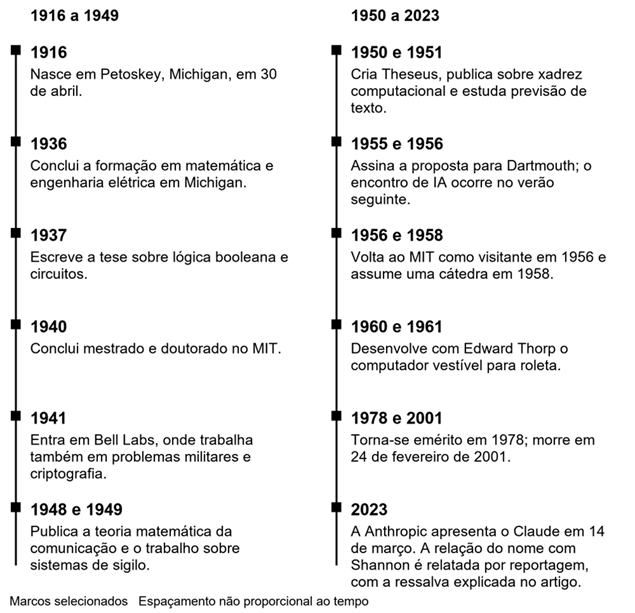
Timeline #
Read the left column and then the right one. Theseus was created in 1950; the label of the photographed object gives the date as 1952.
And that's it. If you read this far, congratulations.
Until next time!