
The Holy Mountain
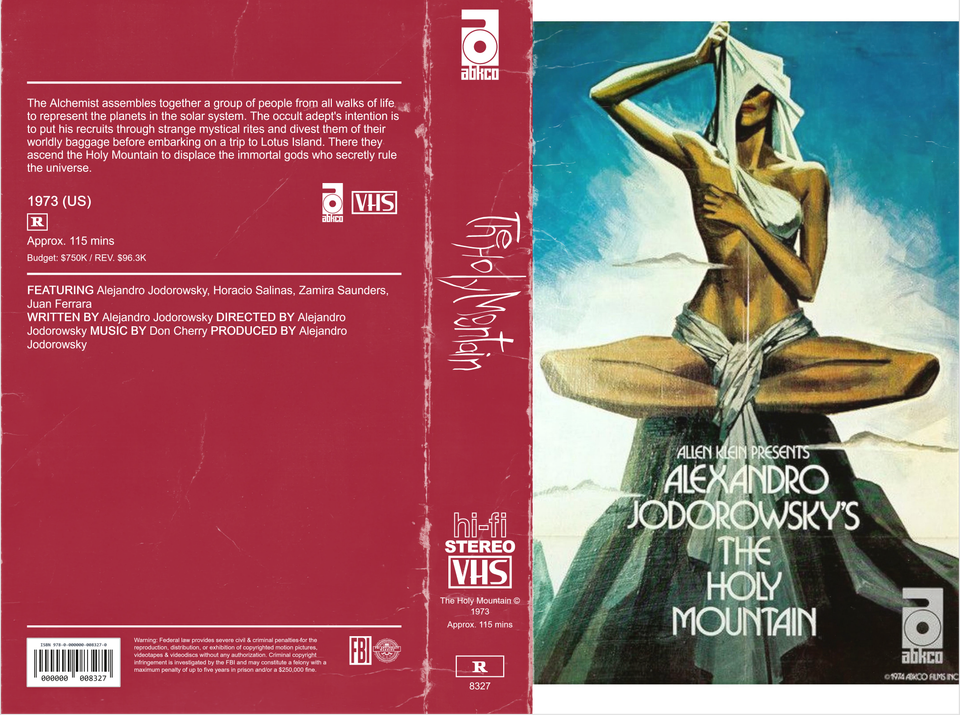
I watched The Holy Mountain and adored it.
That is the simple version. The honest version takes a little longer, because Alejandro Jodorowsky's 1973 film does not behave like something made to be watched politely. It arrives as a ceremony that has escaped from its temple, stolen a camera and somehow found enough money to build magnificent sets. It is vulgar, sacred and often funny. It can also be cruel, and it is completely certain that ordinary cinema is a minor administrative mistake.
There will be spoilers here. Then again, spoiling The Holy Mountain by describing its plot is like ruining a cathedral by mentioning that it contains chairs. The objects are there. The experience is somewhere else.
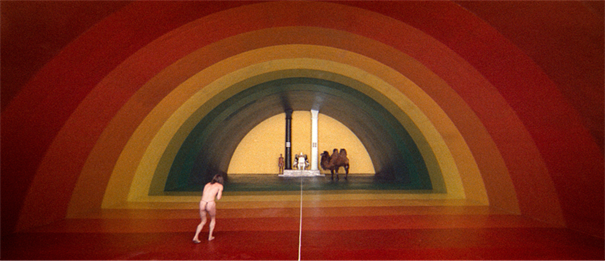
A film that enters like a ritual
The story begins with a nameless Thief, played by Horácio Salinas, who resembles Christ and wanders through a world already drunk on religion, commerce, violence and spectacle. He eventually reaches a tower and meets the Alchemist, played by Jodorowsky himself. From there, the film gathers seven wealthy and morally deformed people, each associated with a planet, and sends the group toward a sacred mountain in search of immortality.
That description sounds almost reasonable.
On screen, reason has been asked to wait outside. Frogs restage conquest. Wax Christs become merchandise. Bodies turn into icons, icons turn into products, and products reveal themselves as tiny religions with excellent packaging. Jodorowsky does not explain the world. He places it on an altar, paints it gold and then checks whether we are foolish enough to kneel.
The film screened out of competition at Cannes in 1973 and returned there in a restored presentation in 2006. Its visual design belongs to a period when a director could apparently respond to the question "Is this too much?" by requesting more birds, more geometric architecture and another occult ceremony before lunch. Rafael Corkidi's cinematography gives all of it a strange precision. The images are wild, but the frame is rarely careless.
This is one of the reasons the film remains so beautiful. Chaos is easy. Organized chaos is art.
The occult is doing real work
I loved the occult symbolism because it is not sprinkled over the film like fashionable incense. It shapes the entire journey. Alchemy, Tarot, astrology, Kabbalah, Christianity, Buddhism and Sufism meet inside the same cinematic laboratory. Some combinations illuminate one another. Others explode. Jodorowsky appears pleased with both results.
The Thief's transformation is openly alchemical. What is rejected as filth becomes gold, and material change becomes a rude, literal image of spiritual change. The pilgrims must burn money, abandon their private myths and submit to rituals designed to empty them of the identities that made them powerful. Their ascent is physical, but the mountain is also the old interior mountain: the place where vanity expects a throne and may instead find a mirror.
MoMA has linked the film to The Ascent of Mount Carmel, by Saint John of the Cross, and René Daumal's unfinished novel Mount Analogue. That lineage matters. The pilgrimage is not a treasure hunt for a secret object. It is a disciplined stripping away of certainty. The movie simply performs that discipline with naked bodies, planetary characters and enough visual blasphemy to make a committee faint.
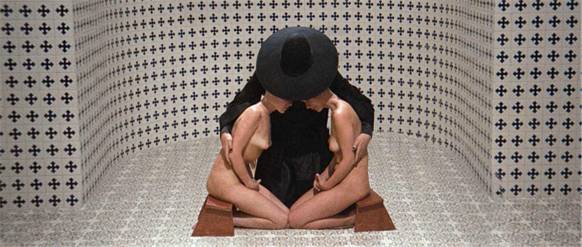
Jodorowsky later said that the viewer should search through Tarot, alchemy and Kabbalah, then forget all of them and return to the world. I think that is the key. The symbols are doors, not furniture. We are not supposed to collect them and decorate our intellectual living room. We are supposed to pass through.
Even color carries an argument. Jodorowsky described red as blood and life, while blue is receptive, restful and open like the sky. He also spoke about removing night and shadow from the film, putting mystery under full light. That choice is brilliant. Occult cinema often hides its mystery in darkness. The Holy Mountain exposes everything beneath an almost indecent sun. The mystery survives anyway.
Music for an initiation
And then there is the soundtrack.
I adored it. Jodorowsky composed the score with Ronald Frangipane and jazz trumpeter Don Cherry, and the result refuses to settle into a comfortable identity. Percussion, ritual voices, brass, sitar and orchestral eruptions make the music feel less like accompaniment and more like another guide in the procession. It does not stand behind the images. It walks beside them carrying a knife and a bell.
The music knows when to be solemn and when solemnity has become ridiculous. This matters because the film is always balancing revelation and satire. A lesser score might have instructed us to admire the strangeness. This one participates in it. At times it feels devotional. At others it sounds as if a jazz ensemble has been asked to perform during the collapse of organized reality.
ABKCO eventually restored the original analog master tapes for the soundtrack's first official release. Hearing the score outside the film makes one thing clear: these pieces have their own architecture. Inside the film, however, they gain teeth. Sound turns tableaux into rites and movement into initiation.
The joke at the summit
The pilgrims finally climb the mountain expecting immortal masters and ultimate knowledge. What they find is a trick. The supposed sages are revealed as substitutes, the director enters the reality of the scene, and the camera pulls back to expose the crew. The sacred journey ends on a film set.
This could be read as pure mockery. I do not think it is.
The ending does not say that the climb was worthless. It says that no image, teacher, ritual or filmmaker should be allowed to imprison us inside a beautiful illusion forever. Jodorowsky spends the entire movie building a temple, then opens a side door and tells us to go outside. He does not destroy wonder. He saves it from becoming bureaucracy.
That is also why the satire still works. The film attacks military power, consumer desire, industrial religion, fashionable rebellion and the market's talent for selling us replicas of whatever once frightened it. Yet it is not content with criticism. Jodorowsky said the film was also searching for truth and a new way of life. He called that proposition positive.
I agree. Cynicism would have left the pilgrims staring at the empty table. The Holy Mountain sends them back to life.
Why I loved it
I loved the film because it trusts images enough to let them remain dangerous. It does not explain every symbol, apologize for every excess or place a sensible guardrail around the sacred. It understands that an artwork may be lucid without being tame.
I loved the soundtrack because it gives the pilgrimage a pulse. I loved the occult machinery because it is serious without surrendering its sense of humor. Most of all, I loved that the final act refuses to sell enlightenment as a product. After almost two hours of rituals, gold, planets and prophetic costumes, the greatest revelation is that we must wake up from the revelation.
What a magnificent joke.
And what an optimistic one. The film removes the masters from the summit, but it leaves us the mountain. We can still climb, change, fail, laugh and return to the world with our eyes slightly less obedient than before.
That is more than enough magic for me.
Sources
• The Holy Mountain, official film page, ABKCO Films
• The Holy Mountain, Festival de Cannes
• El Topo and La Montagne Sacrée press kit, Festival de Cannes
• Alejandro Jodorowsky The Holy Mountain, MoMA
• Alejandro Jodorowsky interview, Interview Magazine
• Where to begin with Alejandro Jodorowsky, BFI
• The Holy Mountain original motion picture soundtrack, ABKCO
• The Holy Mountain Blu-ray and 4K restoration notes, Arrow Films