The Italian Rock and Punk Scene
Italy never absorbed rock and punk as imported fashions in any simple, obedient way. It translated them, argued with them, dressed them in local anxieties, and sometimes made them stranger than their Anglo-American sources. From the beat boom of the 1960s to the progressive excess of the 1970s, from the furious hardcore networks of the 1980s to the independent rock explosion of the 1990s, Italian music built a parallel history of amplification: less globally mythologized than London, New York, or Berlin, but often just as inventive.
The Italian story begins, as so many European rock stories do, with imitation. In the early 1960s, rock and roll arrived through records, films, radio, jukeboxes, and the glamorous machinery of youth culture. Early Italian rock frequently meant covers, adaptations, and Italian-language versions of American and British hits. But that does not make the period disposable. On the contrary, it created the grammar. Singers and groups learned how to bend imported forms into the rhythms of Italian pop, the theatricality of the national song tradition, and the social codes of a country modernizing at high speed.
The beat era was the first real eruption. Groups like Equipe 84, I Ribelli, The Rokes, I Corvi, and Dik Dik brought electric guitars, youth rebellion, harmonies, and a sharper visual attitude into the mainstream. Some of it now sounds charmingly clean, even innocent, but beneath the polished surfaces there was a shift in temperature. The audience was young, urbanizing, and increasingly impatient with the old sentimental formulas. Italy was still the land of Sanremo, melodrama, and bel canto, but the teenagers wanted drums, distortion, and haircuts that annoyed their parents.
Equipe 84 were one of the crucial bridges between Italian pop and rock attitude. Their work mixed beat energy with melodic sophistication, showing that Italian-language rock did not have to sound like a translation exercise. The Rokes, British-born but deeply embedded in the Italian scene, sharpened the transnational quality of the moment: Italy was importing rock, yes, but also reshaping it through television, festivals, and a recording industry that understood melody as a national religion. I Corvi, with their darker garage edge, hinted at a rougher underground sensibility that would later become important.
By the late 1960s and early 1970s, Italian rock had stopped merely borrowing and started building its own monuments. This was the age of rock progressivo italiano, one of the country's great contributions to global rock history. Italian progressive rock was not just a Mediterranean copy of Genesis, King Crimson, or Emerson, Lake & Palmer. At its best, it fused classical training, opera, jazz, folk melody, political intensity, and literary ambition into music that could be lush, theatrical, violent, and delicate within the same piece.
The obvious giants still deserve their status. Premiata Forneria Marconi, usually abbreviated as PFM, remain perhaps the most internationally recognized Italian prog band. Albums like Storia di un minuto and Per un amico showed a group capable of warmth and technical precision without becoming sterile. PFM could be symphonic, pastoral, and explosive; they had virtuosity, but also a human pulse. Their later connection with the English-speaking market helped make them a rare Italian rock export at a time when language was still a major barrier.
Banco del Mutuo Soccorso were more dramatic, stranger, and in some ways more Italian in spirit. Frontman Francesco Di Giacomo had a voice of enormous physical presence, less like a conventional rock singer than a tragic actor leading a band through labyrinths. Their early records, especially Darwin! and the self-titled debut, turned progressive rock into a kind of philosophical theatre: evolution, history, power, fragility, and absurdity all staged through organ surges, complex structures, and sudden melodic beauty.
Then there was Le Orme, often more elegant and concise than their peers. Records such as Felona e Sorona gave Italian prog a dreamlike, almost cosmic melancholy. They were less bombastic than some of their contemporaries, but that restraint is part of their strength. Their best music feels suspended between science fiction, chamber music, and a private emotional landscape.
The 1970s also produced the more radical side of Italian rock. Area, led by the extraordinary singer Demetrio Stratos, took progressive rock into jazz, avant-garde experimentation, Mediterranean modes, political militancy, and vocal research. Area were not background music for fantasy posters; they were a confrontation. Their work still sounds unstable in the best possible sense, as if the band were trying to break the frame around the song. Stratos, in particular, remains one of the most astonishing voices in European experimental music.
Other names deepen the picture: Osanna, theatrical and wild; Il Balletto di Bronzo, whose Ys is dense, dark, and cultishly revered; Museo Rosenbach, whose Zarathustra became a cornerstone for collectors; New Trolls, who moved between pop, rock, and orchestral ambition; and Goblin, whose sinister, precise, keyboard-driven soundtracks for horror cinema made them internationally famous in a different circuit. Goblin's music for Dario Argento films such as Profondo Rosso and Suspiria helped define the sound of Italian horror: elegant, paranoid, and razor-lit.
But Italy in the 1970s was not just a paradise of long tracks and gatefold sleeves. It was a country under political pressure, marked by terrorism, street conflict, labor struggles, and the long shadow of the so-called Years of Lead. That climate mattered. Rock was not merely entertainment; it could be a site of ideological debate, collective identity, and refusal. The line between music, politics, theatre, and social movement was often porous. This is one reason the Italian underground of the following decade felt so intense: it did not come out of nowhere. It inherited a country already used to noise as a form of argument.
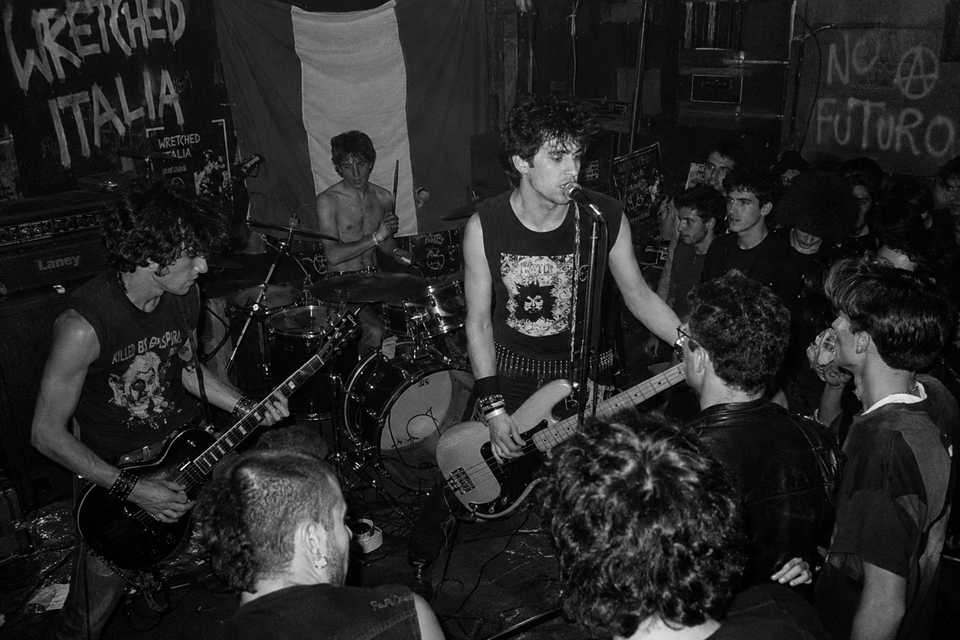
Punk arrived in Italy later than in London or New York, but when it took root it did so with unusual force. By the late 1970s and especially the early 1980s, punk and hardcore scenes had emerged in cities such as Milan, Bologna, Turin, Rome, Pordenone, and Reggio Emilia. Italian punk was rarely only about three chords and sneers. It became tangled with squats, autonomous politics, fanzines, cassette culture, independent labels, anti-fascist networks, and a ferocious do-it-yourself ethic.
One of the most important early names was Skiantos, from Bologna. They were not hardcore, and calling them simply punk misses the joke. Their music was chaotic, absurd, rude, and theatrical, closer to a dadaist attack on good taste than to standard rock rebellion. Led by Roberto “Freak” Antoni, Skiantos turned stupidity into a weapon and parody into critique. They understood that Italian culture, with all its seriousness and ceremony, deserved to be mocked from inside the amplifier.
Bologna itself became a key city. It had a student population, left-wing political currents, underground spaces, and the right amount of disorder. From that climate came not only punk gestures but also broader alternative experiments. The city helped set the stage for Italian new wave, post-punk, and independent music that did not fit cleanly into imported categories.
The hardcore wave of the 1980s was even more direct. Bands such as Negazione, Raw Power, Wretched, Indigesti, Declino, Impact, Peggio Punx, Nerorgasmo, Kina, Contrazione, RAF Punk, and Cheetah Chrome Motherfuckers made Italy one of the great European hardcore territories. This scene was fast, abrasive, political, and deeply connected to international DIY circuits. The records often sounded urgent because they were urgent: short songs, shouted vocals, blown-out guitars, and lyrics shaped by alienation, repression, anger, and community.
Negazione, from Turin, are essential. Their music had the velocity of hardcore but also a sense of emotional and existential pressure that made it more than speed for speed's sake. Turin mattered here: an industrial city, closely associated with Fiat and the working-class tensions of modern Italy. Negazione's best work feels like the sound of bodies pushed through concrete, machinery, ideology, and youth frustration. They toured internationally and became one of the Italian bands most respected by hardcore audiences abroad.
Raw Power, from Poviglio, were another major export. Their name came from The Stooges, but their sound belonged to hardcore's faster, more brutal evolution. They recorded in English more often than many peers, which helped them circulate outside Italy, especially in the United States. Their album Screams from the Gutter remains a classic of European hardcore: ugly, propulsive, and alive with a kind of rural-industrial rage that does not feel like imitation of American punk so much as a parallel mutation.
Wretched, from Milan, represented the darker, crustier, more anarchic side of the scene. Their work was raw even by hardcore standards, driven by anti-authoritarian politics and a refusal of polish. Indigesti, from the Turin area, brought a sharp, compact attack and became another cult name internationally. Kina developed a more melodic but still deeply committed hardcore language, helping point toward the emotional and political possibilities of punk beyond pure abrasion.
At the same time, Italy's post-punk and new wave underground was mutating in fascinating ways. The 1980s produced artists and bands who used synthesizers, drum machines, tape networks, industrial textures, and performance art strategies. This world was less visible than the hardcore circuit but just as important. Groups such as Gaznevada, Neon, Rats, Diaframma, Litfiba, CCCP Fedeli alla Linea, and Not Moving showed that Italian underground rock could be stylish, intellectual, sarcastic, danceable, grim, and politically charged all at once.
CCCP Fedeli alla Linea may be the most iconic Italian alternative band of the decade. Formed by Giovanni Lindo Ferretti and Massimo Zamboni, they created what they called “Emilian melodious music / pro-Soviet punk,” a phrase that already tells you how little patience they had for ordinary genre labels. CCCP mixed punk minimalism, cold war imagery, Catholic residue, communist iconography, provincial Italy, and performance art into something unmistakable. They were ironic, but not empty; ideological, but slippery; theatrical, but never merely decorative. Albums like 1964-1985 Affinità-divergenze fra il compagno Togliatti e noi remain landmarks of European post-punk.
Litfiba, from Florence, began in a darker post-punk mode before becoming one of Italy's biggest rock acts. Their early records, especially Desaparecido and 17 re, combined new wave tension, Mediterranean melodic instincts, and political themes. They later moved toward a more accessible rock sound, but the early work still carries the smell of clubs, basements, and ideological weather. Diaframma, also from Florence, are crucial for anyone interested in Italian darkwave and post-punk; Siberia is one of those records that proves melancholy can have architecture.
Then came the 1990s, when Italian alternative rock finally developed a broader national infrastructure. Independent labels, college scenes, magazines, social centers, and live circuits gave bands more room to survive outside the old pop industry. The decade did not erase politics, but it changed the emotional vocabulary. The sound became more fragmented: noise rock, indie, grunge influence, post-hardcore, ska-punk, folk-punk, and singer-songwriter rock all coexisted.
Marlene Kuntz were one of the defining bands of the period. Emerging from Cuneo, they brought a tense, abrasive, literary form of noise rock that owed something to Sonic Youth and post-punk but sounded unmistakably Italian in its use of language and drama. Their debut Catartica remains one of the most important Italian rock albums of the 1990s: elegant and violent, poetic and nervous.
Afterhours, led by Manuel Agnelli, became another pillar of the alternative scene. Their 1990s work helped establish a model of Italian indie rock that could be literate, emotionally raw, and musically sharp without surrendering to mainstream softness. Hai paura del buio?, released in 1997, is often treated as a generational record, and rightly so. It captured the mood of a scene that wanted intensity, intelligence, and danger in its own language.
Massimo Volume took a different route. Their music was built around spoken-word delivery, repetition, guitar textures, and urban melancholy. They were not trying to be rock stars; they sounded more like people reading dispatches from the ruins of ordinary life. That made them one of the most distinctive Italian bands of the decade. CSI — Consorzio Suonatori Indipendenti, born from the ashes of CCCP — carried some of the 1980s political and theatrical DNA into the 1990s, but with a broader, more atmospheric, sometimes folk-inflected sound.
The punk side also remained alive. Persiana Jones, Punkreas, Shandon, and others brought ska-punk, melodic punk, and politically conscious energy to a wider youth audience. This was not the same as the hardcore underground of the early 1980s. It was more accessible, sometimes more playful, but still connected to social spaces, anti-fascist culture, and the everyday politics of Italian youth. Meanwhile, heavier underground currents continued through post-hardcore, crust, and anarcho-punk scenes that rarely received mainstream attention.
What makes the Italian story so rich is that it never settles into one clean narrative. The country produced polished beat idols, symphonic prog architects, avant-garde radicals, horror soundtrack masters, anarchist hardcore bands, cold new wave poets, and 1990s indie icons. It had artists who wanted international recognition and artists who seemed almost allergic to the idea of being understood. It had music for television, squats, theatres, film soundtracks, social centers, and tiny clubs where the PA probably sounded like a collapsing factory.
Italy's rock and punk scenes from the 1960s to the 1990s were not peripheral. They were parallel: sometimes looking outward, sometimes refusing the outside world entirely, often transforming foreign sparks into local fires. The best Italian artists did not merely ask, “How do we make rock in Italy?” They asked a sharper question: “What does rock become when it passes through Italian language, politics, melody, Catholic ghosts, opera, industrial cities, student movements, cinema, and the beautiful disaster of national identity?”
The answer is scattered across records by Equipe 84, PFM, Banco del Mutuo Soccorso, Area, Goblin, Skiantos, Negazione, Raw Power, Wretched, CCCP Fedeli alla Linea, Litfiba, Diaframma, Marlene Kuntz, Afterhours, Massimo Volume, CSI, and many others. It is not a single sound. It is a map of arguments. And like most good arguments, it still makes noise.
Recommended Listening
- Equipe 84 — Stereoequipe
- I Corvi — Un ragazzo di strada
- Premiata Forneria Marconi — Storia di un minuto
- Banco del Mutuo Soccorso — Darwin!
- Le Orme — Felona e Sorona
- Area — Arbeit macht frei
- Il Balletto di Bronzo — Ys
- Museo Rosenbach — Zarathustra
- Goblin — Suspiria
- Skiantos — MONO tono
- Negazione — Lo spirito continua
- Raw Power — Screams from the Gutter
- Wretched — Libero di vivere / Libero di morire
- Indigesti — Osservati dall'inganno
- Kina — Cercando...
- CCCP Fedeli alla Linea — 1964-1985 Affinità-divergenze fra il compagno Togliatti e noi
- Litfiba — Desaparecido
- Diaframma — Siberia
- Marlene Kuntz — Catartica
- Afterhours — Hai paura del buio?
- Massimo Volume — Lungo i bordi
- CSI — Linea gotica