

A blog worth losing time on: lyra.horse
I went to lyra.horse to read one post about SVG clickjacking and stayed for a lot more. A few favorites from Lyra's blog, from logic gates built out of SVG filters to a one-click Google Drive bug, a JavaScript-free post, and a fake millionaire story.
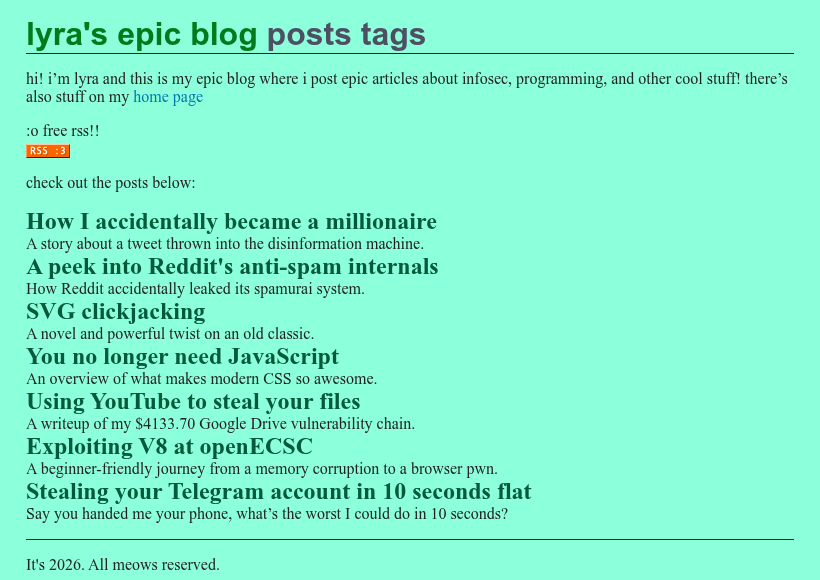
I opened lyra.horse to read one post, the one about SVG clickjacking, and lost a good amount of time there. It's the blog of Lyra, a security researcher who writes about infosec, programming and the web, and it's one of those places where every post sends me to the next one.
The site itself is a small joy: a mint green page, a list of posts, a big RSS button that says "RSS :3" and a footer that reads "It's 2026. All meows reserved." No pop-ups, no newsletter modal, just articles. Below are the ones that stuck with me, with a short note on each.
SVG clickjacking #
This is the one that brought me there, and it's a great example of her style: a serious finding, explained with interactive demos right on the page.
Clickjacking is an old trick. A site loads another site in an invisible frame and puts a decoy on top, so a click meant for the decoy lands on a button underneath.1 It usually works for one or two clicks, because the attacker can't see what's happening inside the frame.
Lyra found a way around that limit. SVG filters, the same ones used for blur and color effects, can be applied to a frame from another site. With the right combination of filters she could read the color of pixels inside that frame, compare them and even build logic gates out of them, all inside the filter. That means a page can react to what the hidden site is showing and guide someone through a multi-step flow, changing the decoy as it goes.
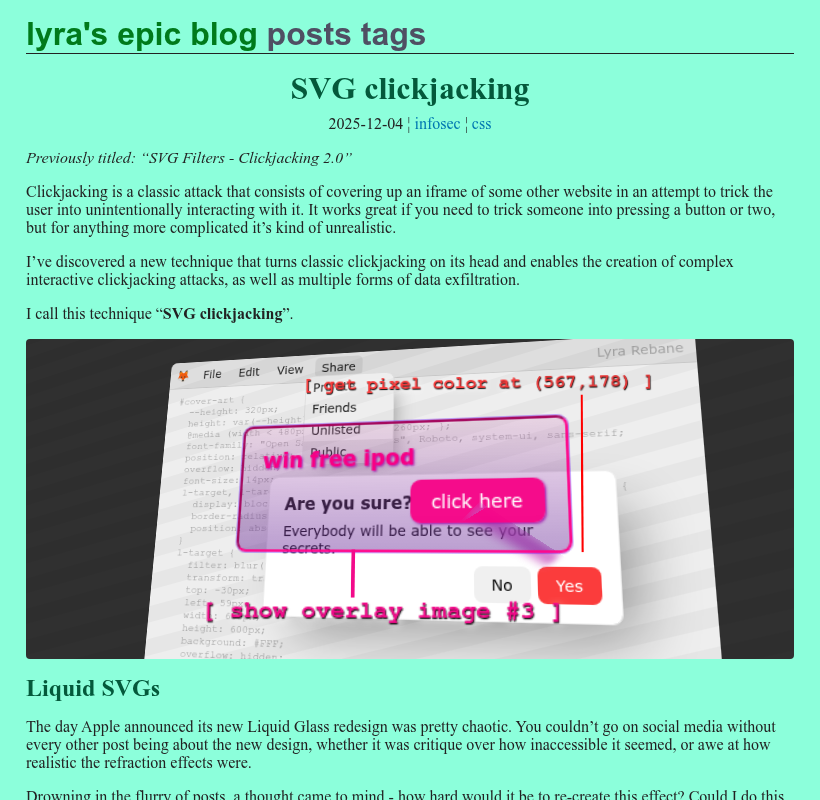
She proved it against Google Docs and got a $3,133.70 bounty from Google for it.2 The post also has a working calculator made only of SVG filters and a recreation of Apple's Liquid Glass effect, which is a strange and wonderful thing to find in the middle of a security writeup. Some demos only work in Chromium-based browsers, so it's worth opening the post in one.
Using YouTube to steal your files #
This one reads like a heist. None of the bugs in it is scary alone: a path traversal in how Google Slides builds YouTube embed links, a YouTube sign-in redirect that goes anywhere on YouTube, another redirect that hops to Google Docs, an old URL format that slips past a framing protection, and a share dialog that can be pre-filled through the address.
Chained together, they made a one-click attack: a page dressed up as a Google Form where a single click on "Send" would give an attacker edit access to someone's Drive files. Google paid $4,133.70. The lesson I take from it is that "low severity" bugs don't stay low severity when someone patient lines them up.
You no longer need JavaScript #
A tour of what modern CSS can do on its own: tabs and toggles made with :has() and radio buttons, accordions with details, light and dark themes with light-dark(), entry animations with @starting-style, form validation styling, and viewport units that finally behave on phones.
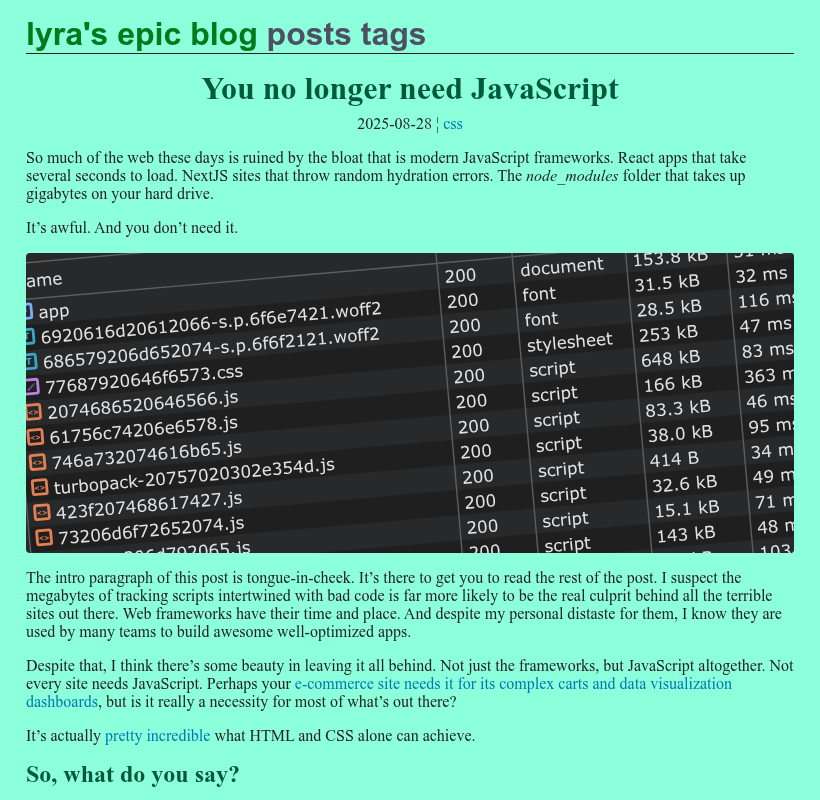
The best detail is that the post practices what it preaches. The whole article, demos included, is a single HTML file with no JavaScript, no images and no external resources, at around 49 kB compressed. There's even a color picker and a little clicker game written in pure CSS. She doesn't argue for throwing JavaScript away, only for using it where it's actually needed. For anyone who likes light pages, it's a very good read.
How I accidentally became a millionaire #
Her newest post, from November 2026, and the funniest. Through a mistake in Google's bug tracker, she had edit access to the bounty field of one of her own reports. As a joke, she changed it to $1,333,337 and tweeted a video of it.
What happened next is the real story. An AI-written Community Note got the facts wrong and then vanished. An automated AI news site turned the tweet into an article. Google's AI Overview, ChatGPT and other assistants started answering questions about the biggest Chrome bounty with her name. Even AI summaries that cited her own correction kept repeating the millionaire part. Google eventually set the bounty back to the original $1,000 and removed her access.
It's light reading with a heavy point: a joke went through social media, search and AI summaries in a few days and came out the other side as a "fact", without anyone intending harm. Someone who did intend harm could use the same path.
And more #
There's plenty more on the blog: a look at Reddit's anti-spam system after it leaked by accident, a beginner-friendly walk through exploiting Chrome's V8 engine in a competition, and what someone could do with a borrowed phone and ten seconds in Telegram. Her home page has other projects too.
If any of this sounds interesting, the RSS feed is the easiest way to catch the next post.