THE ABBESS IS DEAD! - Part I
Translator's Note, copied by a nervous hand
The following chronicle should not be confused with a devotional text, a legal deposition, or a sensible document produced by adults after breakfast. It is a satire, a convent mystery, a medieval farce, and a bureaucratic autopsy performed with a candle in one hand and a knife missing from the kitchen in the other.
Faith slips on its own cassock. Politics drinks sacramental wine off the clock. Truth walks the corridors like furniture being dragged at midnight, waking everyone except the guilty. If any authority feels attacked, let that authority first ask why the shoe fits so beautifully.
This English version does not march word for word behind the Portuguese original like a terrified novice behind Sister Constance. It preserves the incident, the venom, the cadence, the piety with a knife in its sleeve, and the tragicomic suspicion that every institution is only three bad explanations away from inventing an angel.
I. The bell, the piglet, and the announcement nobody ordered
And lo, in those days, the sun rose yet again over the damp and ancient walls of the Abbey of Saint Adelgunda, near the Mediterranean coast by Saint-Raphaël, as if creation itself had not grown tired of the place. Its rays warmed the stones with the optimism of a guest who had not yet smelled the refectory.
Within that sacred residence, the sisters were already awake and performing their daily labors. The more aggressively devout had finished Lauds before the chickens had finished regretting existence. From the northern bell tower, Sister Albertine the Faithful pulled the old bell into speech, announcing to the world that Leviathan had not emerged from the sea, the Last Judgment had been postponed, and breakfast would therefore be served in the usual miserable order.
Across the courtyard came the bright flock of boarding girls, driven forward by Sister Constance the Rigid, who used her disciplinary staff with the pastoral tenderness of a tax collector. 'Move before me, you damp little bouquets of sin!' she cried. 'Forward, victims of the Devil, before I begin naming names!'
It would have been one more mediocre sacred morning, preserved in amber and cabbage steam, had Sister Najla Veruska, Prioress and Deaconess, not appeared on the balcony of the abbess's apartments with the face of a woman who had just found theology lying in a pool of blood.
'The Abbess is dead!' she cried. 'She is dead! Jesus! Why? Why? Woe upon us, woe with embroidery!'
All the sisters, as though rehearsed by generations of scandal, raised their hands to their mouths and stared at one another. Sister Carmen the Saintly ran weeping among the girls, who received the news with the radiance of children unexpectedly freed from arithmetic. A dead abbess meant no lessons, many guards, possible horses, and perhaps a nobleman to stare at while pretending grief.
At that very moment Sister Theodora the Large returned from the market with a piglet over her shoulders for the evening meal. Upon being told the news at the Gatelet of the Just, she clutched her heart and collapsed beneath the animal. The girls called for help, less from compassion than from the reasonable fear that the pork might spoil before dinner. In the moral economy of the abbey, charity and appetite often arrived in the same cart.
II. Sister Constance breaks a saint in the name of respect
Amid the chaos, Sister Constance remembered that the holy terracotta image of Saint Adelgunda could not remain exposed in the courtyard during preparations for a requiem. The fact that no one had thought of this before only increased her certainty that civilization depended entirely on her irritation.
'The death of Abbess Rita the Pure is a sign from God!' she shouted. 'Someone help me remove the saint from the yard before the saint witnesses what passes for discipline among you livestock!'
No one helped. Sacred institutions are filled with people who love tradition until tradition weighs more than a soup pot. Constance therefore embraced the heavy image alone and hurried toward the chapel with the desperate dignity of a woman carrying both heaven and back pain.
Her race ended when a wicked little foot, belonging to one of the internal students and probably to several future revolutions, appeared before her. Constance stumbled. Saint Adelgunda flew in a brief arc of terracotta glory and shattered into many relics, all of them suddenly eligible for veneration if one had a small enough box and no shame.
For three heartbeats the entire courtyard froze. Then every girl began explaining that she had seen nothing, which, in a convent, is usually the clearest sign that everyone saw everything. Sister Constance stood over the fragments, trembling with rage and opportunity.
'Do not touch the saint!' she shrieked. 'From this moment she is multiplied!'
And so, before the corpse of the abbess had even been examined, Saint Adelgunda had already performed her first miracle of the day: becoming more portable.
III. The room, the cleaver, and theology made in a hurry
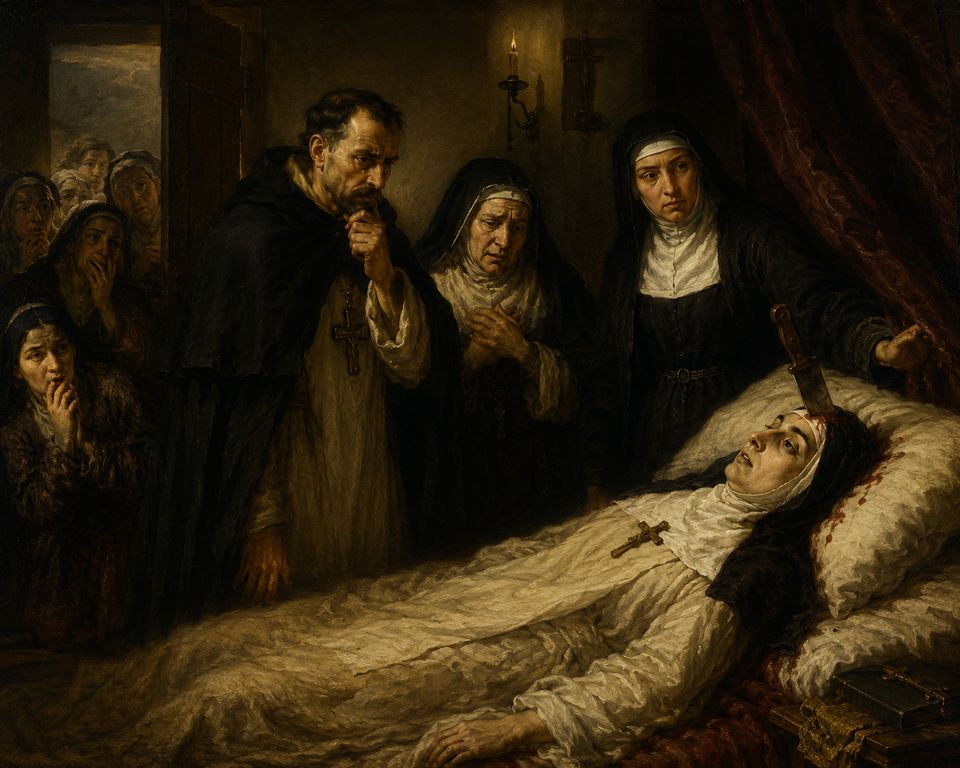
Upstairs, in the abbatial chamber where Sister Najla had found the late Abbess Rita the Pure, three authorities entered with candles and the shared expression of people hoping the problem would explain itself. First came Father Esteban, Dominican and inquisitor, a man who looked as though he had been carved from old doctrine and smoked over a slow fire. Behind him came Sister Carmen the Saintly. Last came Najla, who closed the door as if sealing a tomb or a negotiation.
The scene impressed even Esteban, and he had spent his life cultivating immunity to horror. On the abbatial bed lay Abbess Rita, dead by means of a kitchen cleaver driven into her forehead with such confidence that one could only admire the decisiveness while condemning the method. Her eyes remained wide. One finger pointed stiffly outward. Her mouth held the shape of a final 'You?' as though death itself had arrived wearing a familiar face.
Sister Carmen made a sound too holy to be called vomiting and fled the room in convulsions of grief. Esteban turned slowly toward Najla. The candlelight laid shadows over his face in a manner that would have been excessive on stage and was therefore perfectly suited to the Church.
'How,' he asked, 'does this happen in a sacred house?'
Najla looked left, right, and briefly upward, hoping someone in the Trinity wished to answer first. 'You are asking me? How would I know?'
Najla looked left, right, and briefly upward, hoping someone in the Trinity wished to answer first. 'You are asking me? How would I know?'
He seized her face between his fingers. 'This is not a pantomime. Look into my eyes when you answer.'
'Release my lips and I shall consider language,' she said, though less elegantly because he was crushing her mouth.
Esteban listened, touching his chin as if wisdom might leak from it. 'The cleaver came from the kitchen. Those with access are Sister Theodora, who was at market; you; and the abbess, who is disqualified by the inconvenience of being dead.'
Najla stiffened. 'You are suggesting I struck our crowned mother of this citadel of faith with a utensil better suited to pork?'
'I would send you to the stake,' Esteban said, 'were it not for one detail. To drive the blade through that skull so cleanly required masculine force.'
Najla smiled thinly. 'How fortunate for me that misogyny, at last, has become evidence for the defense.'
IV. The official truth gets dressed before the body cools
Esteban paced the chamber. His reasoning had arrived at the place where institutions usually arrive when facts behave badly: concealment with decorative language.
'We close the matter,' he said. 'We prepare the funeral.'
Najla stared. 'Closed? Father, the abbess has a kitchen implement in the middle of her forehead. That is not closure. That is carpentry.'
The inquisitor glared, then gripped the cleaver with a linen cloth and pulled. It came free with a wet resistance that made Najla reconsider every breakfast she had ever eaten. Blood darkened the bedclothes. Esteban wiped the blade on the pillowcase and offered it to her.
'Return it to the kitchen. Wash it first.'
'And the hole?' she asked. 'What shall we tell the faithful? That an angel opened a window in her thoughts?'
'You are gifted in epic invention. Use it. The people believe the Red Sea opened; they can survive a forehead.'
Najla, who had spent years watching men turn negligence into doctrine, folded her arms. 'Stigmata appear in hands, feet, and side. A cleft in the brow requires a more adventurous theology.'
Esteban found one immediately, as bad men often do. 'Say she read beyond the limits of her feminine nature. Her mind, unable to bear the weight of knowledge, split open so her soul could escape.'
Najla applauded slowly. 'Marvelous. I am accused of inventing legends, yet you build cathedrals out of stupidity. Shall I add that an angel appeared to explain this, since no human mind could produce such a defense without assistance from beyond the veil?'
'Add what you like,' he snapped. 'An angel came while we applied holy oils. The angel explained the wound. The faithful wept. The matter is over.'
As they turned to leave, Esteban kicked an empty bottle beneath the bed. He crouched and retrieved it. The label read SANTIDADE, the abbey's own wine.
'A clue?' Najla asked.
'Yes,' said Esteban. 'To a lesser crime. We have discovered who emptied the cellar. Add this to your chronicle: our holy Abbess Rita died drunk on Sanctity.'
V. A funeral, a miracle, and a budget with gold leaf
By nightfall the basilica was thick with incense, lamentation, and the kind of public grief that always checks to see who is watching. Nobles from nearby estates, village representatives, priests, sisters, novices, merchants, and several people whose relationship to the abbey consisted mainly of unpaid debts filed past the coffin of Abbess Rita the Pure.
Her body rested in carved oak, gilded with such enthusiasm that poverty itself would have crossed the street to avoid looking at it. A crystal panel allowed the faithful to glimpse her painted face and the sacred fissure in her brow, which the mortuary sister had softened with powder, prayer, and the resigned expression of a woman working outside her training.
Father Esteban mounted the pulpit. To his right stood Najla. To his left stood Sister Carmen, still damp with tears and moral danger. Esteban raised his hands.
'Beloved brothers and sisters, we gather under the bitter shadow of farewell. Abbess Rita, pure among the pure, was called from us by a mystery so holy that explanation would only insult it.'
The crowd moaned. A woman fainted into a rope garland. Three people tried to touch the coffin at once and nearly converted grief into a wrestling match. Dominican guards restored order with the pious efficiency of men accustomed to confusing silence with peace.
Esteban continued. 'Our mother sought knowledge with such thirst that her fragile feminine condition could not contain it. In mercy, heaven opened her brow and released her immortal soul.'
Najla made the first mistake of the evening: she laughed. Quietly, but not quietly enough for a man whose ears had been sharpened by years of detecting disagreement.
Esteban leaned toward her. 'What part of this sacred explanation tickles you, demon?'
'Nerves,' Najla whispered. 'A spasm of reverence.'
'Another spasm and I shall send you to accompany her.'
The people, meanwhile, accepted the miracle with gratitude. Ignorance, offered with incense and lighting, is often mistaken for peace. The girls stared at the corpse with fascination. One of them whispered that if reading could split a woman open, grammar lessons should be suspended by canon law. This argument, though elegant, was ignored.
VI. The Duke arrives dressed like a sofa with hereditary rights
Just as the coffin was being sealed, a man remained standing beside it with the calm insolence of someone who had not been invited and had enjoyed that fact. It was the Duke of Frejus, wearing enough velvet to upholster a minor throne. Beside him stood Gustaf, his horse-master and trusted arm, and behind them the pale Bavarian shadow everyone called the German, because imagination in the village had limits.
Esteban left the pulpit at once, his guard moving with him like an accusation. Najla followed, because she would rather be stabbed than miss the conversation. Sister Carmen tried to stop her. Najla shook free.
'Let me pass. I may die by sword, but I refuse to die uninformed.'
The coffin lay between the two men like a diplomatic table built by undertakers.
'I do not remember inviting you,' Esteban said. 'Will you leave, or must we escort you to the gates of hell?'
The Duke touched the ornaments at his throat. 'What a rough greeting for one of your most generous donors and the legal representative of the Crown in this pleasant coastal province.'
'Calvinist. Sodomite. Practitioner of all filth.'
Several sisters crossed themselves with such speed that a breeze passed through the nave.
The Duke smiled. 'I come in the name of law to inquire about the death of your abbess. A lamentable incident. To die from a miracle with every visible feature of murder.'
Esteban's eyes narrowed. 'If there had been murder, I would prove the chief beneficiary stands before me.'
'And if I prove there was no miracle?'
'Then the people, robbed of their holy wonder, may decide that blasphemy lives in your castle and should be removed headfirst.'
The Duke's smile cooled. 'So ignorance is not merely a blessing. It is policy.'
'At last,' Esteban said, 'you understand something.'
To be continued...