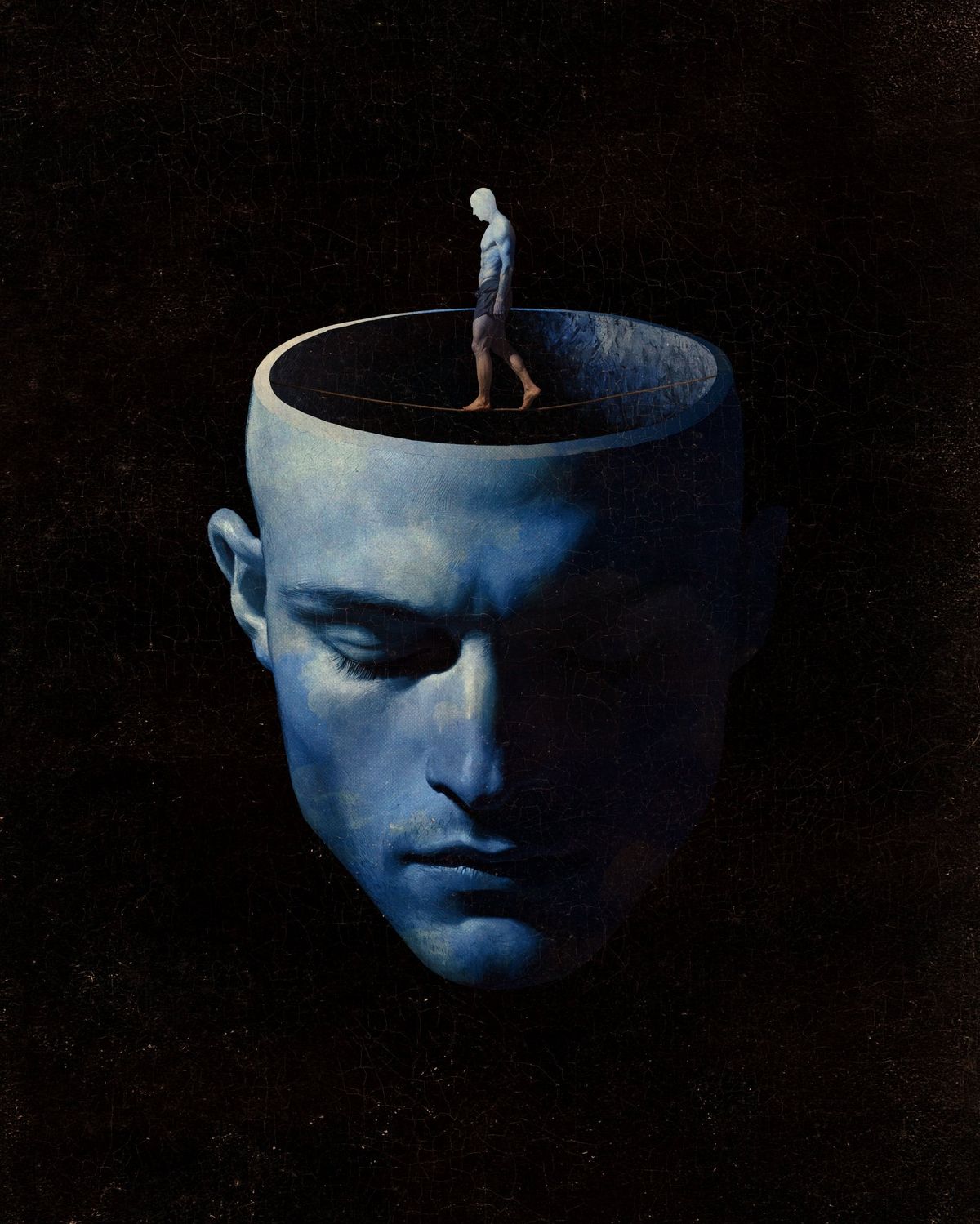

The Grace of Solitude: A Philosophical Essay on the Antisocial Temperament
Pablo Murad
Introduction
This essay seeks to examine the phenomenon commonly called antisocial behavior, not as a defect to be hastily diagnosed, but as a posture worthy of philosophical attention. The word antisocial often arrives already burdened with suspicion: it suggests the recluse, the misfit, the person unwilling or unable to participate in the ordinary rituals of communal life. Yet such a view is too narrow. Withdrawal may be pathological, yes, but it may also be voluntary. It may be chosen not out of bitterness or fear, but as a deliberate path toward self-discovery, inwardness, independence, and personal refinement.
Across the history of philosophy, solitude has rarely been treated as mere absence. It has been praised as a chamber of thought, a discipline of the spirit, and a necessary condition for certain kinds of freedom. To be alone, when one knows how to inhabit that aloneness, is not always to be deprived. Sometimes it is to be restored.
I. Understanding the Antisocial Temperament
Before considering the advantages of an antisocial disposition, we must clarify the meaning of the term. In this essay, antisocial does not refer to cruelty, hostility, moral indifference, or a refusal to recognize the dignity of others. Rather, it describes a temperament that privileges solitude and limits social interaction, not necessarily as the consequence of trauma or dysfunction, but as a conscious and deliberate choice.
The antisocial person, in this sense, is not one who despises humanity. He may simply distrust the noise of crowds, the tyranny of expectation, and the subtle violence of constant social performance. He does not reject the world entirely; he merely refuses to be swallowed by it.
II. The Advantages of Antisocial Behavior and Their Philosophical Resonance
Autonomy and Authenticity
To distance oneself from the demands and expectations of society can allow the individual to develop a sharper sense of autonomy and authenticity. Social life, while often necessary and beautiful, also comes with invisible chains: conventions, fashions, inherited opinions, rituals of approval, and the quiet pressure to become intelligible to everyone.
Jean-Jacques Rousseau argued that genuine freedom requires a refusal to submit blindly to artificial conventions. From this perspective, solitude may become a form of resistance. By stepping away from the crowd, the individual gains space to ask: What do I actually believe? What do I desire when no one is watching? Who am I when I am not performing?
The antisocial temperament, at its best, protects the private self from being negotiated away.
Introspection and Self-Knowledge
Solitude offers the mind a rare privilege: silence. In that silence, thought can deepen. Blaise Pascal famously observed that much of human misery comes from man’s inability to sit quietly in a room. The remark remains devastating because it exposes a permanent truth: many people flee into society not from love of others, but from fear of themselves.
The person who embraces solitude is forced into a more difficult intimacy. He must encounter his own doubts, motives, contradictions, wounds, and ambitions without the anesthetic of distraction. This inward confrontation can be uncomfortable, even merciless, but it is also the beginning of self-knowledge.
To be alone is not automatically to be wise. But without some capacity for solitude, wisdom rarely takes root.
Creativity and Innovation
By withdrawing from the immediate judgment of society, the solitary individual creates room for experimentation. New ideas are fragile in their early life. They are easily crushed by ridicule, conformity, or premature exposure. Solitude protects the unfinished thought.
Many great thinkers, writers, artists, and inventors have been marked by a certain distance from ordinary social rhythms. Their withdrawal gave them the freedom to wander intellectually, to entertain unpopular intuitions, and to cultivate visions that might have seemed strange or unacceptable in conventional company.
Arthur Schopenhauer, who held solitude in high regard, saw it as essential to intellectual life. For him, the mind that depends too heavily on society risks becoming diluted by it. Creativity often requires not only talent, but distance — distance from fashion, from applause, from the hunger to be understood too quickly.
Reduction of Stress and Mental Clarity
For some individuals, limited social interaction can contribute to psychological calm. Human relationships can be sources of affection, meaning, and joy, but they can also generate conflict, comparison, obligation, anxiety, and exhaustion. The absence of constant interpersonal demands may allow life to become simpler and the mind less burdened.
Henry David Thoreau’s Walden remains one of the most enduring meditations on this possibility. In retreating to the woods, Thoreau did not merely flee civilization; he tested life by stripping it down. He sought clarity through simplicity, and simplicity through solitude.
The antisocial temperament may find in such withdrawal not emptiness, but order. Not deprivation, but peace.
III. Balance and Moderation
Yet solitude, like any powerful medicine, becomes poisonous when taken without measure. The advantages of the antisocial life must not blind us to its dangers. A person may begin by seeking peace and end by cultivating avoidance. He may confuse independence with emotional numbness, depth with isolation, or self-sufficiency with pride.
Human beings are not made only for withdrawal. We are also shaped by affection, friendship, conversation, tenderness, contradiction, and the moral education that comes from living among others. Without meaningful human connection, solitude can harden into loneliness; independence can decay into alienation.
Aristotle, in the Nicomachean Ethics, defended the importance of moderation and the golden mean. His insight applies here with precision. The question is not whether one should live entirely among others or entirely apart from them. The wiser question is: What proportion of solitude and society allows a person to become most fully himself?
The antisocial temperament is defensible only when it remains conscious, balanced, and humane.
When approached with awareness and moderation, the antisocial disposition can offer genuine advantages: autonomy, authenticity, introspection, creativity, and mental clarity. But solitude should not be romanticized into an absolute ideal. It is not a universal cure, nor a badge of superiority. It is a path — and like all paths, it must be walked with discipline.
Each person must learn his own measure: how much society nourishes him, how much solitude restores him, and where the boundary lies between retreat and escape. Introspection is essential to personal growth, but so too are healthy and meaningful relationships. A life without solitude may become shallow; a life without connection may become sterile.
In the end, the philosophy of the antisocial temperament invites us to question the values imposed by society and to consider alternative routes toward fulfillment. It asks us to distinguish between loneliness and solitude, between rejection and independence, between silence and emptiness.
To withdraw from the world, when done consciously, is not necessarily to abandon life. Sometimes it is to return to it with clearer eyes.