THE ABBESS IS DEAD! - Part IV
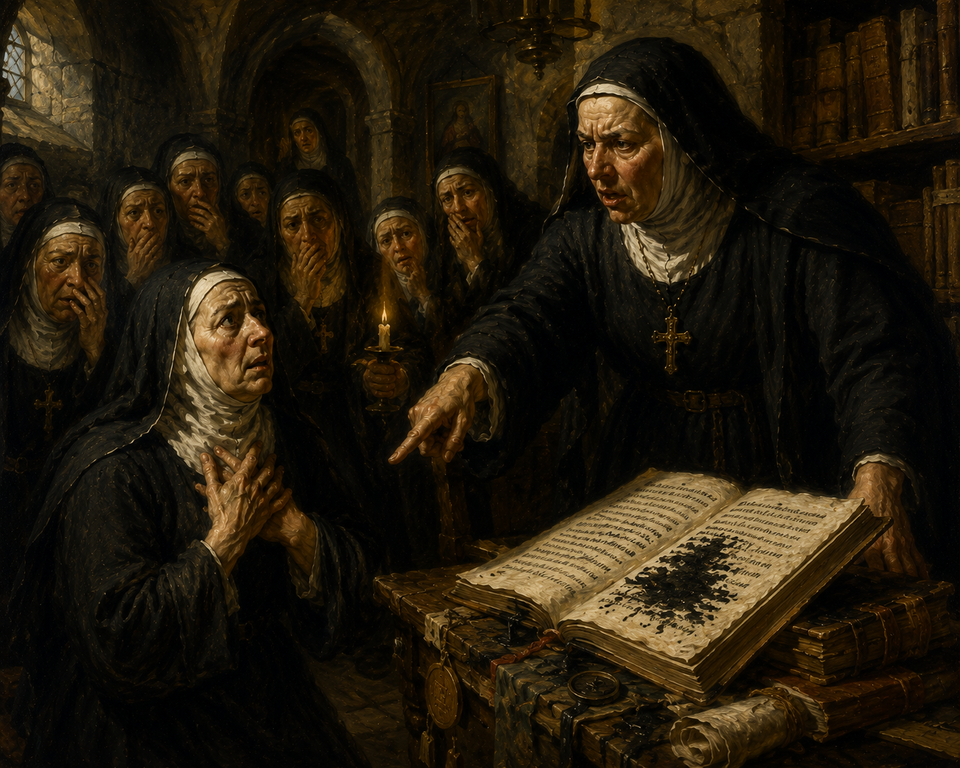
XXI. Reforms, or the art of making guilt fill forms
Mother Souphy began reform with the kitchen, because all revolutions fail if soup becomes late. She created a ledger for knives, cleavers, ladles, hammers, keys, candles, ropes, funeral cloths, and any object that, in the wrong hand, could become theology.
Najla called it administrative excess. Souphy called it memory with columns.
A new rule declared that no miracle could be announced until the location had been inspected, the witnesses separated, the instruments counted, and the wine cellar checked for motive. This reduced minor apparitions by seventy percent and bad explanations by nearly all.
Albertine demanded a procedure for incubi. Souphy, having learned that fighting Albertine directly wasted more time than bureaucracy, created Form I-13: Nocturnal Demonic Suspicion, with three copies and a section for hoofprints. Albertine was delighted. Bureaucracy is the stuffed animal of the terrified.
The porter's gate was widened. Constance objected until Souphy appointed her Mistress of Proper Passage and gave her a measuring cord. Within a week Constance had begun inspecting doorways with the severity of a woman who had finally found tyranny acceptable to architecture.
Theodora instituted a rule that any theological debate longer than twenty minutes required bread. This improved doctrine immediately.
Marie became Keeper of the Lower Archive. She wore the keys under her habit and answered questions with the calm of someone who had seen how much evil depends on people being too polite to ask where the bodies are stored.
Najla remained prioress. Not as reward. As supervised usefulness. Souphy believed discarding a skilled sinner was wasteful when one could harness her like a dangerous horse and keep both hands on the reins.
XXII. The Duke mistakes survival for victory
The Duke of Frejus left the abbey convinced he had benefited. Esteban was disgraced, Rome was embarrassed, Souphy owed him civil acknowledgment, and the village had seen him stand on the side of inquiry. This was the pleasant arithmetic of noblemen: every event must somehow add up to themselves.
At the courtyard gate, however, destiny had arranged poultry.
No one ever discovered who released the hen. The official chronicle blamed accident. The girls blamed providence. Theodora blamed the hen's political awakening. The hen, being unavailable for deposition, maintained an elegant silence.
The bird emerged from behind the broken remains of Saint Adelgunda's pedestal, fixed one bright bead of an eye upon the Duke's velvet shoe, and charged.
The Duke retreated with dignity. The hen advanced without it, which gave her the tactical advantage. Gustaf tried to intervene and received a peck to the glove. The German stepped aside, proving once again that neutrality is often cowardice wearing good boots.
By the time the Duke reached his carriage, his cloak had caught on a thorn, his hat sat crooked, and several village children had learned a new and durable form of laughter. A legend was born before supper: the Duke who feared the republican aggression of laying hens.
Souphy watched from the steps. 'Do not record that in the official report,' she told Carmen.
Carmen nodded and wrote it in the Book of News, which was worse.
XXIII. Najla attempts repentance and finds it badly furnished
Repentance did not suit Najla at first. She approached it the way a courtier approaches a poor cousin: aware of obligation, skeptical of comfort, and worried about smell.
She tried apology. Carmen listened with hands folded. Najla explained fear, pressure, Esteban's threats, the danger to the abbey, the Duke, Rome, the archive, the people, the girls, the fragile balance of power. It was all true. None of it was sufficient.
'You wiped my name away,' Carmen said.
'I know.'
'Not my name. My truth.'
Najla's mouth opened. For once, nothing useful came out.
Later she went to Mathias in the Lower Archive. 'What does one do after betraying someone?'
'If you are asking how to feel better, you have come to the wrong clay.'
'And if I am asking what to do?'
'You become useful to the wound you caused, without demanding the wound admire your usefulness.'
Najla hated this answer because it was excellent.
She began with small obediences. She gave Carmen full access to records. She stopped editing testimony. She corrected false rumors even when the truth made her look worse. She listened to Marie. She allowed Constance to measure her doorway without sarcasm, an act of mortification the saints themselves might have considered excessive.
Carmen did not forgive her. But one afternoon, when Najla brought fresh ink without being asked, Carmen said, 'Set it there.'
At Saint Adelgunda, that was practically an embrace.
XXIV. Sister Theodora defends pork before a tribunal of vegetables
During the reforms, Sister Theodora was interrogated regarding the repeated disappearance of pork during penitential seasons. She presented a defense so theologically crooked that Souphy ordered it recorded for future use against lawyers.
'If God is omniscient,' Theodora declared, 'then He knew I would eat the crackling before I ate it. If He knew and still created the pig, then the crackling entered salvation history.'
Constance demanded exemplary punishment.
Souphy asked Theodora whether this reasoning applied to theft.
'Only when the stolen thing is delicious and would otherwise suffer neglect.'
'And fasting?'
'Fasting strengthens the soul. Pork strengthens the body that carries the soul. I am practicing integrated devotion.'
Marie covered her mouth. Mathias, who did not eat, asked whether appetite always produced such advanced metaphysics.
'Only in the kitchen,' Theodora said.
Souphy imposed a compromise. Theodora would keep the kitchen, but all festive meats would be counted before and after preparation. Theodora agreed, then asked whether tasting counted as subtraction or verification.
Carmen wrote in the margin: The question remains unresolved, like many mysteries, because resolving it would require courage no one possessed before dinner.
XXV. The Book of News becomes impolite literature
Once restored to its proper office, the Book of News changed character. Before, it had recorded weather, feasts, illnesses, deliveries, deaths, confessions of broken windows, and occasional livestock trespass. Under Carmen, it became a weapon sharpened on punctuation.
She recorded not merely events but evasions. If a sister said she had misplaced a key, Carmen wrote that the key had been found under her pillow beside three sugared almonds and a devotional pamphlet opened suspiciously near the section on temptation. If a monk arrived from Rome with orders, Carmen described his shoes, his pauses, and whether he avoided eye contact when speaking of obedience.
Souphy approved. 'History should make liars sweat backward.'
Najla objected to several passages about herself. Carmen offered to remove any sentence that was false. Najla read the pages again and found herself trapped by accuracy, which is the most irritating prison.
The girls began whispering that the Book could see into souls. This was incorrect. It merely listened when people forgot paper had memory.
Albertine requested that the Book include a separate index for demonic suspicions. Carmen refused until Albertine threatened to create one independently. The result was Appendix D: Incubi, Apparitions, Drafts, Noises, and Other Misfiled Fears. It became the most borrowed section in the abbey.
XXVI. Rome answers in Latin because embarrassment needs curtains
The second letter from Rome arrived six weeks later. It was written in Latin, sealed twice, and so cautious that even the wax seemed to be avoiding responsibility.
Pilon praised the abbey's prudence, lamented irregularities, commended temporary measures, expressed concern regarding public scandal, and requested discretion. He did not mention Esteban's guilt by name. Institutions rarely name the infection while still hoping to save the limb.
Souphy read the letter in chapter. When she finished, Theodora asked what it meant.
'It means Rome knows,' said Souphy, 'and is deciding how to know without being seen knowing.'
Carmen wrote that sentence down immediately.
Najla suggested they comply outwardly while preserving the full record. Souphy stared.
'That was not manipulation,' Najla said. 'That was strategy.'
'The difference?'
'Strategy has minutes.'
Marie proposed making copies of the Book's essential pages and hiding them in different places. Constance suggested under the chapel stones. Albertine suggested the bell tower, guarded against incubi. Theodora suggested the flour barrels because no man of rank ever looked inside flour unless bread had already happened.
Mathias suggested giving a copy to the Duke as insurance. Everyone objected at once. Then everyone reconsidered in silence.
The idea was dreadful. Therefore useful.
XXVII. The Duke receives a copy and misunderstands literature
Souphy sent the Duke a sealed summary, not the Book itself. The summary included enough truth to restrain him and enough omission to prevent him from becoming insufferable before lunch.
He received it in his solar, wearing a robe embroidered with hunting scenes in which no animal had consented. Gustaf read over his shoulder. The German stood by the window, pretending not to read and therefore reading most attentively.
'So,' said the Duke, 'the abbey admits murder.'
'The abbey admits a former inquisitor committed murder,' Gustaf corrected.
'A distinction without a feast.'
'A distinction that keeps you from marching soldiers through a girls' school and becoming the villain of every song from here to Marseille.'
The Duke disliked this because it was practical. He had a nobleman's fondness for bold action performed by other people in ways that improved his portraits.
He dictated a public statement expressing confidence in Mother Souphy's leadership, sorrow for the late abbess, and commitment to order. It was a masterpiece of saying nothing while arranging one's face beside everything.
Carmen later copied the statement into the Book of News and added: His Grace successfully resisted the temptation to mention the hen.