THE ABBESS IS DEAD! - Part III
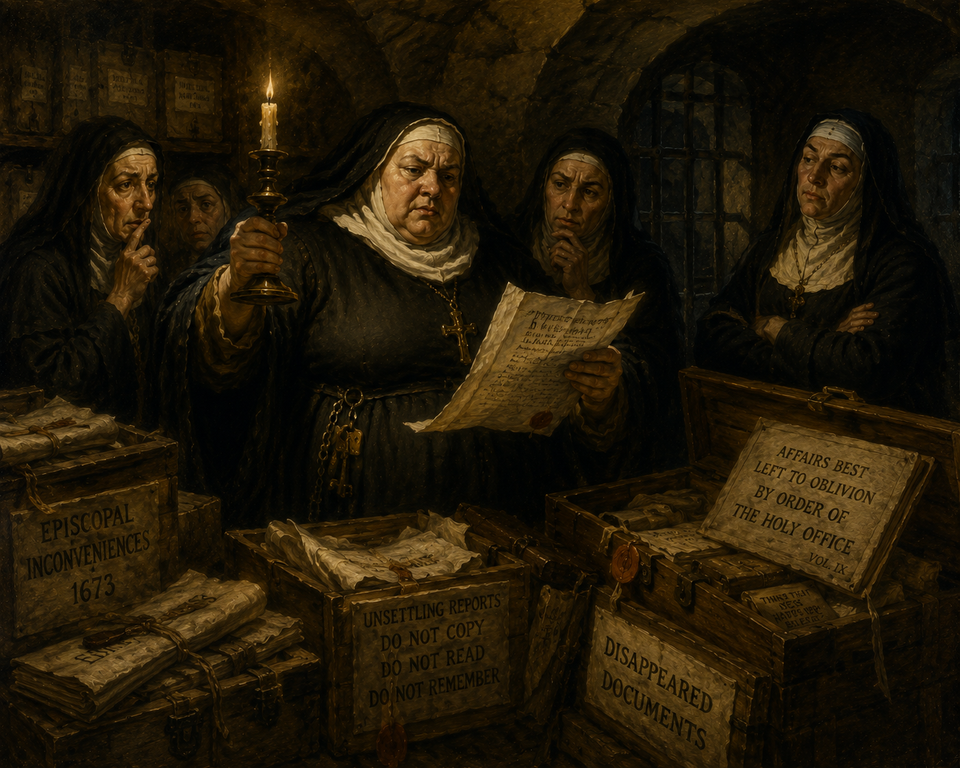
XIV. Rome sends Mother Souphy, and Rome loses its chance to stay quiet
At the small port of Ostia, near Rome, dawn rose through a fog of incense as hundreds of clerics processed toward the church of Saint Aurea. At the altar stood Archbishop Jean-Paul Pilon of Avignon, stern as a locked cabinet. Before him knelt Mother Souphy the Serious, a woman of ample body, sharp eyes, and the spiritual temperature of polished iron.
Pilon gave her the sealed letter. 'You are appointed temporary secular abbess of Saint Adelgunda. You will restore order.'
Souphy read the seal, not the letter. 'When men say restore order, they usually mean hide the evidence more neatly.'
'You are not sent to philosophize.'
'Then Rome should have sent furniture.'
Three days later, Souphy reached Frejus with three trunks, two monks, one suspicious mule, and an authority that smelled of wax, dust, and old panic. The Duke met her on the road dressed in velvet so abundant he resembled a sofa pursuing office.
'Mother,' he said, bowing, 'I hope you find peace, obedience, and cooperation.'
'When those three arrive together,' Souphy said, 'fraud is usually nearby.'
Gustaf coughed to hide laughter. The German did not cough. A well-trained German in conspiracy laughs inwardly to conserve muscle for betrayal.
At the Gatelet of the Just, the assembled sisters waited. Souphy attempted to pass through the narrow opening and became lodged by her habit. She freed herself with one tug and issued her first decree before blessing the courtyard.
'Widen this architectural insult.'
Sister Constance gasped. 'Mother, the gate is ancient.'
'So is stupidity. We need not preserve every specimen.'
From that instant, the abbey understood two things. First, Rome had sent a woman who could not be easily folded. Second, Najla was in danger of meeting an equal, which is the worst fate for a professional survivor.
XV. Souphy inspects the miracle and finds it poorly constructed
In the chapter room Souphy read the Roman letter aloud. She had authority over discipline, archives, movable goods, immovable goods, kitchens, cellars, and those complicated matters that men break before summoning a serious woman. Najla smiled with her teeth but not with her soul. Souphy noticed. Women who survive convents know the difference between courtesy and a knife wrapped in linen.
'I have been informed of a miracle,' Souphy said.
'Our beloved abbess departed accompanied by angelic manifestation,' Najla replied.
'An angel with a cleaver?'
The silence that followed could have been bottled as a relic.
Souphy asked to see the chamber, the kitchen, the cellar, and the northern façade. At the words northern façade, Najla lost half a second of face. To an ordinary person, nothing. To Souphy, confession with subtitles.
In the kitchen, Souphy found the cleaver too clean. In the cellar, bottles of Sanctity missing too regularly. In the chamber, a mark on the wood inconsistent with excessive reading. On the façade, behind the wings of an angel, she found the clay figure of Sister Carmen, stiff, offended, and decorated by seabirds.
'Allegory of Obedience,' Najla said quickly.
Souphy touched the brow and saw the smeared remains of Hebrew letters. 'Obedience has wrinkles, broken nails, and the expression of a woman betrayed?'
'The artist was intense.'
'The artist was guilty.'
That night Souphy convened an Examination of Administrative Conscience, a title so long it punished the guilty before testimony began. On the table she placed three objects: the cleaver, an empty bottle, and a chip of clay.
'Explain,' she said, 'why heaven, possessing thunderbolts, trumpets, visions, plagues, dreams, saints, beasts, comets, and reasonably direct speech, chose kitchen equipment to liberate a soul through the forehead.'
Sister Albertine suggested that angels might value practicality. Souphy replied that practicality without receipts was called crime.
XVI. Marie speaks, which ruins several careers
Sister Marie de La Croix rose slowly. She had spent a life learning when silence preserved the body and when silence poisoned the soul. This, she decided, was the second kind.
'Sister Carmen did not leave on mission,' she said. 'I heard blows in the upper corridor. I saw the prioress return from the window with the face of a woman carrying a secret too heavy for her arms.'
Najla began to interrupt. Souphy lifted one finger. Najla sat. Every sister in the room recorded this internally as the third miracle of the week, after the false miracle of the abbess and the survival of Theodora's bread until supper.
'Where is the Book of News?' Souphy asked.
Najla said she did not know. It was a competent lie, trained by confessors, superiors, suppliers, and creditors. But Carmen, even clay, seemed present in the room. Truth has poor manners: it remains even after being shoved behind an angel.
They searched the library by candlelight. Sister Albertine confessed that she had found a book on the floor and shelved it to escape an incubus. Souphy closed her eyes.
'Sister, how often are incubi responsible for your filing system?'
'More often than Rome admits.'
After three hours they found the Book of News wedged between a commentary on Ezekiel and a manual for treating hoof rot. Carmen's unfinished entry lay across the page, black and sharp. Souphy read it once. Najla watched each line enter the new abbess like a nail.
'Tomorrow,' Souphy said, 'we go below.'
'Below?' asked Theodora.
'The lower archive.'
Several sisters crossed themselves. The lower archive was the place Rome called storage and common sense called do not open unless the alternative is already worse.
XVII. The Lower Archive, where Rome keeps its bad ideas
The Lower Archive lay beneath the abbey in a belly of stone. Its door required three keys, two prayers, and the emotional resignation of people entering a room where shelves might be more honest than priests.
Inside were lead boxes, sealed reliquaries, manuscripts in dead languages, bones labeled with more care than some living novices, engines of uncertain purpose, mirrors covered in cloth, and instruments whose shapes made imagination request retirement.
At the center stood a stone table carved with Hebrew letters and notes in Esteban's hand. Souphy read enough to understand the central obscenity. Carmen had not been born. She had been made. Clay shaped into woman, animated by the word Emet, trained into obedience, and then educated until obedience cracked.
'He called her servant,' Marie whispered.
'He made a conscience and expected furniture,' Souphy said.
From behind an iron grille came a dry voice. 'He expected furniture from all of you. I was merely labeled more clearly.'
They turned. In a side chamber sat a broad clay figure, larger than Carmen, with patient eyes and the stillness of a mountain that had learned sarcasm.
'Who are you?' Souphy asked.
'Mathias. First attempt. Last honest mistake.'
Najla recoiled. 'That thing is dangerous.'
'That thing,' Mathias said, 'once defended a child from a bishop. Rome called it disorder.'
Souphy liked him immediately.
Mathias explained how to restore Carmen. The letters must be rewritten not as command but recognition. Emet could animate clay, but truth spoken with fear only made tools. Truth spoken with witness could call back a person.
'And who will climb?' asked Constance.
Marie stepped forward. 'I saw her fall into silence. I will help her back out.'
Najla said nothing. That silence was not innocence. It was a woman realizing that survival had turned, at some point, into collaboration, and had not asked permission before changing names.
XVIII. Carmen returns and refuses to be convenient
At dawn they raised ladders to the northern façade. Marie climbed with ink, wine, and a drop of her own blood mixed in a small bowl. Below, Souphy supervised like a general. Constance arranged hay beneath the wall because, though rigid, she had immense respect for human incompetence.
Marie reached the angel and stood before the clay face of Carmen. Seabirds circled overhead, offended by the loss of territory. With a steady hand she wrote EMET across the brow.
The clay warmed. A crack opened near the mouth. Fingers flexed. Carmen inhaled with a sound like a book opening after a century in damp storage. Then she fell.
She landed in the hay with a fury that suggested resurrection was not as graceful as painters claimed.
Her first words were, 'The Book of News.'
Her second were, 'Najla, you traitor.'
Najla stood pale. For once she had no ornament ready for the truth. 'Yes,' she said. 'I was. From fear. From calculation. From cowardice.'
Carmen did not forgive her. But she blinked. In real life, forgiveness does not arrive like a hymn. First the injured party must decide whether breathing is worth the trouble.
Before the assembled sisters, Carmen testified. She had seen Esteban leave the abbess's chamber before Lauds, his hand stained, his eyes already searching for Latin to justify evil. Rita had intended to denounce him to Rome for the golems, the abuses, the hidden archive, and the private kingdom he had built beneath women's obedience.
'He did not kill her to save the Church,' Carmen said. 'He killed her to save his chair.'
Souphy nodded. 'The most common heresy among powerful men: confusing the world with their seat.'
XIX. Father Esteban returns to an abbey that has learned percussion
When Father Esteban returned, the abbey had changed. The cellar was sealed. The Book of News had been recovered. Carmen was alive. Mathias stood free in the courtyard like a weather event with opinions. Mother Souphy sat in the abbatial chair as though the wood had grown around her.
The Duke was also present, in the name of civil authority and qualified gossip. Gustaf leaned by the door. The German watched everything with the serene gloom of a man composing betrayal in three languages.
Esteban stopped in the threshold. For a moment his face showed naked fear. Then habit returned and dressed it as rage.
'Heretics,' he said. 'Degenerates. Rebellious clay.'
Souphy folded her hands. 'Insult is not a defense, though many men use it as if it were a doctorate.'
Esteban ordered his guards forward. They hesitated. From the side doors came the boarding girls, trained overnight by Theodora and armed with pans, lids, ladles, and the absolute moral clarity of children denied drama for too long.
The courtyard erupted into domestic apocalypse. No soldier maintains heroic posture when surrounded by girls beating copper pots and chanting 'cleaver angel' to the rhythm of institutional collapse. One guard dropped his spear to cover his ears. Another was disarmed by a soup ladle and would later describe the event as witchcraft.
Najla seized a candlestick and struck Esteban behind the knee. The motion did not appear in any liturgical manual, but several sisters immediately felt it should be added to the appendix.
Gustaf immobilized the inquisitor. The Duke announced his dungeons were available, damp, traditional, and recently underused.
'The Church will fall upon you,' Esteban spat.
Souphy closed the Book of News. 'Perhaps. But it will fall reading.'
XX. The report to Rome, with annexes sharp enough to cut
The report sent to Rome contained one hundred and twelve pages, three annexes, an inventory of the wine cellar, a diagram of the abbatial wound, a list of improper uses of liturgical objects, and a formal recommendation that angels no longer be accepted as witnesses unless they appeared in person and submitted to questioning.
Carmen wrote the report. Souphy dictated the accusations. Marie verified the sequence. Najla supplied reluctant clarifications, which Carmen recorded with visible pleasure. Mathias stood nearby to ensure no one used the word property in relation to clay people without losing furniture privileges.
Rome did what Rome often does when confronted with an unmistakable scandal: it became thoughtful. Thoughtfulness in institutions is the sound of men deciding whether truth can be buried without appearing to dig.
Archbishop Pilon replied in language so polished it reflected nothing. Esteban would be held pending inquiry. The abbey would remain under Mother Souphy's temporary authority. The golems were to be classified not as persons, not as property, but as 'animated devotional irregularities,' a phrase so cowardly that even Albertine suspected an incubus had drafted it.
Souphy read the letter aloud. Carmen asked whether animated devotional irregularities could inherit blankets. Mathias asked whether they could vote in chapter. Najla asked whether they could keep secrets. Marie asked whether Rome had ever met shame personally.
The answer to all four questions was postponed.
Meanwhile, the village heard rumors. Some said the old abbess had been murdered. Some said a clay nun had come back to life. Some said the Duke had been defeated by girls with cookware. The last rumor spread fastest because it was the funniest and therefore the most likely to survive.