THE ABBESS IS DEAD! - Part II
VII. Najla almost becomes abbess and crashes into reality
The Duke, having found insult insufficiently nourishing, asked what would become of the abbey now that its head had been removed by heaven, or by cutlery, depending on one's relationship with evidence.
Esteban straightened. 'The death of the abbess changes nothing. Our orphanhood will be brief. A new abbess has already been appointed by Rome.'
Najla's soul left her body, crowned itself, returned, and began arranging furniture in imagination. Prioress. Deaconess. Abbess of Frejus. Najla the Great. Veruska in Glory. Mater et Magistra of Everyone Who Ever Underestimated Me. She pictured herself processing through the basilica while enemies choked politely on incense.
A guard nearby asked whether she felt ill. She blinked herself back into the world just in time to hear Esteban finish.
'Before Sunday ends, the faithful shall know whom Rome sends to govern this house. She will come with the heavy hand of the Holy Father.'
The imaginary crown fell down a well.
When the Duke departed, injured in both pride and strategy, Najla turned on Esteban. 'Explain. Was that to gain time? To unsettle him? What luxury is this, an abbess chosen by the Pope? Tradition says one of us should be elevated.'
'Tradition also suggests abbesses should not be found perforated.'
'You thought for a moment I could not govern?'
Esteban looked her up and down. 'I thought for many moments.'
Najla swallowed hatred with the discipline of a woman who has survived by digesting insults slowly. Then she pointed toward Sister Carmen. 'Remember she witnessed the truth. Carmen writes the Book of News. Carmen does not lie. She is transparent, just, inflexible as stone.'
Esteban followed her gaze. Sister Carmen stood near the pulpit, weeping with the terrible innocence of someone who might ruin everything by telling the truth.
'That,' Esteban said, 'can also be managed.'
VIII. Sister Carmen and the dangerous vice of accuracy
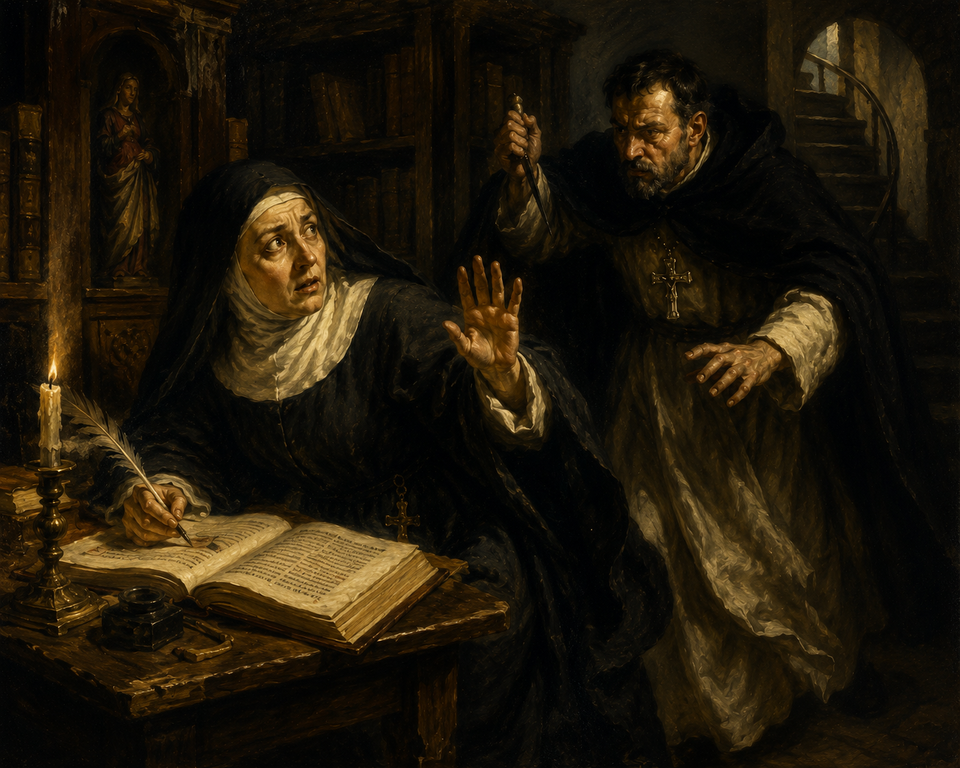
After Compline, when the abbey settled into darkness and the sisters retired to contemplate death in preparation for sleep, Sister Carmen the Saintly did not go to her bed. Duty pulled her toward the Great Library, which at night looked less like a house of learning than like a forest where shelves had learned to judge.
She opened the small safe behind the second cabinet and withdrew the Book of News, the official chronicle of all happenings in the abbey. It was bound in leather, sealed in wax, and dangerous in the way only honest books are dangerous: it remembered things powerful people preferred to rename.
By candlelight she broke the seal, dipped the quill, and wrote:
ON THIS FIFTEENTH DAY OF MARCH, IN THE YEAR OF OUR LORD 1760, DURING THE HOLY HOURS OF LAUDS, I, CARMEN, SERVANT OF GOD, DID BEHOLD, TOGETHER WITH FATHER ESTEBAN AND PRIORESS NAJLA VERUSKA, THE BODY OF OUR MOST SACRED ABBESS RITA THE PURE, MURDERED BY A MALEFACTOR WHO DROVE A KITCHEN CLEAVER THROUGH HER BLESSED FOREHEAD IN THE FRONTO-OCCIPITAL DIRECTION...
She stopped. Footsteps descended the spiral stair.
Carmen hid the book beneath her habit and lifted the candle. Father Esteban emerged from the dark like a threat that had learned Latin.
'Sister,' he said, 'you need confession.'
'I am confessed, Father. You are my confessor.'
'Then I know the stain that remains: conspiracy against the holy mystery of Abbess Rita.'
Her hands trembled. 'There is no mystery in a cleaver.'
'Where is the Book of News?'
Carmen tried the old innocent face, the one that had fooled novices, cooks, and once a bishop with weak eyesight. It did not fool him. Esteban wrapped cloth around his knuckles as pugilists do before making theology physical.
'Truth,' he said softly, 'may be concrete or abstract, private or official.'
'Then official truth is only a lie with better shoes.'
He drove a letter opener through the sleeve of her habit, pinning her to the desk. With his other hand he covered her mouth.
'The book,' he hissed. 'Or I shall beat you worse than Rome beat syntax.'
Carmen seized the inkpot and threw it into his eyes. The inquisitor howled. She tore herself free and fled for the spiral stairs, leaving behind dignity, blood, and most of the ink.
IX. The least dignified chase since stairs were invented
Carmen climbed as fast as age allowed and terror demanded. Behind her, Esteban stumbled after her half-blind, black with ink, and less like a servant of God than a chimney demon with legal authority.
At the turn of the stair he caught her ankle. 'The book, cursed woman!'
'Release me!'
'A golem does not disobey its master.'
The word struck the air harder than his hand. Carmen's face changed. Fear remained, but beneath it rose something older than fear and more stubborn than prayer. She kicked him with her free foot. The blow caught his head. He rolled down the stairs in a percussion of bones, curses, and Dominican cloth.
In the struggle, the Book of News slipped from Carmen's habit and fell to the library floor below. Neither saw it. Carmen reached the upper corridor and almost wept with relief when she saw Najla approaching.
'Friend! Blessed be God! Esteban has gone mad. Help me flee!'
Najla did not move aside.
Carmen understood before Esteban reappeared, limping up the stair, his face painted with ink and humiliation. Najla held Carmen gently but firmly, as one holds a rabbit selected for stew.
Esteban wiped his eyes with the cloth around his knuckles. 'You are rebellious, ungrateful, and disobedient. I gave you life.'
'You gave me movement,' Carmen said. 'The difference matters.'
Najla began to speak. Esteban told her to be silent. She spoke anyway, as Najla often did when silence would have been safer and less interesting. She argued that if the people learned a murderer lived inside the abbey, the Duke would storm the place, seize its secrets, and turn Rome's hidden sins into provincial entertainment.
Esteban slapped her. Najla fell. Carmen escaped to a window, climbed out, and began crawling along the narrow stone ledge outside, with the cold sea wind pulling at her habit. Below, the courtyard waited with the patient appetite of gravity.
X. Emet, or the inconvenience of being truth
Carmen edged along the façade until she reached one of the four great angel statues that decorated the northern wall. She tucked herself behind its wings, trembling, her veil torn away by the wind. On her forehead, exposed at last, were Hebrew letters: EMET. Truth.
Esteban leaned from the window. 'Come back, Carmen. You owe me obedience. I wrote Emet on your brow.'
'When you wrote Truth upon me,' she called, 'you condemned me to be true. I will not profane the Book of News with lies.'
Najla, pushed by Esteban onto the ledge like a sacrifice with administrative experience, crawled toward her. 'Carmen, dear one, consider the stupidity of this position. You are clinging to an angel over a courtyard in the middle of the night while I freeze my sanctified parts off. Give me the book and come back.'
'He will erase me.'
'Only if you persist in being inconvenient.'
Carmen looked at her with pity so clean it offended Najla. 'A golem is useful only while obedient. But knowledge has made me more than obedience. I have a soul of my own making, whether heaven recognizes the paperwork or not.'
Najla, shivering behind the angel, thought darkly of Esteban: New Christian by ancestry, Dominican by costume, inquisitor by profession, secret student of Jewish mysteries, burner of witches, maker of clay women, and somehow still convinced that everyone else was the scandal.
Carmen drew a small missal from her habit. 'I have a book. Promise my safety until morning, and I will give it to you.'
Najla saw her chance, and in fear people often call betrayal prudence. She snatched the missal with one hand and, with the cloth Esteban had given her, wiped the letters from Carmen's brow.
The change was immediate. Warmth fled. Skin dulled to clay. The living woman stiffened into a rough terracotta figure with frightened eyes and hands still shaped by refusal. The wind carried away the last human heat.
Najla stared, horrified by what she had done and more horrified that she had done it efficiently.
XI. The wrong book and a canonical beating
Najla crawled back to the window half-frozen and wholly damaged. Esteban pulled her inside with the tenderness of a man retrieving luggage.
'The Book of News,' he demanded. 'I saw you take it.'
She raised one finger to her lips. 'Thank you would be appropriate.'
He did not thank her. He did not belong to that branch of civilization.
Najla, exhausted and furious, reminded him that she and the abbess had opposed the whole golem enterprise from the beginning. He had brought his inherited clay servant from the Holy Land, performed a private demonstration for the abbess, and played God in front of women he later called dangerous for reading too much.
'Now you expect me to explain why your truth-woman is decorating the façade like a gargoyle with grievances.'
Esteban slapped her again. 'You did not kill anyone. A golem is not alive. You merely extinguished a candle before it set fire to us.'
'That is a beautiful sentence,' Najla said, touching her cheek. 'You should embroider it on the banner of every coward.'
'The book.'
She drew it from her habit and handed it over. Esteban opened it. It was a missal. A common missal. No wax seal, no chronicle, no dangerous testimony. Just prayers, which in that room were the least useful paper imaginable.
His face altered. 'This is the Book of News?'
Najla backed away.
'Answer me, dog.'
He beat her with the missal and with his hands while the sisters' final chant of Compline drifted through the corridor: He shall come in the night and cover me with grace. The lyric did not improve Najla's mood.
Hidden behind a half-open door, Sister Marie de La Croix the Ethiopian witnessed enough to understand too much. She waited until the footsteps faded. Then she stepped into the corridor, saw the window, the darkness, and the distant shape behind the angel, and whispered, 'Lord have mercy. How that woman gets beaten. A harbor whore would have union protection by now.'
XII. Albertine blames the incubus, as usual
Below, in the Great Library, the Book of News lay on the floor where it had fallen from Carmen's habit. It remained there until Sister Albertine, late for the final bell, cut through the library on her way to the northern tower.
Albertine was the kind of woman who believed every object out of place was either negligence, demonic activity, or a test designed specifically for her irritation. She tripped over the book and hit the floor with the sharp little grunt of a saint discovering gravity.
'Which lazy strumpet left this damned thing here?' she muttered, recovering both the book and her dignity in pieces.
She did not read the cover. Reading unexpected books at night was how demons entered through the eyes. She shoved it into the first empty space on the nearest shelf and ran on, increasingly certain that an incubus had placed it in her path so that, while she lay vulnerable on the floor, some unspeakable nocturnal enterprise might occur.
By the time she reached the bell tower, the theory had matured. By the time she pulled the rope, it had become doctrine.
The bell rang over Saint Adelgunda. Albertine cried into the night, 'The angels keep watch in Christ over this sacred house, but pray against incubi!'
The sisters heard it in their beds and accepted it as a general precaution. At Saint Adelgunda one rarely knew whether any given warning was metaphor, theology, or maintenance.
XIII. The candle proves God enjoys irony
Near dawn, in the office of the Holy Office, Father Esteban wrote letters by candlelight while Najla sat across from him with a split lip and the expression of a woman arranging future revenge alphabetically.
The office was less a room than an embassy of fear. From that desk Esteban administered the hidden work of the abbey: not the education of girls, not the feeding of the poor, not the singing of psalms, but the guarding of objects, texts, bones, engines, relics, formulas, and historical embarrassments that Rome preferred locked behind women it officially considered fragile.
'A courier will carry this to Archbishop Pilon,' Esteban said without looking up. 'He knows the nature of this place. Rome will send the new abbess. I must leave before Lauds for Seville. Heresy, unfortunately, has become punctual.'
'And who will guide this imported abbess?' Najla asked.
'You, obviously. What other harlot here is so well integrated into the rot?'
Najla bowed her head. 'Your confidence honors me.'
Esteban rose, leaned over the desk, and threatened her with Lisbon's slow-burning fires if he returned to find the new abbess unmanageable. He grew so theatrical that his sleeve descended into the candle flame. Fire took the cloth, climbed toward his beard, and delivered the only honest criticism of the evening.
'Father,' Najla said, 'I believe Lisbon has arrived early.'
He shrieked, rolled, tore a tapestry from the wall, and smothered himself in it while Najla filled a tiny cup at the washstand. She used the water to extinguish the candle, since Esteban himself was now providing superior illumination.
In darkness, he asked whether he was wounded.
'Did it hurt?' she replied, with the innocence of a dagger wrapped in lace.
He nearly strangled her before throwing her into the corridor. Najla walked to her cell bleeding and thinking: Men are alike, sacred or worldly. They strike, insult, command, and call the wreckage order. But tomorrow is always another day. And tomorrow, unlike men, can be educated.