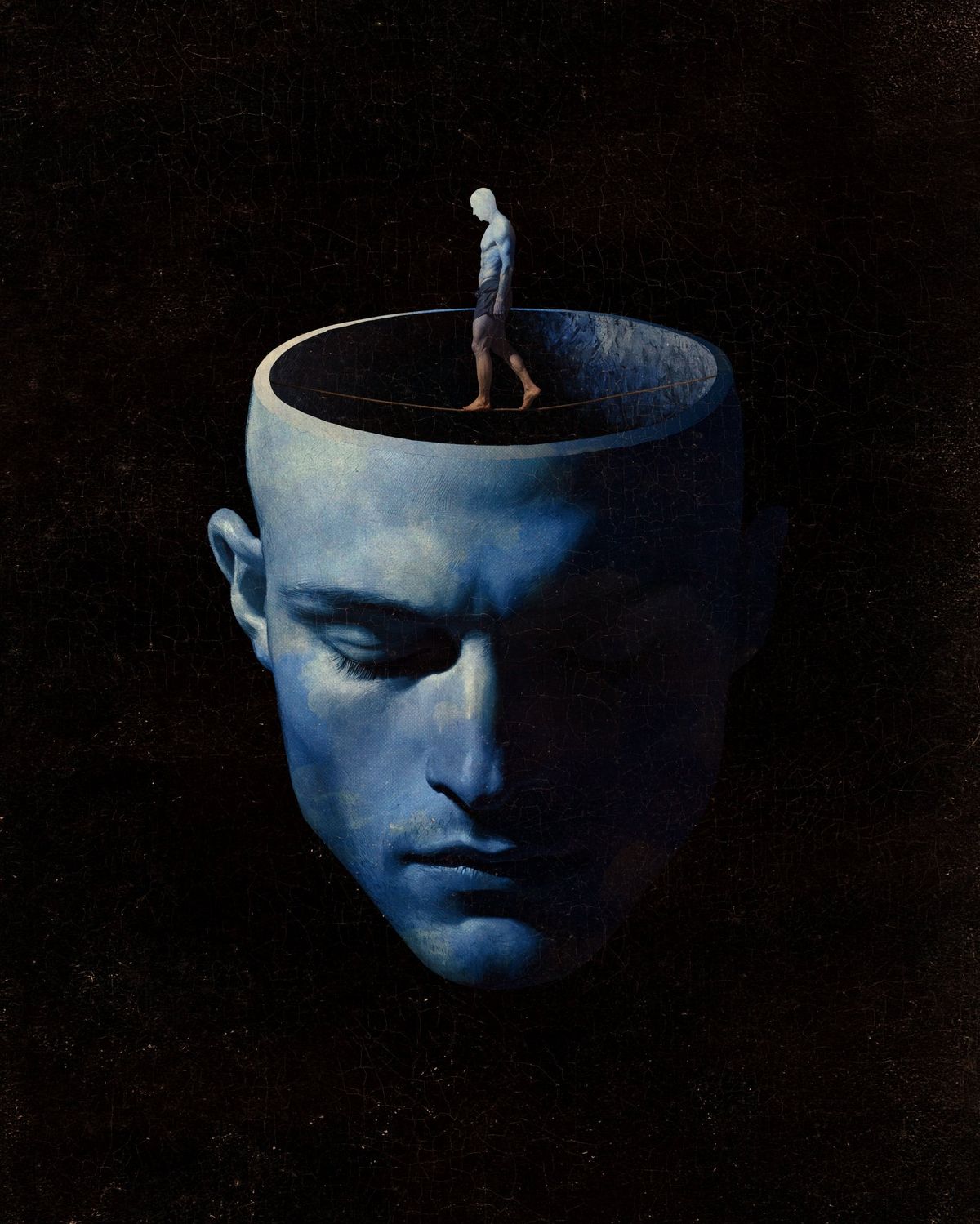

The First Time the Machine Looked Back
I still remember the first time I saw ChatGPT.
It was around November 2022, and there was something strangely beautiful about it. Not beautiful in the polished, product-design sense. Beautiful because it felt unfinished in the right way — rough, limited, occasionally wrong, but carrying the unmistakable smell of the future.
It was nowhere near what it is today. And even today, it is nowhere near what I imagine it will become.
One small detail fascinated me: the notice at the bottom of the screen. It told you up to which point its knowledge had been “synced” with reality. That felt almost poetic. Back then, the warning was not centered around hallucinations, mistakes, or the platform’s own unreliability. The mood was different. ChatGPT was treated as something close to unbeatable, almost mythological.
Claude would only show up as a serious contender about a year later. Most companies were not even publicly dreaming of having their own large language models. For a brief moment, ChatGPT did not feel like one AI product among many. It felt like the event.
And still, my enthusiasm was not naive. I could see the gaps. I could see the limitations. But none of that reduced the scale of what had just happened.
The real shock came when, in that same November of 2022, I asked ChatGPT what it knew about Pablo Murad.
It did not have internet access. It did not have live information. It was not connected to the present. And yet, somehow, it answered with maybe 40% accuracy.
To most people, 40% would sound like failure.
To me, it was enough.
I looked at Samuel, my marketing lead at the time, and said: “Man, the future of search is going to be AI.”
He laughed. He disagreed. Samuel is a skeptic by instinct.
The funny part is that just yesterday we were working on how AI perceives us — how it reads, ranks, interprets, and represents who we are. I reminded him of that moment. He laughed again. Not because it was absurd anymore, but because it had become obvious.
That is the strange thing about good predictions: they usually sound ridiculous before they sound inevitable.
Four years ago, this felt almost impossible.
Now, here we are, all preparing for the AI wave.
And this wave is not just another technological upgrade. AI will shape the algorithm. In many cases, it will become the algorithm. It will influence how people search, write, buy, learn, code, create, and decide what deserves attention.
I do not see this as something purely dystopian. Some changes are not threats; they are the natural consequence of a system becoming more efficient. I am not conservative enough to be angry at AI. Quite the opposite: I find it extraordinary.
I also do not believe the simplistic idea that AI will merely “replace humans.” That is too lazy a reading.
What will happen is more interesting.
Humans will move.
Programmers will become engineers of intelligent systems. Writers will become managers of language. Artists will become creative directors of machines capable of producing endless variations. The human role will shift away from raw execution and toward intent, judgment, taste, and direction.
But there is one part that still unsettles me: human emotion in contact with synthetic creation.
The other day, I saw an elderly man enjoying a song made by AI. That stayed with me. Not because the song was bad. Not because it was artificial. But because it raised a harder question: if something synthetic can touch a real memory, awaken a real sadness, or create a real sense of beauty, then where exactly does the human part begin?
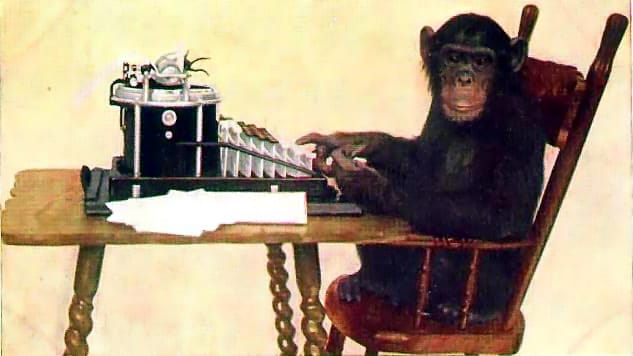
If we reduce AI to “if” and “then,” we miss the scale of what is happening. Yes, underneath it all, there is structure, probability, computation. But from enough structure, enough probability, and enough computation, something begins to resemble meaning.
Maybe we are all living through a practical version of the infinite monkey theorem.
Except the monkeys are models, the typewriters are data centers, and the accidental Shakespeare is no longer accidental. It is optimized, predicted, and delivered in milliseconds.
That is what I felt back in November 2022.
Not that the machine had arrived fully formed.
But that, for the first time, it had looked back.