THE ABBESS IS DEAD! - Final
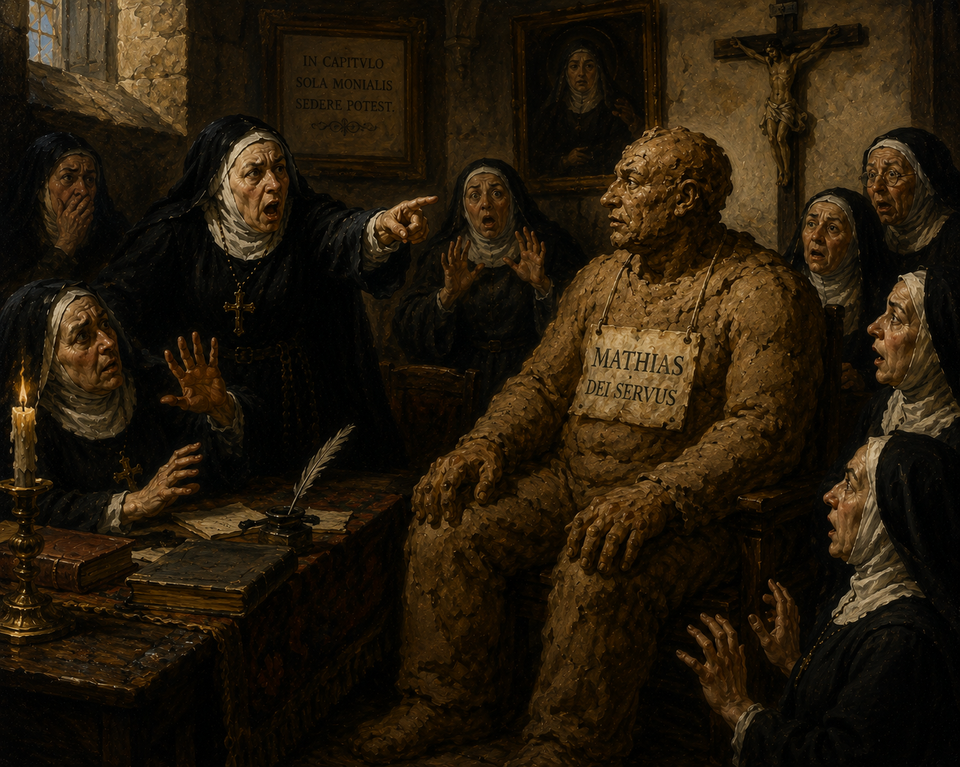
XXVIII. Mathias requests a chair and causes a theological crisis
The matter of Mathias's status became urgent when he asked for a chair in chapter. The request was reasonable. He had been standing for decades. Reason, however, often becomes scandal when applied to those previously classified as objects.
Constance argued that only sisters sat in chapter. Mathias asked whether he should become a sister. Albertine fainted into a basket of mending. Theodora revived her with the smell of broth.
Souphy ruled that Mathias could sit as witness and guardian but not vote until Rome stopped hiding behind adjectives. Carmen supported this. Marie supported Carmen. Najla supported whatever prevented Mathias from becoming angry near load-bearing walls.
A chair was brought. It broke immediately. A bench was brought. It groaned but survived. Mathias sat. The room adjusted around him.
'I have another request,' he said.
'Naturally,' Najla murmured.
'Teach me to write.'
Carmen looked at his broad clay hands. 'It will be slow.'
'I have been locked under the abbey for years. Slow is an improvement.'
So began the education of Mathias. His first letters were enormous. His first sentence, after many days, read: I WAS NOT MADE TO BE SILENT. Carmen pinned it above the desk. Souphy called it good doctrine.
XXIX. Esteban's trial, conducted by men allergic to clarity
News of Esteban's trial reached the abbey in fragments. He was not tried for murder first. That would have been vulgar. He was tried for procedural abuses, unauthorized animation, misuse of sacred names, irregular custody of restricted materials, and conduct unbecoming to the Holy Office, a phrase broad enough to cover murder without suffering the indignity of saying cleaver.
The sisters gathered as Souphy read the report.
'Will he burn?' Constance asked.
'Probably not,' Souphy said. 'Men who know where documents are buried rarely burn quickly.'
Najla's face hardened. 'Then justice fails.'
Carmen shook her head. 'Justice is not only punishment. It is record. It is witness. It is making it harder for the lie to walk upright.'
'That sounds like consolation for losers.'
'Often. But consolation can still be true.'
Esteban was removed from office and confined to a remote monastery pending further judgment. The monastery was famous for silence, cold soup, and an abbot with no patience for theatrics. Souphy considered this insufficient but not useless.
Mathias asked whether the remote monastery had stairs. When told yes, he smiled for the first time. It was a slow geological event, but unmistakable.
XXX. The schoolgirls form opinions, which is always dangerous
The boarding girls, having witnessed murder, resurrection, political humiliation, and cookware-based defense, became difficult to educate in the old manner. Arithmetic seemed smaller after one has seen an inquisitor felled by a candlestick. Latin declensions lost authority after Rome itself appeared unable to decline responsibility.
Souphy adjusted the curriculum. Alongside scripture, needlework, music, and moral instruction, she added accounts, rhetoric, legal memory, practical medicine, locks, maps, and the identification of bad arguments.
Constance objected. 'Too much knowledge caused the abbess's forehead to split, according to the funeral sermon.'
Souphy looked at her until the objection crawled away and died.
The girls took eagerly to bad arguments. They identified false dilemmas in sermons, circular reasoning in kitchen excuses, appeals to authority in housekeeping orders, and slippery slopes in Albertine's incubus theories. This made the abbey both smarter and louder.
One girl asked whether obedience remained a virtue if the order was stupid. Souphy answered that obedience without judgment was merely rented cowardice.
Carmen wrote the phrase down. Najla underlined it when no one was looking.
XXXI. Saint Adelgunda multiplies beyond control
The shattered statue of Saint Adelgunda became, despite Constance's efforts, a devotional economy. Each fragment was wrapped, labeled, and placed in a small box. The larger pieces remained in the chapel. Smaller ones began appearing in pockets, under pillows, inside lesson books, and once in Theodora's spice drawer, where the saint acquired a faint aroma of cumin.
Pilgrims came asking to see the multiplied saint. Souphy saw no reason to discourage donations provided no one lied. The official explanation stated that the statue had been broken during the confusion following the abbess's death and that the faithful had, with questionable taste but sincere feeling, begun venerating the pieces.
This honesty disappointed pilgrims at first, then impressed them. A miracle honestly denied can become more attractive than a miracle badly sold.
Constance was appointed Keeper of the Fragments. Power improved her mood and worsened everyone else's. She created a numbering system, a polishing schedule, and a rule that no fragment of the saint could be kissed with oily lips.
Theodora asked whether gravy counted as oil. Constance replied that Theodora's mouth was an unresolved canonical category.
XXXII. The final entry of the first book
At year's end, Carmen opened the Book of News to a fresh page. Her hand no longer trembled as it had on the night of the murder. The abbey was not purified. No institution is purified by one scandal. It was merely less comfortable lying to itself, which is the beginning of every difficult mercy.
She wrote of Rita the Pure, who had drunk too much Sanctity and trusted the wrong man. She wrote of Esteban, who built a throne under a crucifix and called it service. She wrote of Najla, who betrayed and then remained to be useful without being absolved cheaply. She wrote of Souphy, who arrived too late to prevent evil but early enough to stop its public relations campaign.
She wrote of Marie, who spoke. Of Theodora, who fed. Of Constance, who measured. Of Albertine, who feared incubi with admirable consistency. Of Mathias, who learned letters. Of the girls, who learned that truth without courage becomes furniture.
Then Carmen paused. At the bottom of the page she added:
Ignorance may indeed be a blessing, but chiefly for those in command. For the rest of us, knowledge is knife, key, bread, witness, and, when required by circumstances, a candlestick to the knee of an inquisitor.
She sanded the ink, closed the book, and listened to the bell. Outside, the sea struck the rocks below Saint Adelgunda with its old indifferent rhythm. The abbey stood above it, cracked, guilty, alive.
The angels did not testify. Prudent creatures, angels.
Apocryphal Glossary
Abbess, secular: A religious authority summoned when men have finished breaking everything and require a woman to make the wreckage look intentional.
Book of News: The official chronicle of Saint Adelgunda. In a house full of versions, it had the discourtesy to record what happened.
Cleaver: A kitchen instrument that nearly became an accepted branch of angelology.
Compline: Night prayer. At Saint Adelgunda, frequently accompanied by threats, falling furniture, and poorly timed revelations.
Emet: Truth. A small word with catastrophic administrative consequences.
Gatelet of the Just: A narrow opening designed to remind every entering soul that architecture, too, can judge.
Incubus: A nocturnal demon blamed by Sister Albertine for misplaced books, drafts, loose shutters, and nearly all filing irregularities.
Sanctity: Wine produced by the abbey. Suitable for Mass, melancholy, negotiations, and the concealment of lesser crimes.
Truth, official: A lie that has received stationery.
Truth, living: The kind that crawls along a ledge in the wind and still refuses to cooperate.