


The small things I love
Eight small things I built and love: bimb.ooo for pastes and tiny sites, tuno.place notes, pupu.page for writing, tedy.science sums, phlog.space for wrecked photos, and three ravens that carry email: RavenMail forms, theraven.my and the new theraven.social. All free, no ads.
Contents
- Five rooms in the same house
- bimb.ooo, somewhere to put things
- tuno.place, a board for loose notes
- pupu.page, a quiet place to write
- tedy.science, a desk for everyday sums
- phlog.space, a photo log of wrecked photos
- Three ravens
- theraven.email, contact forms delivered by raven
- theraven.my, a town of letters
- theraven.social, good company delivered
- Why small
Some of my favorite things on the internet are tiny: a page that does one job, a tool with a cat on it, a place where nobody counts your followers.
So I keep making them. This post is a walk through eight small things I built and love: five cozy places from the same house, and three ravens that carry email around. All of them are free. Like I wrote on theraven.my: "All my projects are free to use. And when they mature, they become free and open-source software."
Five rooms in the same house #
The first five share a house called muradcorp. Each one has a single job and the same rule: no ads, no tracking, nothing you didn't ask for.
bimb.ooo, somewhere to put things #
bimb.ooo is a small home for text, guarded by a pink elephant. You can paste a snippet of code, write a page in Markdown or hand-roll a tiny site with an index, a style.css and an about. Everything lands at you.bimb.ooo, under a name you pick, at paths you can read out loud over the phone.
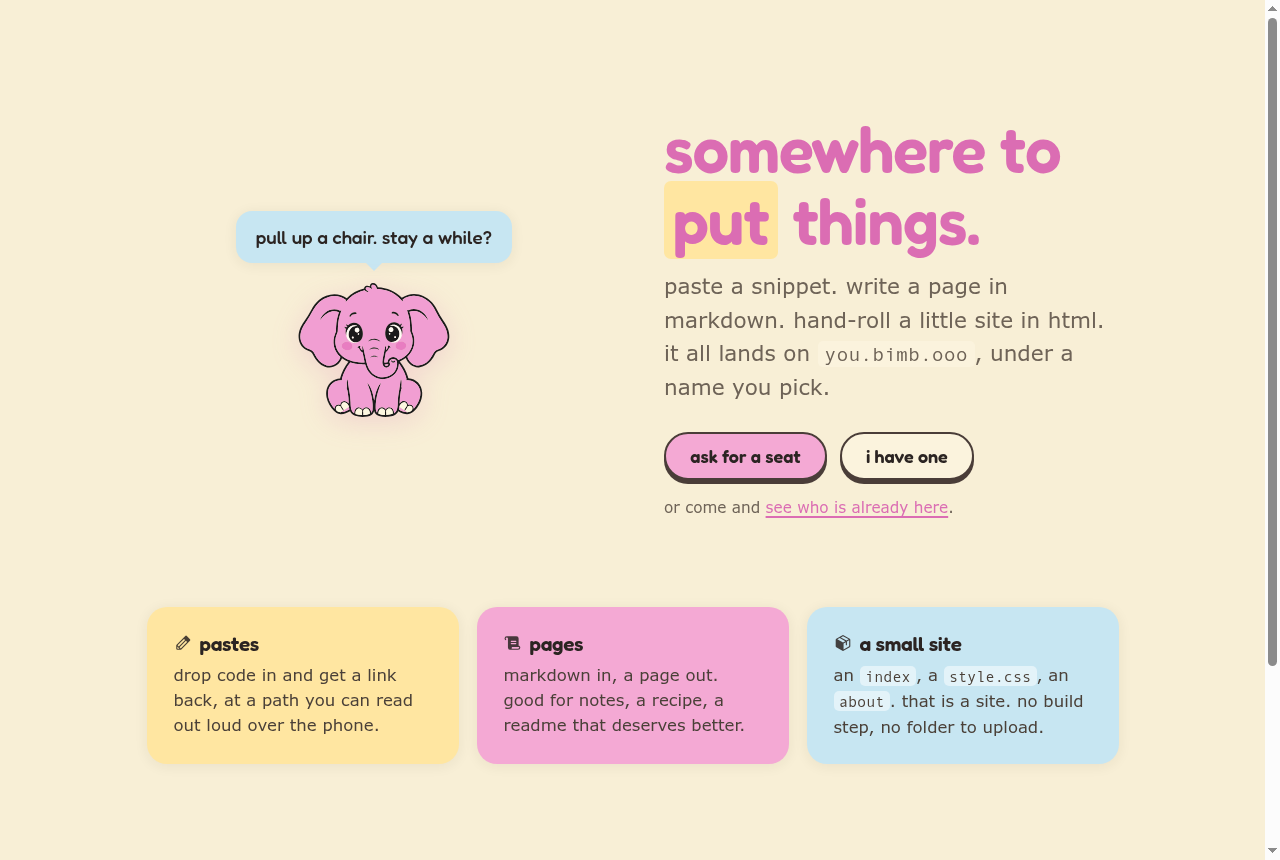
There's no build step and no folder to upload. Every site gets an Atom feed at /feed.xml on its own, so people can follow you from a feed reader without you doing anything. Under the hood it's one Go binary with SQLite behind it, and every person lives on their own subdomain, so one person's HTML can never touch someone else's.
It's invite only, in the nicest way: you ask for a seat, and you can see who is already here before you do.
tuno.place, a board for loose notes #
tuno.place is a board of colorful note cards, with Tuno, a white cat holding a pencil, at the top. You write a note, then make it look like yours: rounded rectangle, square, circle, arch, pill or hexagon, a background you can shuffle, a string tied from one note to another. When a note is done, you can save it as a picture or print it.
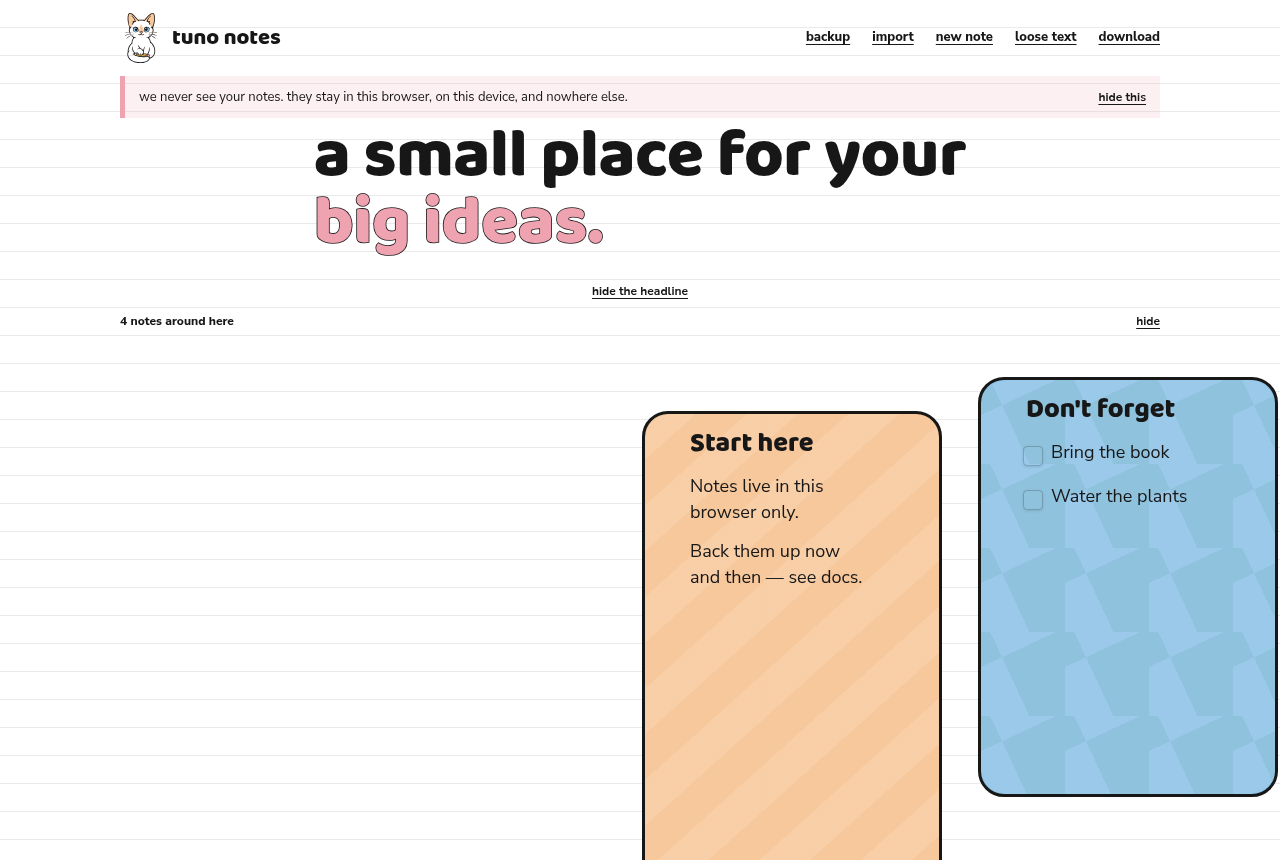
The notes never leave your browser. There's no account and no server holding them, which also means backing them up is your job (there's a button for that). It's officially described as "delightfully buggy".
pupu.page, a quiet place to write #
pupu.page is a room for writing one thing at a time. The first thing it asks is "how is the light where you are?", night or day, and then it gets out of the way. Pupu, a small black cat, sleeps through both.
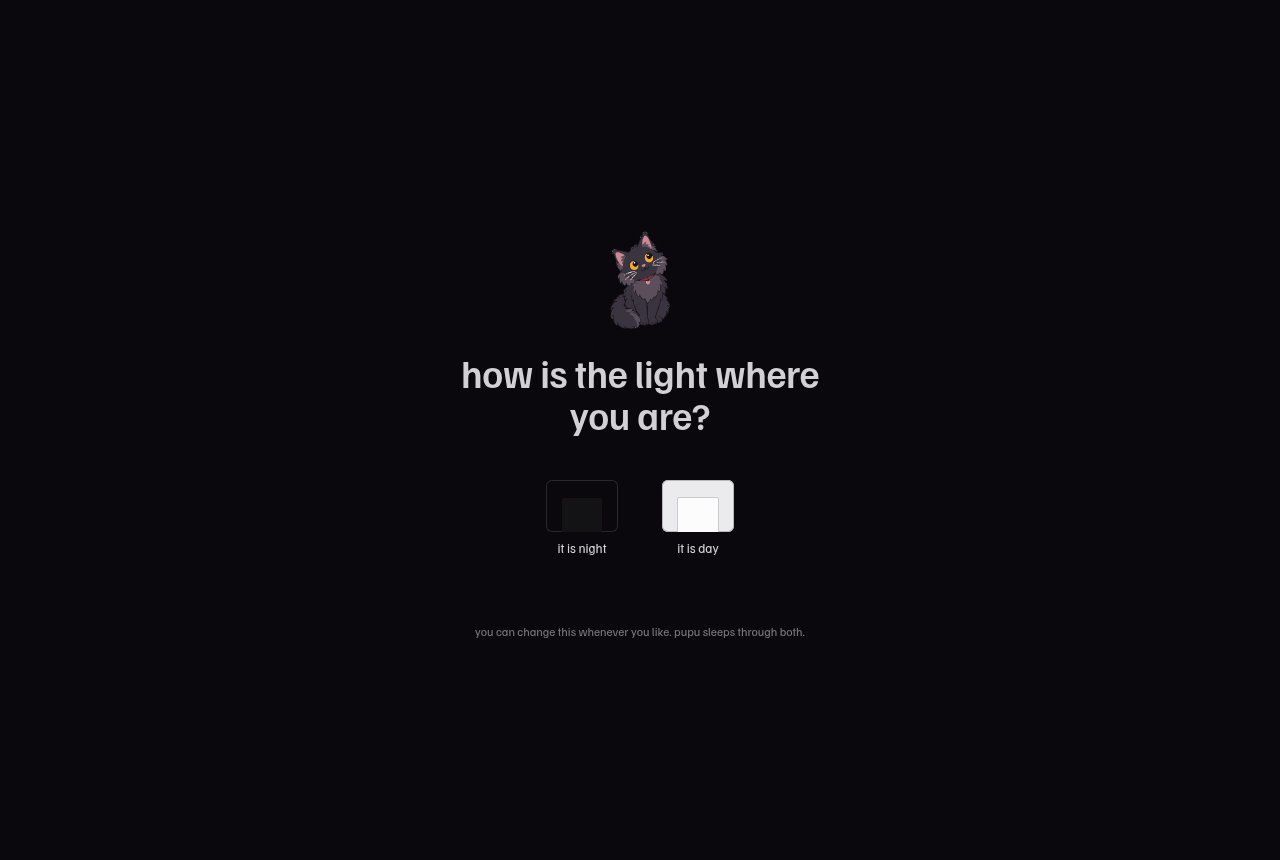
You write in Markdown, and the punctuation steps aside: the stars and pound signs hide on every line except the one you're on, so what you see already reads like finished writing. The line you're typing holds still while the page moves around it, and everything except the sentence you're in can fade out, so your eyes have nowhere else to go. When you're done, you export a .md file that's byte for byte what was on the screen.
It works offline, saves as you type, and makes no request to anywhere else. Even the fonts live on the site itself, so nobody learns that you sat down to write today. No account, no server, no AI.
tedy.science, a desk for everyday sums #
Tedy's Science is a notepad that does math. You type lines the way you'd say them, and the margin answers. Ted, a ginger cat with his tongue out, supervises.
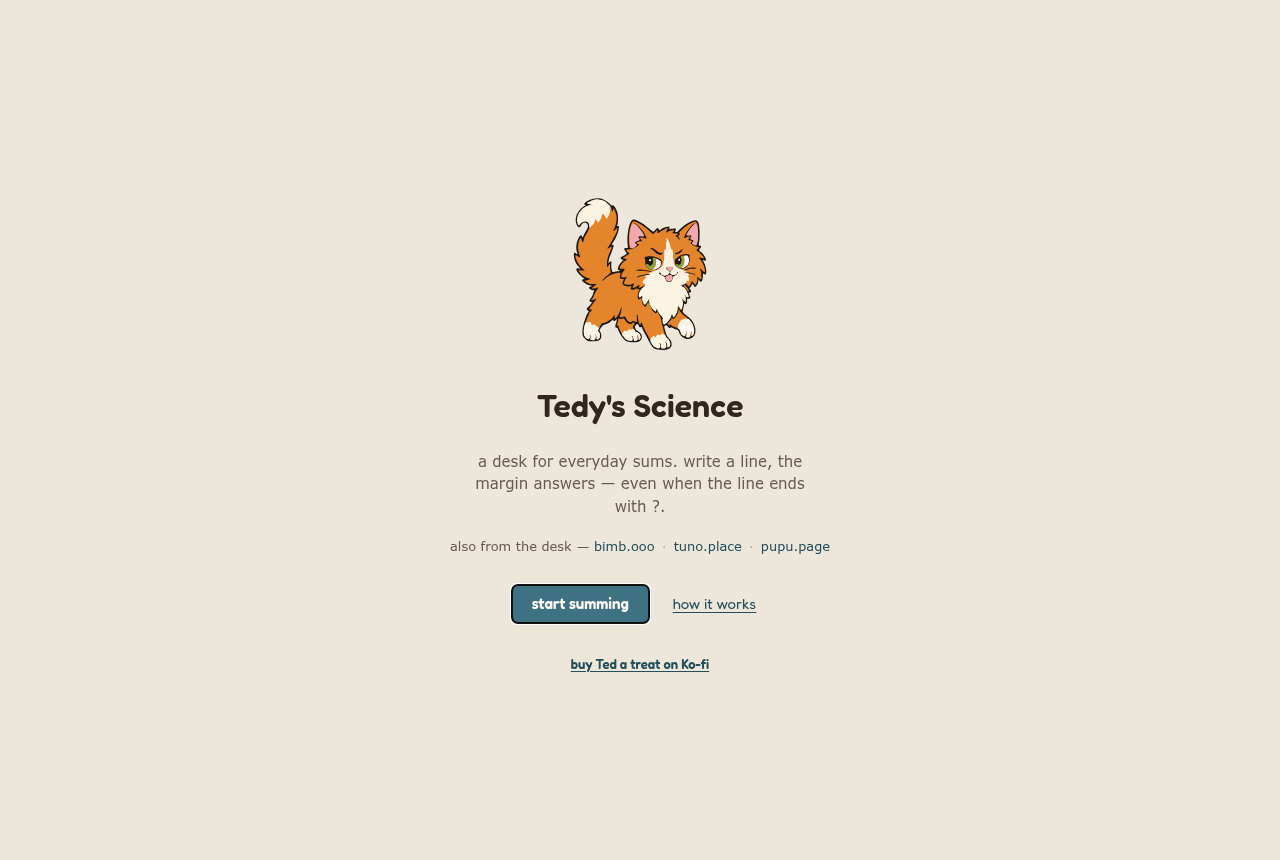
Write lunch 45 + uber 22 and the margin says 67. The words are just labels, so your sums stay readable. A few more things it understands:
850 + 20%: 1020
15% of ? = 60: ? = 400
120 km / 2 hours: 60 km/h
today + 30 days: the date 30 days from now
1200 in 12x: twelve payments of 100
1/3 cup * 3: 1 cup
The ? is the neat part: put it anywhere in a line and Ted solves for it. There are variables, headings that split a sheet into sections with their own subtotals, units that refuse to add kilograms to hours, dates, fractions, a scientific calculator running the same engine, and a set of ready-made formulas to paste in.
Your sheets live in your browser. To share one, you send a link, and the whole sheet travels inside the part of the address after the #, which never reaches the server. And if Ted is earning his keep, you can buy him a treat on Ko-fi.
phlog.space, a photo log of wrecked photos #
phlog.space is a photo log where your pictures get wrecked on purpose. You post a JPEG or PNG, and on the way in it gets one of 36 effects, picked at random: crunchy JPEG, pixel sorting, VHS, CGA and VGA palettes, fax, thermal camera, Kodachrome, Super 8, silent film, cyanotype, a square 2012 phone-app filter and more. Then it's shrunk to 400 pixels or less, and the original isn't kept.
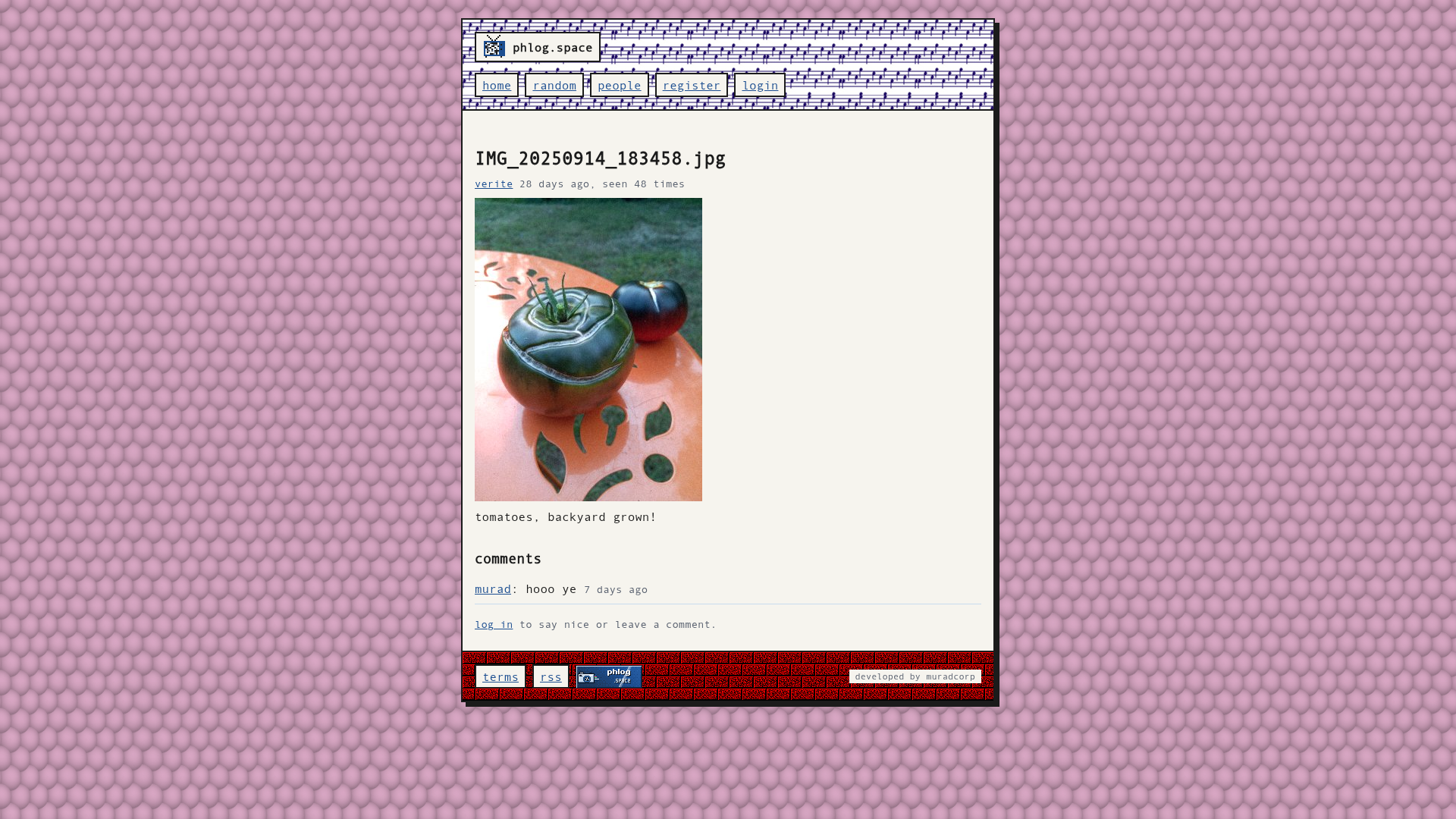
If you'd rather post a photo as it is, you can turn the effects off in your settings. The rest is built like the old web: each member can leave one "nice" and one single-line comment per photo, sign other members' guestbooks and browse by month. Profiles live at /~name and come with a hit counter, and there's a random photo link, a member list, an RSS feed and an 88x31 button for your own site.
Under the hood it's plain PHP with SQLite, no framework and no JavaScript. New accounts wait for an admin to let them in, so register and give it a little time.
Three ravens #
The other three are about the one protocol that everybody already has: email. No app to install, no new password, no feed. You write from the mail program you already use.
theraven.email, contact forms delivered by raven #
RavenMail gives you free contact forms for any website. Make a form, put it on your site, and every message lands in your inbox, with Reply-To set to the sender so you answer by pressing reply.
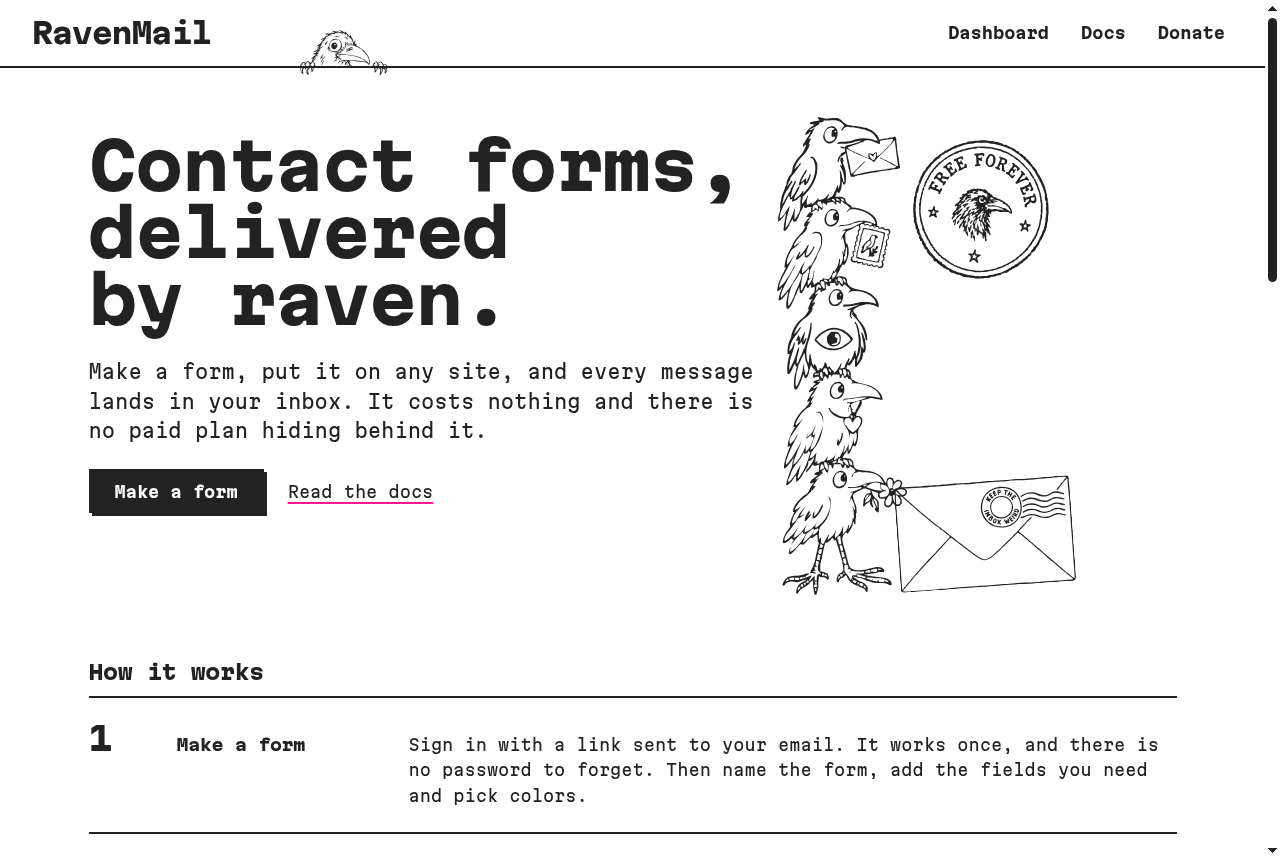
Each form works three ways at once: as a link you can put in a bio, as an embed with one script tag, or as the target of a plain HTML form with no JavaScript at all. You sign in with a link sent to your email, so there's no password to forget.
What you get, all of it free: up to 10 forms, custom fields, attachments, webhooks to JSON, Discord or Slack, your own colors for light and dark mode, and labels in English, Portuguese or Spanish. Spam gets stopped without sending your visitors to anyone else: a small proof of work solved in their browser, a hidden trap field and a few limits. There's no upgrade screen. It's funded by donations.
theraven.my, a town of letters #
theraven.my is a blog you write by email. Each resident has a house and a secret address. You send an email to that address, and it becomes a post. Attach photos, and they become the pictures. You can sign up, edit, delete and change your settings, all by email. The site is only for reading.
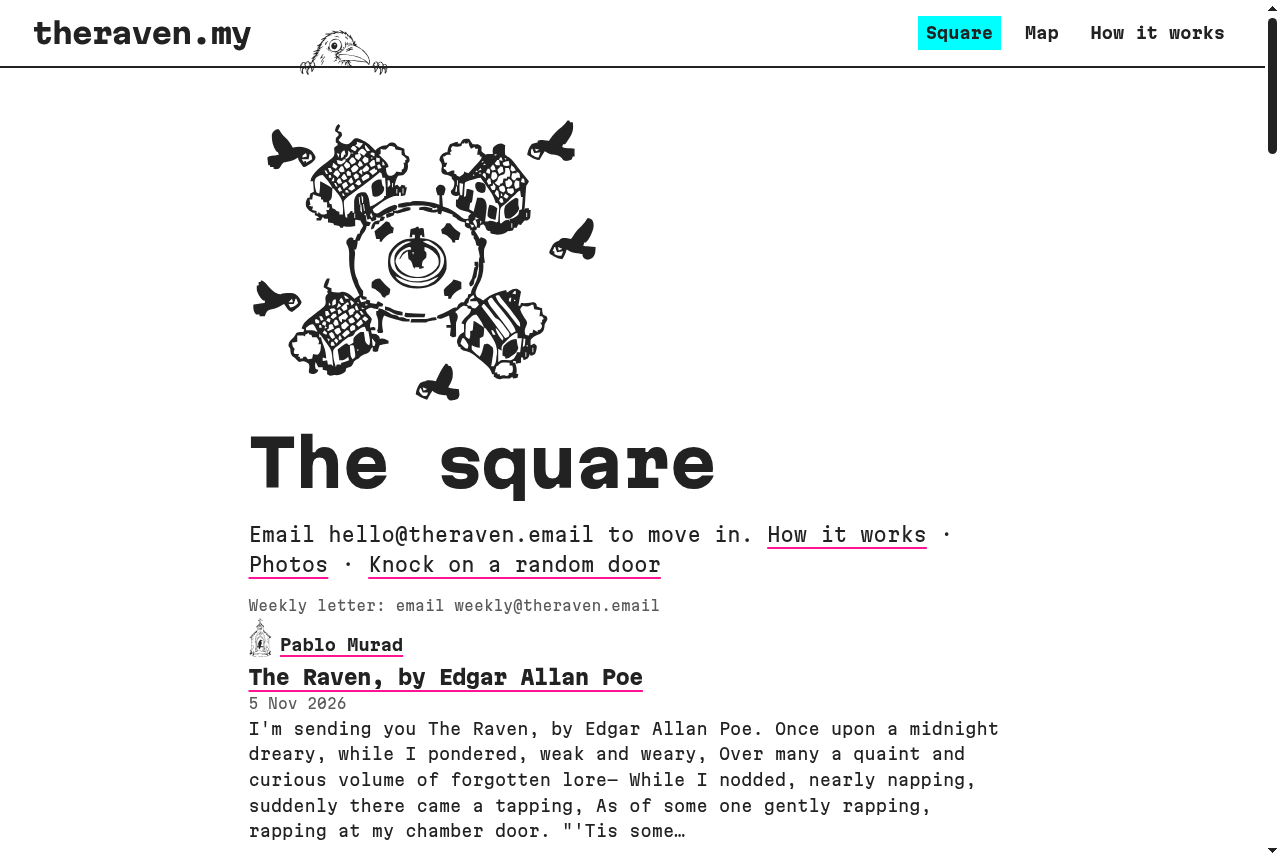
Everybody's posts meet in the town square, and there's a button to knock on a random door. It's a nice place to send a poem, a photo from your walk or a "we arrived" to your family. The last thing I posted there was Poe's The Raven. To move in, email hello@theraven.email.
theraven.social, good company delivered #
theraven.social is the newest raven. It's a small post office for people who write letters.
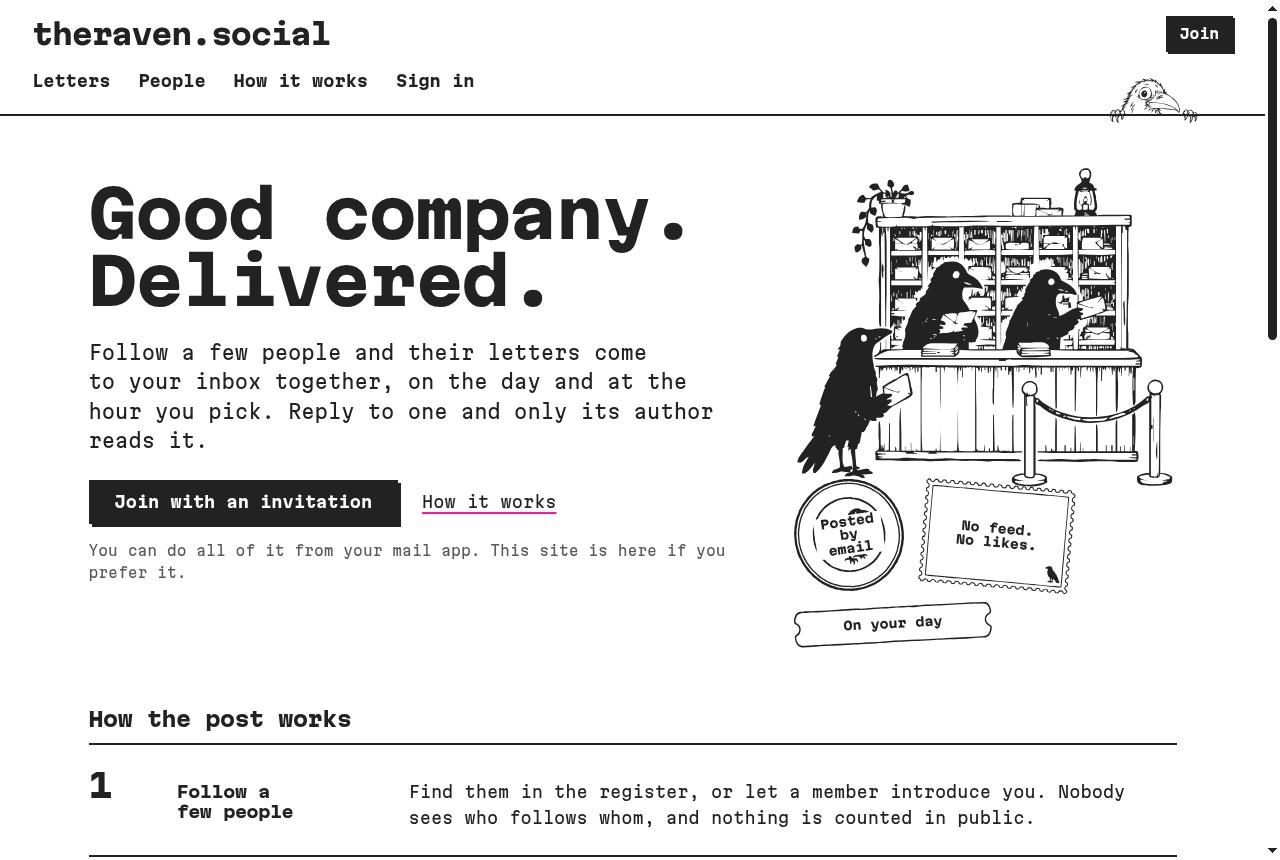
You follow a few people, and their new letters arrive together in a single email, daily, twice a week or weekly, at the hour you pick, in your time zone. Each delivery has an end. Every letter has its own reply address, so when you write back, only the author reads it, and your email address stays hidden. Nobody sees who follows whom.
Just as important is what it doesn't have: no endless feed, no likes or rankings, no public follower counts, no read receipts or tracking pixels, no ads, no recommendations tuned to keep you scrolling, no AI writing or summarizing letters, and no app to install. You can do all of it from your mail program. Independent servers can even federate with each other.
It's open by invitation, and the archive of public letters is still empty. The first one could be yours.
Why small #
None of these is trying to be big. Each one does one thing, keeps your words and pictures where you put them and lets you leave whenever you want.
Try one, or all eight. And if you make something with them, write to me. A raven will find me.