

Emmanuel Santiago, the poet of birds
I met Emmanuel Santiago in a cyber café in São Lourenço, in 2002. He became a poet, a literature teacher and one of my best friends. He died in April 2026. This is my memory of him, and a reading of the four books he left, from the peacock to the hummingbirds.
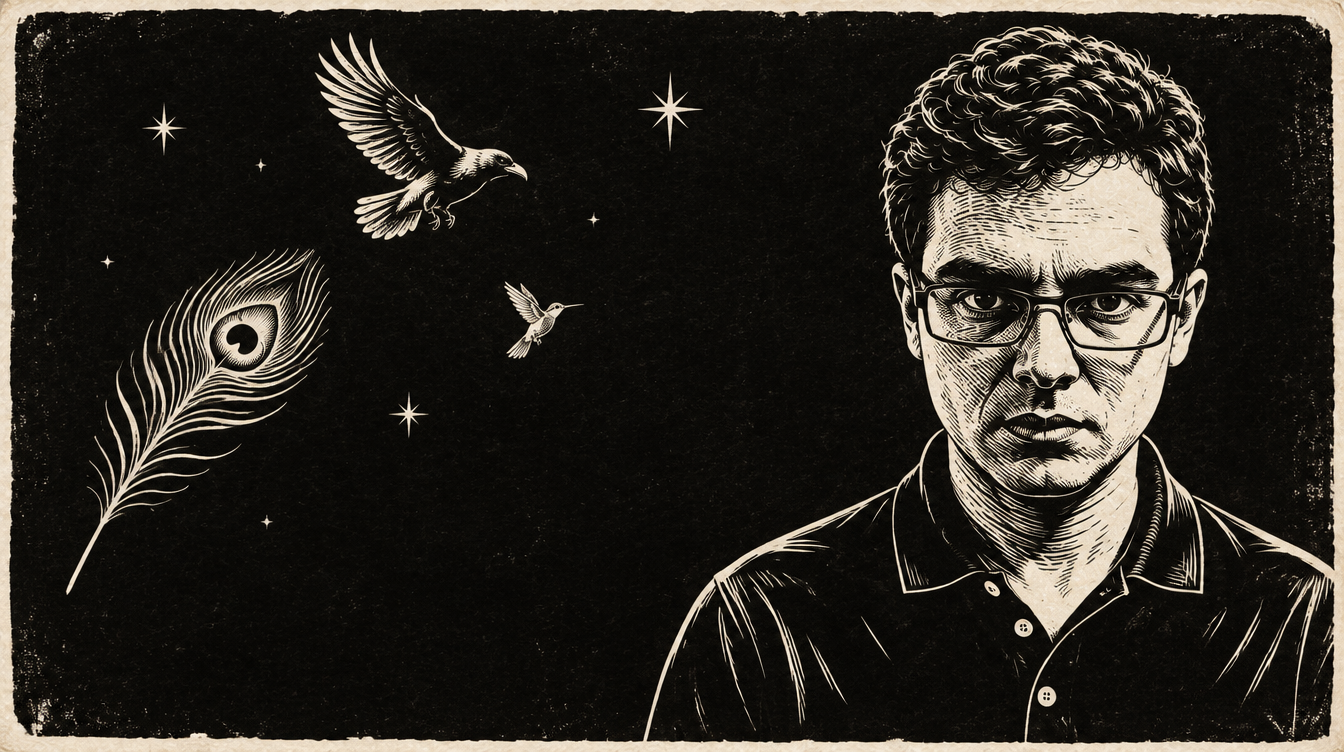
I met Emmanuel when I was still a teenager: an awkward kid, covered in pimples, with a curiosity that never seems to have let go of me. It must have been around four in the afternoon on some Tuesday in 2002. I remember the place well: the old Cyber Café in São Lourenço.
Back then, internet access was still a rare thing. Cyber cafés were everywhere, rooms full of computers where you paid to spend a little time online and, almost always, to drink bad coffee. Between the machines there were tables full of people playing Magic: The Gathering and RPGs, talking for hours about imaginary worlds.
That's where I saw him for the first time. There were three guys. One had long hair and looked like a rocker. Another had a strong presence. And there was a third one, thin, odd, a bit out of place, as if he didn't quite match the other two. That was Emmanuel. Of course, his was the strongest voice, the sharpest criticism and the widest knowledge.
I walked up to them, and the friendship came fast, the way some friendships do when you recognize something in the other person before you even know what to call it.
For the next three years, Emmanuel and I were almost inseparable. I was always amazed at how much he read, how much he knew, and the passion he put into talking about ideas, books, authors, symbols and whole worlds. Believe me: a good part of the hungry reading habit I still carry today was born from that friendship.
Years later, Emmanuel would become a writer and a literature teacher. But before that, he was my friend. And as a friend, he taught me things I still carry with a deep, boundless affection. He taught me theosophy, demonology, occultism, Brazilian literature, classical literature, Russian literature, the Gothic movement, movements from here and from there. And I remember very well how much I loved hearing him explain who the Marquis de Sade was. Man, I learned a lot.
But life doesn't stop. It goes on its way, indifferent to how much we want to stay close to the people we love.
Today I dedicate this text to a great friend who is gone. A friend I talked to the day before his last surgery. A friend who had made it clear, on Facebook, that he wasn't very confident he'd come back.

Who the poet was #
Emmanuel Santiago was born in São Lourenço, in the south of Minas Gerais, on April 13, 1984. He graduated in Letters from the Federal University of Ouro Preto in 2006 and did his master's and doctorate at the University of São Paulo. He taught literature to high school students at the Instituto Alpha Lumen, in the Paraíba Valley, published four books of poetry, and scattered poems and translations across magazines, including the Revista Brasileira, the journal of the Brazilian Academy of Letters. In 2018 he spoke from the Academy's own lectern about Olavo Bilac and the Parnassian city, in a lecture series coordinated by Antonio Carlos Secchin.
His colon cancer was found in early 2024. Students and friends ran campaigns to help pay for the treatment. He had been in intensive care since March 2026, and he died in Jacareí on April 23, ten days after turning 42. It was World Book Day, the date Shakespeare died too, a poet Emmanuel translated: he turned sonnets from English into twelve-syllable lines, published in the Revista Brasileira.
The critic came first #
Before the books of poems came the professional reader. His master's thesis, defended in 2010, is called A narração dificultosa (The difficult narration), and it studies "Cara-de-Bronze", one of the novellas in Guimarães Rosa's Corpo de baile, a text famous for handing its story to the reader in pieces. To read it, he turned to Hans Robert Jauss's reception aesthetics, the theory that puts the reader at the center of meaning. The work came out as a book in 2014, in the Produção Acadêmica Premiada series.
His doctorate, from 2016, is A musa de espartilho: o erotismo na poesia parnasiana brasileira (The corseted muse: eroticism in Brazilian Parnassian poetry). The central idea is beautiful and simple. A fixed form works like a corset, which squeezes the body and, by squeezing it, makes it erotic. With that key he reread Raimundo Correia, Alberto de Oliveira, Luiz Delfino and Francisca Júlia, whose famous "marble coldness" he read as a strategy, against the tradition that saw nothing there but coldness.
That thesis is also the best way into his poetry. Emmanuel wrote sonnets, villanelles, sestinas, ballades, tankas and haiku. He liked rhyme, including assonant rhyme, the kind that matches only the vowels. And in almost everything he published, the form squeezes, and it's inside that squeeze that desire, humor and anger show up.
Pavão bizarro (Patuá, 2014) #
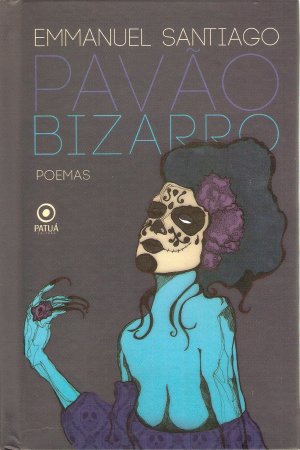
His debut, whose title means "bizarre peacock", gathers 39 poems written over ten years. The most visible shadow is João Cabral de Melo Neto, with his idea of the poem as a built object, measured, never spilling over. T. S. Eliot is around too. The title sums up the book well: the peacock is the bird that turns its own plumage into a show, and the adjective warns you the show is going to come out crooked.
Two moments show the project. "A fábula de Fabergé" (The fable of Fabergé) brings the czars' jeweled eggs into the book, objects that exist only to show off craft, and it's hard not to see in them a portrait of the poem as a piece of goldsmithing. And the duet that sets João Gilberto and João Cabral side by side joins two masters of economy, one of the almost whispered voice, the other of the dry line. For a first book, it's a clear statement of principles: rigor, concision and an open taste for artifice.
A ave Lúcifer (Patuá, 2020) #
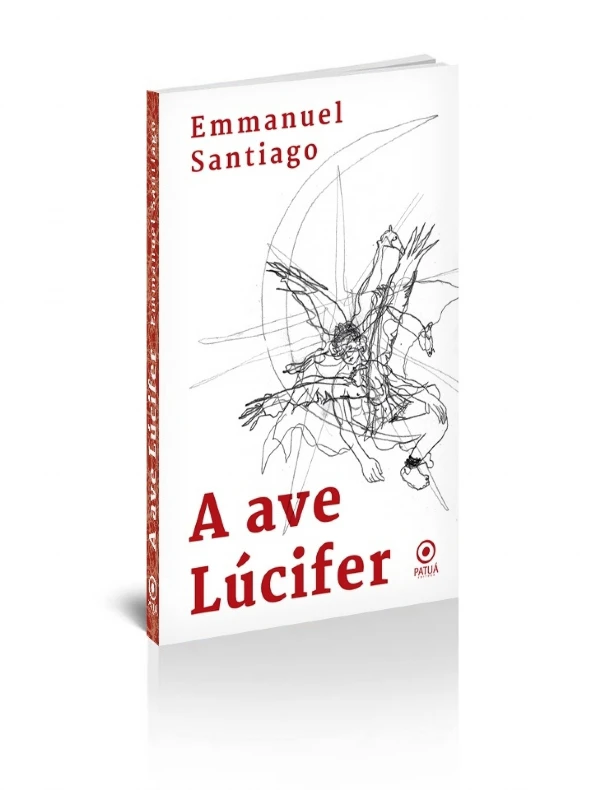
Six years later came his most ambitious book, A ave Lúcifer, "the Lucifer bird". Here Emmanuel leaves the short poem behind and sets out for long, narrative forms, with an eye on Eliot, on Poe and on Octavio Paz's thoughts about the long poem. The muse has something of Baudelaire, and the humor became at once more erotic and more bitter. The title is already a little lesson in the demonology he liked to explain: Lucifer means "light-bearer", and it was the Latin name of the morning star before it became the name of the fallen angel.
The fourth part is the most political, and the one that shows his method best. Instead of commenting on the news, Emmanuel dressed the news in an old form. The fire at the National Museum in Rio, in 2018, becomes "Queimemos de Alexandria", which ties the fire in Rio to the lost library of antiquity. Torture shows up in a sestina about Saint Anthony, with an epigraph by Alberto da Cunha Melo taken from the poem he wrote for Vladimir Herzog, the journalist killed under torture by the military dictatorship. The sestina is an obsessive form: the same six words come back at the end of the lines, stanza after stanza, and few forms could fit a torment that repeats itself better. "Havendo paz, eu me rebelo" (If there's peace, I rebel) is a fake sirventes, the satirical genre of the Provençal troubadours, written in the manner of Bertran de Born, the troubadour who sang of war.
In interviews he said poetry doesn't transform reality, but it can denounce barbarism, as long as it admits its own powerlessness. And he said he used allegory so his poems wouldn't stay stuck to the moment. The book's titles show the clash this produces: "Álbum de férias em Abu Ghraib" (Vacation album from Abu Ghraib), "Orfeu desce à Cracolândia" (Orpheus goes down to Cracolândia, São Paulo's crack district), "Legenda de Robert Johnson" (Legend of Robert Johnson). The prison in Iraq becomes a travel souvenir, the Greek myth goes down into downtown São Paulo, and the bluesman who supposedly sold his soul to the devil at a crossroads gets a legend, the word that in the Middle Ages named the lives of the saints.
The book closes with "A rola" (The turtledove), a parody of Edgar Allan Poe's "The Raven". The raven stayed perched on his head, and three years later it came back whole.
A renga do corvo (Bestiário, 2023) #
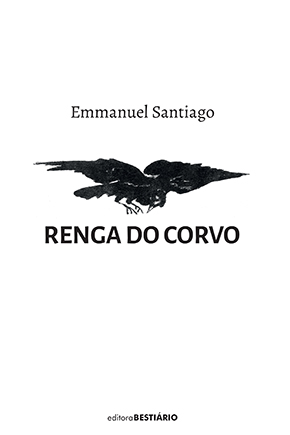
"The Raven" had already passed through the hands of Machado de Assis and Fernando Pessoa, among many other translators. Emmanuel did something else with it. In 94 pages, A renga do corvo (The raven's renga) turns Poe's poem into a renga, the chain of poems from the Japanese tradition, made here of tankas, five-line stanzas. And he put rhyme where the Japanese don't, in a scheme of his own, aba/bB.
He called the book a platypus himself, an animal that's neither a real renga nor a translation. The comparison is a good one. A traditional renga is written by several poets taking turns, and here a single poet talks with Poe stanza by stanza, as if he were the second player at the table. Poe liked to say, in "The Philosophy of Composition", that he built "The Raven" step by step, like someone solving a math problem. A poet who spent his doctorate studying what form does to a text could hardly find a better partner.
O livro dos colibris (Mondrongo, 2025) #
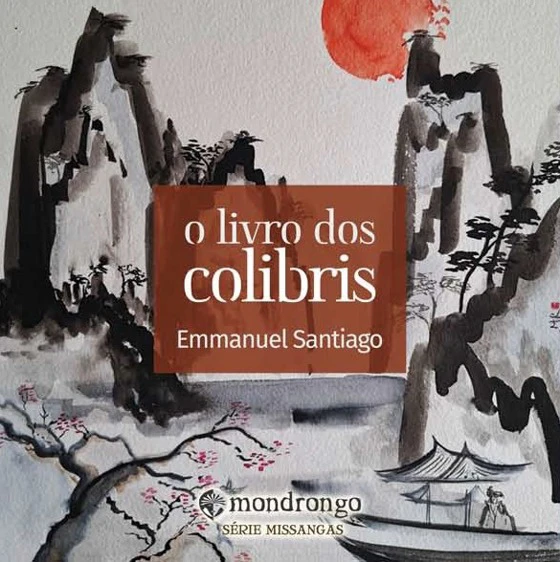
His last book, O livro dos colibris (The book of hummingbirds), came out in 2025, in Mondrongo's Série Missangas, while he was already ill. It's haiku. His interest in Japanese forms went way back, to senryū published in magazines and to the renga itself, but here he went all the way down that road. The poet who said he wanted to write a long lyric poem published, last of all, one of the shortest forms there is. And he chose the hummingbird for it, the smallest of birds, which beats its wings so fast it seems to hang still in the air.
An aviary #
Four books, four birds: the peacock, the Lucifer bird, the raven and the hummingbirds. Read in order, they trace a path from plumage on display to the smallest flight, from the Cabral-style poem to haiku. What doesn't change is the craft. Emmanuel treated fixed form as a place of freedom, and he did it with learning, humor and an anger that never turned into a pamphlet.
The poet João Filho, from Bahia, called him "one of the greatest contemporary poets". Besides the books, he left an essay in the collective volume O que restou de 22 (Sétimo Selo, 2022), the texts he published on Substack, the poems scattered across magazines, his Shakespeare translations, and a lot of students who learned literature from him.
Well, Emmanuel. I remember. I remember all of it. And today, especially today, I'm going to remember you.
Emmanuel was a writer. He was a poet. And, somehow, he left this world the way poets tend to: with an absence full of words.
Goodbye, Emmanuel.
I first wrote this in Portuguese, on noctem.art.