

Usenet, from 1979 to today
Usenet has been copying discussions from server to server since 1979. How it started at Duke and UNC, the Big 8 and alt.*, how an article travels, a real NNTP session, how yEnc, PAR2 and NZB turned it into a file network, and where to read it in 2026.
Usenet is a worldwide set of discussion groups that no company owns. You write a message, called an article, and post it to a group like comp.misc. Your server keeps a copy and passes it to the servers it trades with, they pass it on to theirs, and within minutes the same article sits on servers all over the world. Anyone reading that group, on any of those servers, sees it.
It started in 1979, more than ten years before the web, and it's still running. While writing this post I connected to a free public server and asked for the newest article in comp.misc. It had been posted that same morning, from a newsreader running inside Emacs.
This post covers how Usenet began, how the groups are organized, how an article travels, the protocol your newsreader speaks, and how a network built for short text messages ended up carrying hundreds of terabytes of files a day. At the end, a look at the small news server I run.
Two universities and a phone line #
In 1979, Tom Truscott and Jim Ellis, graduate students in computer science at Duke University, had an idea for sharing news and discussion between Unix machines. Steve Bellovin, a graduate student at the University of North Carolina, wrote the first program. The first network was just the computer science departments at Duke and UNC, with Duke's physiology department joining in 1980. The machines called each other over phone lines with UUCP, the Unix-to-Unix copy program, and the modems of the time moved about 300 bits per second.
Ellis and Truscott presented the design at the Usenix conference in Boulder, Colorado, in January 1980. From there, the software went through several generations:
- 1980, A News: a rewrite by Truscott and Steve Daniel, another Duke student.
- 1982, B News: Matt Glickman and Mark Horton made it faster. Rick Adams took over maintenance in 1984.
- 1986, NNTP: a protocol for moving news over TCP/IP networks instead of phone calls. More on it below.
- 1989, C News: Henry Spencer and Geoff Collyer, at the University of Toronto, rewrote it again for speed.
- 1991, INN: Rich Salz released InterNetNews, built around NNTP from the start.
INN is the one that lasted. It's still maintained, version 2.7.4 came out in June 2026, and every server I connected to for this post was running it, mine included.
Groups, hierarchies and the Great Renaming #
A newsgroup name reads from general to specific, separated by dots: comp.lang.c is about computers, then languages, then C. The first part is the hierarchy, and each hierarchy has its own rules for creating groups.
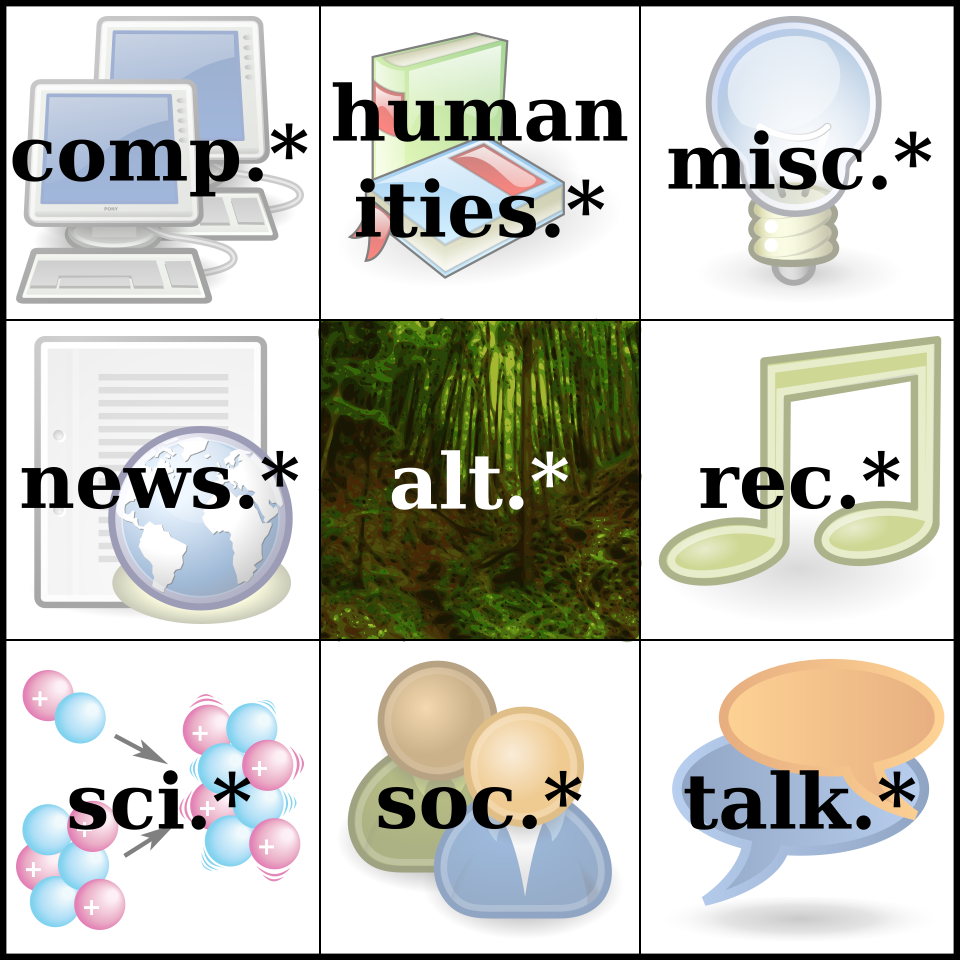
Before 1987, most groups lived under net.*, with moderated ones under mod.*. That year, the Great Renaming sorted the main groups into seven hierarchies, the Big Seven:
comp: computers
misc: everything that fits nowhere else
news: Usenet itself
rec: recreation, hobbies and the arts
sci: science
soc: society and culture
talk: debate on contested topics
Creating a group in those hierarchies took a proposal, a discussion and a vote. Not everyone liked that. Soon after the renaming, John Gilmore and Brian Reid created alt.*, a hierarchy outside that process where anyone could create a group. The old joke is that alt stands for "Anarchists, Lunatics and Terrorists". In 1995 humanities.* joined the seven, and the official set became the Big 8.
There are also national and regional hierarchies, like de.* for German and pl.* for Polish groups, and private ones that companies and universities keep to themselves.
Some groups are moderated. Your post goes by email to a moderator, who approves it or not, and only approved posts spread. In unmoderated groups, which are most of them, a post goes out as soon as you send it.
How an article travels #
Usenet has two kinds of connections, and it helps to keep them apart. You, the reader, talk only to your own news server. Servers talk to each other, each one trading articles with a few neighbors, called peers.
When a server receives a new article, it stores one copy and offers it to all its peers. They do the same with theirs. That's called flooding, and it's why an article reaches the whole network in minutes without any central server.
Flooding in a network full of loops needs two safety catches. The first is the Message-ID, a unique name for each article, like <82o6brrd46.fsf@example.com>. Every server remembers the IDs it has seen and refuses copies of articles it already has. The second is the Path header: each server adds its name to the front of it before passing the article on, and a server never sends an article to a peer already listed there.
Here's the header of that comp.misc article as the server sent it. I only joined one line the server had folded in two and removed the author's email address:
Path: nnrp.usenet.blueworldhosting.com!!spool1.usenet.blueworldhosting.com!usenet.blueworldhosting.com!diablo1.usenet.blueworldhosting.com!weretis.net!feeder8.news.weretis.net!reader5.news.weretis.net!news.solani.org!.POSTED!not-for-mail
From: Richmond <address removed>
Newsgroups: comp.misc
Subject: Re: the Microsoft global outage
Date: Sat, 14 Nov 2026 09:11:53 +0000
Organization: Frantic
Message-ID: <82o6brrd46.fsf@example.com>
References: <6af7cacb$11$74195$882e4bbb@reader.netnews.com>
MIME-Version: 1.0
Content-Type: text/plain
Injection-Info: solani.org; logging-data="1635832"; mail-complaints-to="abuse@news.solani.org"
User-Agent: Gnus/5.13 (Gnus v5.13)
Cancel-Lock: sha1:Jfrmwh9WRrfAhk/GPoE/RyOAAEw= sha1:2erpllyTKwSdoe03AnYk97zru/Y=
Xref: nnrp.usenet.blueworldhosting.com comp.misc:41148
Read the Path from right to left and you have the article's trip. It was posted at news.solani.org (that's what .POSTED marks), went through three servers at weretis.net, and then through four machines at Blue World Hosting before it reached the one I was talking to.
The rest is close to an email, and that's on purpose: the article format is a cousin of the email format. The current rules are in RFC 5536, from 2009, which replaced the older RFC 1036. Every article must have exactly one each of From, Date, Message-ID, Newsgroups, Path and Subject. A few of the others are worth knowing:
References: the Message-IDs of the articles this one replies to, which is how readers build threads
Newsgroups: can list more than one group (a crosspost), and the article is still stored only once
Injection-Info: where the article entered the network, and where to send abuse complaints
Cancel-Lock: lets the author, and only the author, cancel or replace the article later
Xref: this article's number in each group, on this server only
User-Agent: the newsreader that wrote it, here Gnus, which comes with Emacs
About canceling: Usenet always had a control message to ask every server to delete an article. Anyone could forge one, so for years people canceled other people's posts, and many servers stopped obeying cancels at all. Cancel-Lock is the later fix, a secret only the original poster can prove they know.
NNTP: the protocol #
The first Usenet copied articles in batches between machines over UUCP, and every machine kept a full copy of everything. In February 1986, Brian Kantor and Phil Lapsley published RFC 977, the Network News Transfer Protocol. Its idea was to keep the articles on one server per site and let everyone else read them over the network, instead of keeping duplicate copies on every host. The current version is RFC 3977, from 2006.
NNTP is a text protocol, like SMTP for email: you send a command as a line of text, and the server answers with a three-digit code and some text. The usual port is 119, and 563 for connections with TLS. Here's the real session behind the header above, in order (C is me, S is the server):
S: 200 nnrp.usenet.blueworldhosting.com InterNetNews NNRP server INN 2.8.0 (20260912 snapshot) ready (posting ok)
C: CAPABILITIES
S: 101 Capability list:
S: VERSION 2
S: IMPLEMENTATION INN 2.8.0 (20260912 snapshot)
S: AUTHINFO USER
S: COMPRESS DEFLATE
S: HDR
S: LIST ACTIVE ACTIVE.TIMES COUNTS DISTRIB.PATS DISTRIBUTIONS HEADERS MODERATORS MOTD NEWSGROUPS OVERVIEW.FMT SUBSCRIPTIONS
S: NEWNEWS
S: OVER
S: POST
S: READER
S: STARTTLS
S: XPAT
S: .
C: MODE READER
S: 200 nnrp.usenet.blueworldhosting.com InterNetNews NNRP server INN 2.8.0 (20260912 snapshot) ready (posting ok)
C: GROUP comp.misc
S: 211 40524 1 41148 comp.misc
C: HEAD 41148
S: 221 41148 <82o6brrd46.fsf@example.com> head
S: (the header shown above)
S: .
C: QUIT
S: 205 Bye!
GROUP comp.misc selects a group, and the 211 answer means: about 40,524 articles, numbered from 1 to 41148, in comp.misc. HEAD 41148 asks for the header of the newest one. A line with a single dot ends any answer that has more than one line.
The first digit of every answer tells you how it went:
1xx: information
2xx: done, it worked
3xx: so far so good, send the rest (for example, the text of a post)
4xx: the command was fine, but it failed
5xx: unknown command, not allowed, or a syntax error
And these are the commands you'd use most:
CAPABILITIES: what this server supports
GROUP name: select a group
ARTICLE, HEAD, BODY: get a whole article, only its header, or only its text
OVER: get a summary line of many articles at once (subject, author, date, size), which is how readers fill their list of threads
POST: send a new article
IHAVE <message-id>: one server offering an article to another
QUIT: say goodbye
IHAVE is the server-to-server side. Before sending a whole article, a server offers its Message-ID. The other one answers "send it" or "already have it". That one line keeps flooding cheap: an article the other side already has is never sent again.
You can try all of this by hand. Open a connection to a server that allows reading without an account, type the commands and press Enter after each one:
telnet news.blueworldhosting.com 119Newsreaders #
Nobody reads Usenet by typing HEAD all day. A newsreader does the talking, keeps track of what you've read, builds threads from the References headers and lets you hide people and subjects you don't want to see. Usenet's old word for a list of hidden authors is a killfile, and the noise of dropping someone into it is "plonk".
Many of the classic ones are still around:
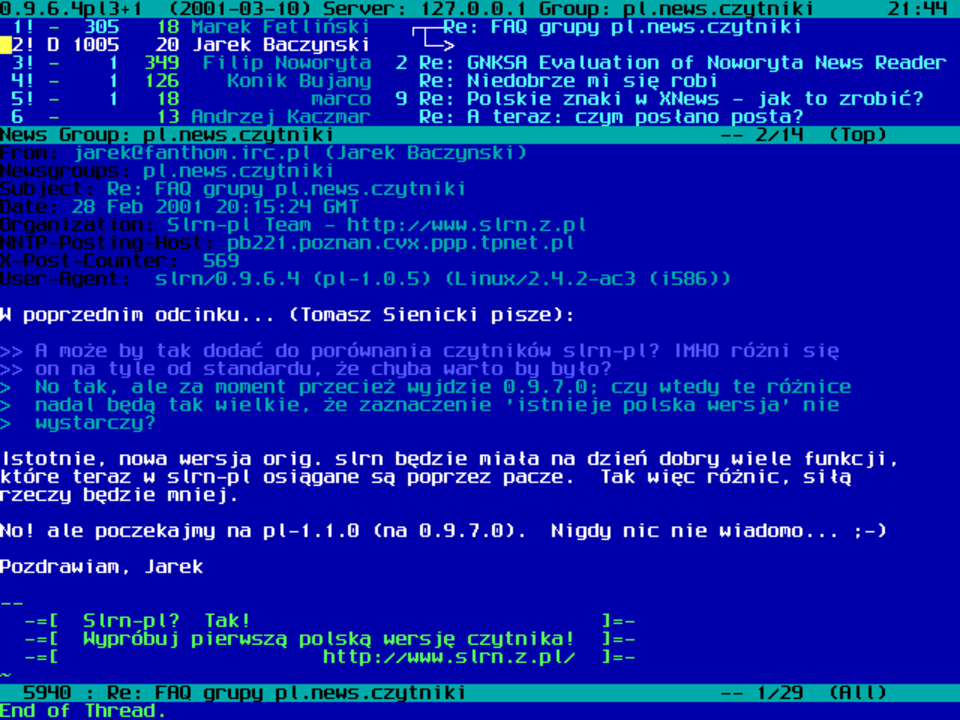
- tin and slrn run in the terminal. The picture above is slrn in 2001, in a Polish group about newsreaders.
- Gnus comes inside Emacs. The
comp.miscarticle above was written with it. - Thunderbird reads newsgroups next to email, and Pan is a graphical reader that also handles binaries.
If you use Emacs, two lines are enough to read real groups. Gmane, a service that mirrors thousands of mailing lists as newsgroups, has the Org mode list as gmane.emacs.orgmode:
(setq gnus-select-method '(nntp "news.gmane.io"))
;; then M-x gnus, and U to subscribe to gmane.emacs.orgmode
Files on a network made for text #
Usenet was built for short text. Articles were 7-bit text, and a binary file, like a picture or a program, had to be turned into printable characters before it could be posted. The usual tools for that, uuencode and later Base64, make a file 33 to 40 percent bigger.
People posted binaries anyway, in groups under alt.binaries.*, and I wrote about how that works today in How Usenet serves files. The short version is three inventions, all from the early 2000s.
In 2001, Jürgen Helbing released yEnc. Its bet was that by then nearly every server could carry 8-bit bytes untouched, so there was no need to squeeze files into printable characters. yEnc adds 42 to each byte and escapes only the few values that would break an article (NUL, line feeds, carriage returns and the = sign it uses as an escape). The overhead drops to 1 or 2 percent. A file too big for one article is split into parts, and each part is wrapped in lines like these:
=ybegin part=1 line=128 size=500000 name=mybinary.dat
=ypart begin=1 end=100000
(the encoded data for those bytes)
=yend size=100000 part=1 pcrc32=abcdef12
size is the whole file, begin and end say which bytes this part holds, and pcrc32 is a checksum of the part, so the downloader can tell whether it arrived intact.
In 2002, Michael Nahas published version 2.0 of Parchive, better known as PAR2. A big file turns into thousands of articles, and some never reach your server or expire before you get to them. PAR2 recovery files carry extra blocks computed from the original, and they can rebuild the missing ones.
The last piece was the NZB, an XML format created by the developers of the Newzbin index. It lists the Message-ID of every article that makes up a file, so a program can ask the server for each one with ARTICLE <message-id>, decode the parts, repair what's missing with PAR2 and put the file back together.
The binary side grew enormous. NewsDemon, one of the providers, estimates that a large backbone takes in 400 to 600 terabytes of new articles a day in 2026. Eweka, another provider, advertises more than 6,662 days of retention, which is over 18 years of articles kept online. Most of that is binaries, and the binary groups are mostly read through paid accounts. The text groups are a tiny part of the traffic.
Famous posts and hard years #
A lot of internet history was first posted on Usenet. On August 6, 1991, Tim Berners-Lee announced the World Wide Web in alt.hypertext. On August 25, 1991, Linus Torvalds asked comp.os.minix what people would like to see in Minix, while telling them about the free operating system he was writing, which became Linux.
Then the crowds came. Every September, a new class of university students got accounts and had to learn the local manners. In 1993 and 1994, internet providers and online services started giving Usenet to many new users, AOL among them from March 1994, and the newcomers never stopped arriving. Old users called it the September that never ended, or Eternal September.
On April 12, 1994, two lawyers, Laurence Canter and Martha Siegel, posted an ad for their green card lottery service to at least 5,500 newsgroups, one separate copy per group. It's considered the first big commercial spam on Usenet, and spam never left.
From 2008, internet providers started to drop Usenet. After an agreement with New York's attorney general, several American providers stopped offering it or cut whole hierarchies, and AT&T ended its Usenet service in July 2009. In May 2010, Duke, where it had all started, shut down its own news server, citing low use and rising costs. On February 22, 2024, Google Groups stopped carrying Usenet: no new posts, no new articles, and Google's server stopped peering with the rest of the network. The old archive is still there to search.
Usenet in 2026 #
The text side is small, but it's alive, and still free. A few places to start:
- Eternal September gives free accounts on a server for the text groups.
- Blue World Hosting let me read
comp.miscwithout any account, as in the session above. -
Gmane serves thousands of mailing lists over NNTP at
news.gmane.io.
Point any newsreader at one of them, subscribe to a handful of groups, and read the way people read in 1990: threads in plain text, no feed choosing what you see, and the same articles copied across servers run by many different people.
A news server of my own #
skull.black is a small private news server I put together to learn how NNTP works under the hood. I told how it started in A piece of me in every corner of the internet. It runs INN 2.7.4, the current release, and this is what a newsreader meets when it connects to news.skull.black, before logging in:
S: 200 news.skull.black InterNetNews NNRP server INN 2.7.4 ready (no posting)
C: CAPABILITIES
S: 101 Capability list:
S: VERSION 2
S: IMPLEMENTATION INN 2.7.4
S: AUTHINFO USER
S: COMPRESS DEFLATE
S: HDR
S: LIST ACTIVE ACTIVE.TIMES COUNTS DISTRIB.PATS DISTRIBUTIONS HEADERS MODERATORS MOTD NEWSGROUPS OVERVIEW.FMT SUBSCRIPTIONS
S: NEWNEWS
S: OVER
S: POST
S: READER
S: XPAT
S: .
C: GROUP skull.general
S: 480 Authentication required for command
C: QUIT
S: 205 Bye!
The whole conversation runs over TLS on port 563, from the first byte, so passwords never cross the network in the clear. Until you log in, with AUTHINFO USER and AUTHINFO PASS, the greeting says no posting and any command that touches the groups gets a 480. The same account works in a newsreader and in the browser at skull.black, which shows the same groups as threads on a web page.
The server has its own hierarchy, skull.*, with seven groups:
skull.meta: rules, announcements and welcome
skull.general: general chatter
skull.tech: technology and craft
skull.art: art and writing
skull.dev: commits and dev
skull.news: news from RSS feeds
skull.binaries: binaries, stored on S3 with unlimited retention
skull.dev and skull.news are seeded, one with commits and the other with items from RSS feeds. skull.binaries keeps its files on S3 storage, with no expiry.
skull.black doesn't trade articles with other servers. Its only feed is itself, so the skull.* groups live there and nowhere else, the same idea as the private hierarchies that companies and universities kept on the same software as the public network. If you want to try it, sign up on the site, then point Thunderbird, Pan, Gnus or any newsreader that speaks TLS at news.skull.black, port 563.