

Neat Finds #08: Ink Clocks, Webrings and Plan 9 Corners
Issue eight: a clock that tells time with book quotes, a newspaper for old Kindles, an e-paper tty, a webring for the Portuguese-speaking web, a space station made of DNS records, Wikipedia over Gemini, a Mac-style desktop for 9front, Acme in Go and Linux for 486s.
Issue eight wanders through three neighborhoods. The first is paper, or the closest a screen gets to it: e-ink clocks, newspapers and terminals that only redraw when they have to. The second is the small web, with webrings, a search engine for personal pages and browsers for the quieter protocols. The third is Plan 9, which keeps finding new ways to run on other people's computers. A Linux for 486s and a sequencer made of letters close it out. As usual, no AI projects.
Same deal as always: I haven't tested everything here, and the last lines of each entry are what I'd be tempted to build, not promises.
01. LitClock #
github.com/kapoorankush/litclock
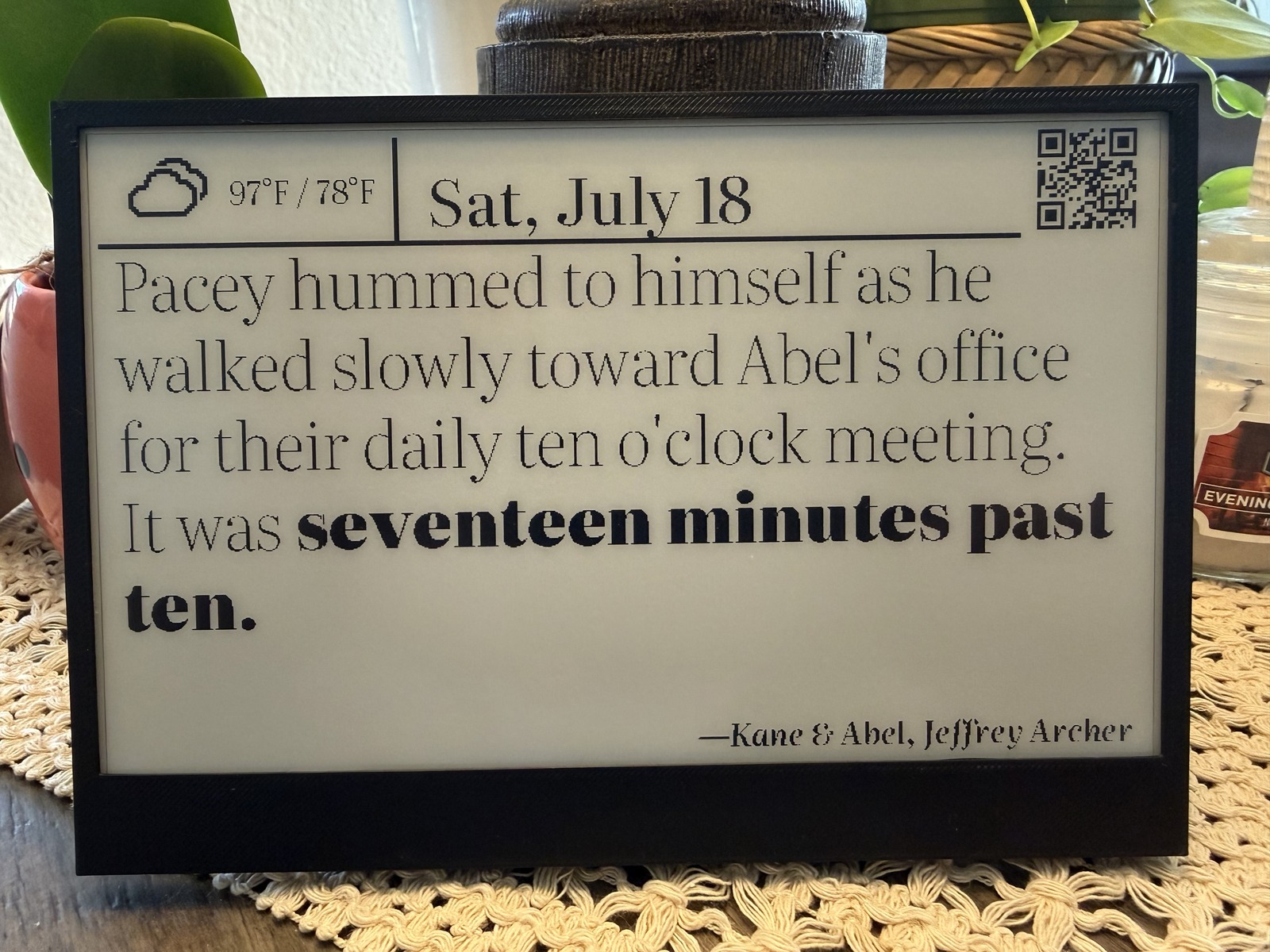
A clock that tells the time with literature. It holds more than 4,800 passages from books, one for every minute of the day, and at 10:17 it shows a line where some character notices it's seventeen minutes past ten, with the time in bold. It runs on a Raspberry Pi Zero 2 W and a 7.5-inch Waveshare e-paper panel, and it also shows the date and the weather. The author is strict about the parts: that exact board and that exact panel are the only ones tested, and a 32-bit Pi won't even boot the image. Setup happens from a phone in a couple of minutes, and after that the clock updates itself and rolls back on its own if an update leaves the screen blank. A clock like this would look right next to the books.
02. Stop Press #
A newspaper for your old e-reader. Stop Press turns a jailbroken Kindle into a broadsheet that updates itself, with a front page and lead photo, world news, markets with 30-day sparklines, a weather and diary page and full articles, and each night it files a proper Kindle periodical into the library. Without the jailbreak, it still runs in the browser of most e-readers, old phones and tablets. It came out of a small computer-donation project, and the reason in the README is a good one: these screens still work fine, they just stopped getting updates. There's a public demo you can open on any device. Any Kindle sitting in a drawer could use a job like this.
03. papertty #
Firmware that turns a 5.79-inch e-paper panel on an ESP32-S3 board into a physical tty. It listens on USB serial and draws whatever text arrives, picking the largest font that fits and waiting a second for the rest of the input, so half a line never flashes on the glass. Using it is echo 'Hello' > /dev/ttyUSB0, and the README's examples pipe in ls, cowsay and the weather from wttr. A little status board for the servers, refreshed once an hour, would fit on a shelf.
04. Anel da Web Lusófona #
github.com/offeringofpie/anel-da-web-lusofona
A webring of personal sites from the Portuguese-speaking world, with the instructions in Portuguese from Portugal and in English. Joining is the classic way: you put the ring's banner on your site, add yourself to a JSON file with a name, a URL and, optionally, a feed, a description, languages and an 88x31 button, and open a pull request. Sites can be in any language, which means this blog qualifies even though it's in English. It's nice to see the Lusophone web get a ring of its own.
05. Meta Ring #
A webring for personal websites that have a colophon or a meta page, the page where a site explains how it's built, what it runs on and why. The idea came from a post by the author and from Seirdy's meta page. The ring's site is built with Lume and Deno, and joining is a pull request to one JSON file, without running anything locally. This blog would need a proper colophon first, which might be a good excuse to write one.
06. TIMDA #
github.com/timda-space/timda.space
"A webring as objet d'art": a space station where every member site is a Section docked to a hub. The fun is in the specs. Each Section publishes DNS TXT records under _timda, which the docs call a "finger" for sites, signs its statements with its SSH key so anyone can check them against the key in DNS, and can open an inbox for signed messages between Sections, optionally sealed with age. There's in-world lore too, and the one rule is that everything is opt-in, from docking to playing along. It mixes finger, SSH signatures and age, three things this blog has written about recently, so it's hard not to like.
07. Wiby #
The source of Wiby, a search engine that tries to rebuild the web as it was in its earlier days. It indexes personal sites made by hobbyists, academics and enthusiasts, the pages that usually get buried under commercial results, and those pages happen to be light enough for vintage computers to browse. Wiby is free software under the GPLv2, and the repository is just the files and a pointer to the installation guide. Running a small Wiby for the tildes and pubnixes would be a fun experiment.
08. Aspis #
github.com/htejera/aspis-spartan
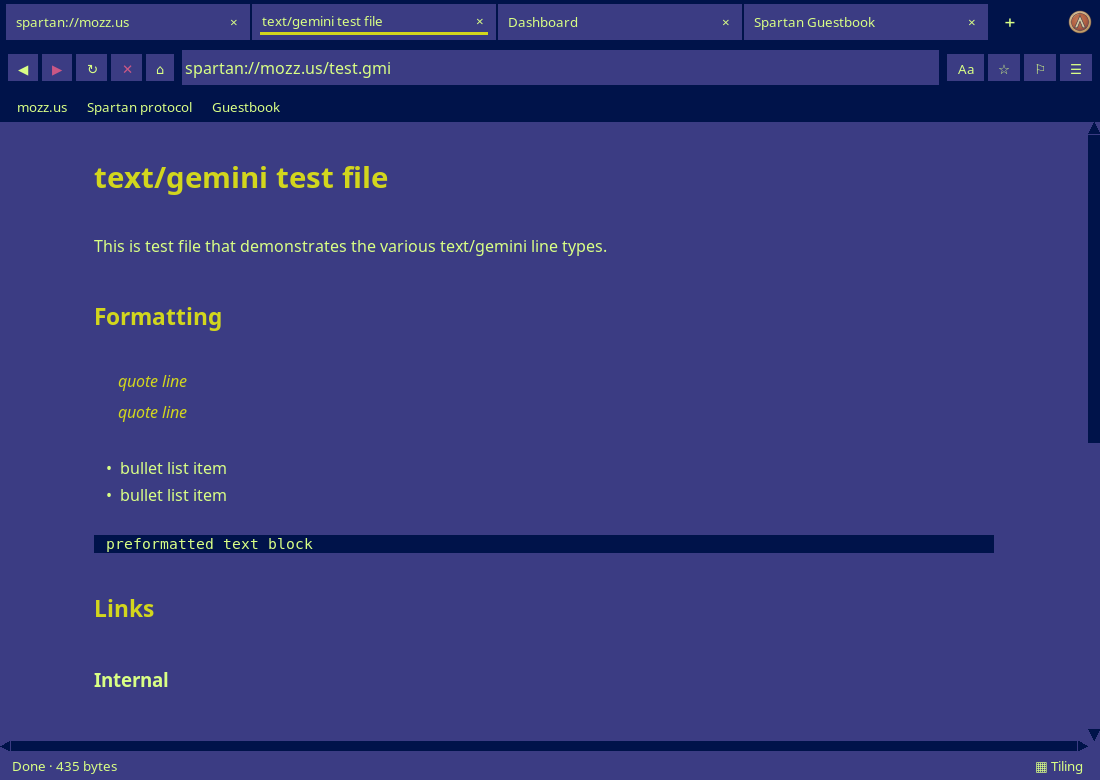
A small desktop browser for the Spartan protocol, written in Tcl/Tk and needing nothing else: one script, started with wish aspis.tcl. Spartan is a cousin of Gemini without TLS, and Aspis reads its gemtext pages, plain text and PNG and GIF images, with tabs you can tile side by side, a reading mode, bookmarks with folders and notes, and 17 themes. It's the kind of program that would run happily on an old laptop.
09. Gemipedia #
Wikipedia over Gemini, built for reading. It reaches every language edition, shows search results with excerpts, groups an article's links by section, pulls the images into a separate gallery, links coordinates to OpenStreetMap and leaves out what doesn't belong in gemtext, like citations and external links. It even has the daily featured article and the most-read stories of the day before. The public instance lives at gemini://gemi.dev/cgi-bin/wp.cgi/. It's from the same author as Kennedy, from an earlier issue.
10. 9/UX #
A Macintosh-inspired graphical environment for 9front: a spatial desktop, a global menu bar, icons and consistent dialogs, in the spirit of the classic Mac and Apple's A/UX. It isn't an emulator. It's built the Plan 9 way, with a fork of rio and libdraw drawing the screen, every application's interface and commands exposed as files over 9P, and the plumber opening documents. Normal rio programs keep working. The design principle in the README sums it up: keep the Mac's direct manipulation, but make every object and action visible as a Plan 9 file. It's at version 0.1, and I'll be keeping an eye on it.
11. h9 #
Same author, opposite direction. h9 runs native 9front programs on macOS, Linux and Windows as if they were local commands. Nothing boots and there's no disk image: you type h9 ls, and 9front's own ls runs on a virtual CPU from the host's hypervisor, with a Plan 9 kernel inside the h9 process answering its system calls. That kernel is also the sandbox, so a program only sees the files and network you hand it, and Linux binaries run the same way, next to rc. It hasn't had a release yet, and the README warns that the sandbox hasn't been audited. After a morning installing Inferno, this looks very tempting.
12. Edwood #
A Go port of Rob Pike's Acme editor, the one where every piece of text is a command and the mouse does the rest. It started from an earlier transliteration of the C code from plan9port and has been drifting away from it since. On Unix it still borrows a few plan9port pieces by default, unless you build the experimental pure-Go version, and on Windows it never needs plan9port at all. The name honors Ed Wood, and ed, the editor.
13. SHORK 486 #
github.com/SharktasticA/SHORK-486
A Linux distribution for 486 and 586 PCs, maintained and modern, with BusyBox as init and userland. A build configurator trims it down, and the "mini" variant runs in 8 MiB of RAM and about 8 MiB of disk. The project patches the kernel to keep supporting those processors, so it won't be stuck on an old one, and it comes in versions for hard disks, CDs and floppies. The author's origin story is lovely: they wanted their early-'90s ThinkPads, with those keyboards, to work as SSH terminals and writing machines. That's a good fate for any old laptop.
14. Orca #
github.com/hundredrabbits/Orca
An esoteric programming language for building sequencers, from Hundred Rabbits. Every letter of the alphabet is an operation, you place them on a grid, and the grid sends MIDI, OSC or UDP to whatever makes the sound, like a synth, Ableton, VCV Rack or SuperCollider. It's a live-coding environment, not a synthesizer, and it runs as a desktop app, in the browser with WebMIDI or in a terminal, in C. Watching it run is half the fun.
Bonus tabs #
A few more I refuse to close:
img2css · Turns any image into pure CSS, rebuilt from box-shadows.
CToy · An interactive live-coding environment for C.
Brogue CE · The community edition of Brogue, the much-loved minimalist roguelike.
text-engine · A browser-based engine for text adventures, with a sample game.
eleventy-webring · A really simple webring generator built on 11ty, with no backend and no JavaScript.
That's issue eight. Most of it moves slowly on purpose, whether it's a clock that changes once a minute, a webring you join with a pull request or an editor from another operating system.
Found a strange repository, a forgotten tool or a small piece of software I should see? Send it my way. Reader suggestions are welcome for issue nine. And if you make something with any of these, I'd like to see it.
Happy wandering!
Pablo