


Primer, explained as much as it can be
Primer cost $7,000 and is still one of the hardest time travel films to follow. How the box works, the week day by day, the twist with the three Aarons, the main theories, the real science in the garage and why programmers will recognize half of it.
Primer is 77 minutes long, cost about $7,000 to make, and has a reputation as one of the most confusing time travel films ever made. It trusts you completely, and nobody in it stops to explain anything. You follow two engineers around, overhear their conversations, and by the last half hour you're trying to work out which copy of which character is on screen.
This post is an attempt to untangle it. The first part has no real spoilers. After that, everything is on the table: the box, the week, the twist, the theories and the bits of science and computing hiding in the dialogue. If you haven't seen the film, watch it first and come back. Turn on the subtitles, because some of the most important lines are mumbled.
A film made by an engineer, for almost nothing #
Primer was written, directed, produced, edited and scored by Shane Carruth, who also plays Aaron, one of the two leads. Before making films, Carruth had a degree in mathematics and worked as an engineer developing flight simulation software. He studied physics while writing the script.
The numbers are part of the legend:
- a budget of $7,000;
- a crew of five people;
- five weeks of shooting on the outskirts of Dallas, Texas, on Super 16mm film;
- a shooting ratio of 2:1, which means almost every take ended up in the film;
- two years of post-production, during which Carruth says he nearly gave up several times.
Most of the cast were his friends and family. He cast himself as Aaron because he had trouble finding actors who would stop "filling each line with so much drama." The time machine is a plain grey box, and its hum is a mix of a mechanical grinder and a car engine, with no digital effects.
In 2004 it won the Grand Jury Prize for drama at Sundance. It also won the Alfred P. Sloan Prize, which Sundance gives to films that deal with science and technology.
The setup #
Aaron and Abe are engineers who, with two friends, build electronic gadgets in Aaron's garage on their own time, hoping one of them will sell. While working on a device meant to reduce the weight of objects, they notice something strange about what they've built.
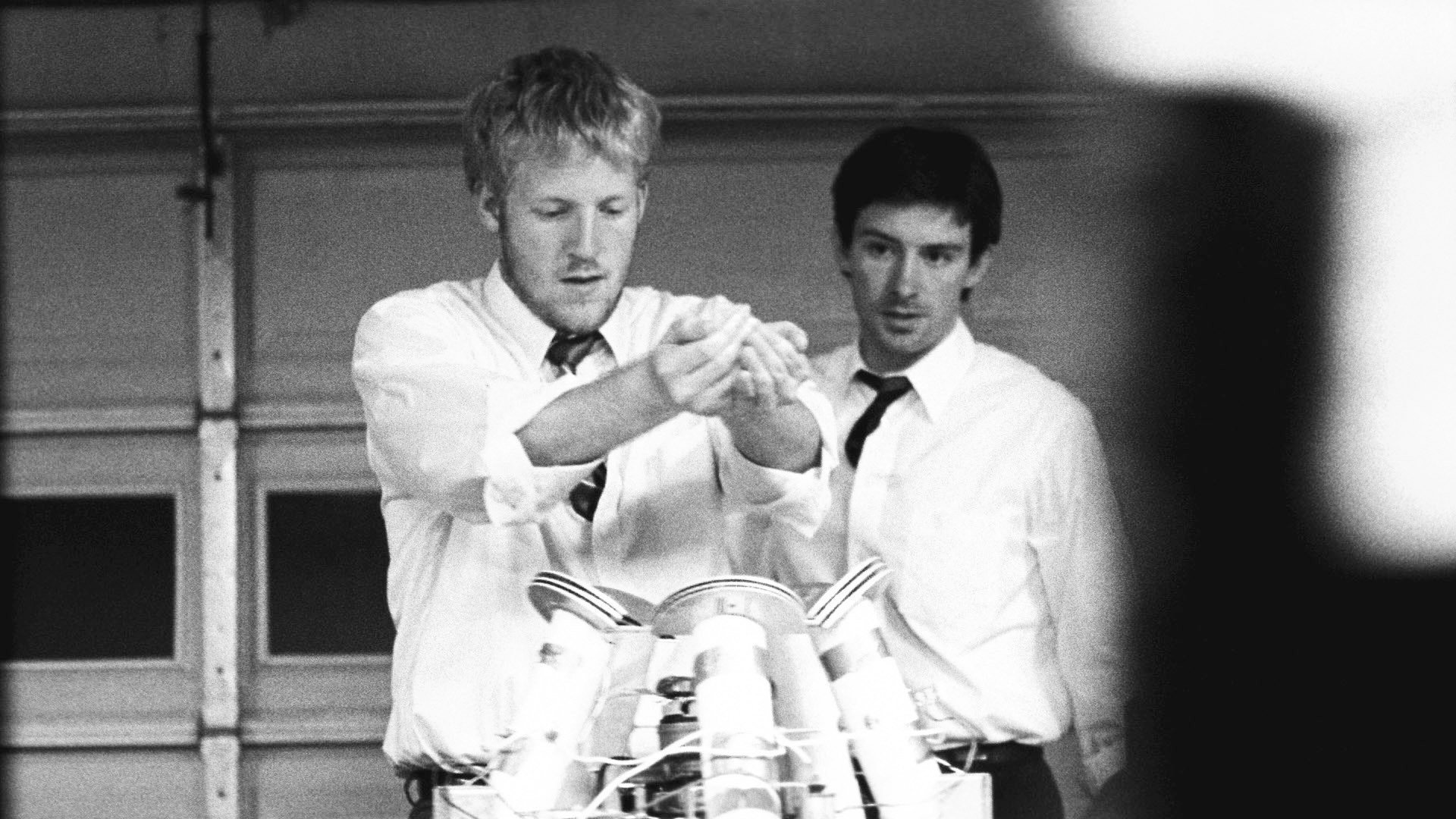
The dialogue in these scenes is dense on purpose. The characters talk the way engineers talk to colleagues who already know the project: half sentences, jargon, no explanations. Carruth has said he wanted the audience to feel as lost as the characters are. The real subject, in his words, is the relationship between the two men breaking down because neither of them can handle what the machine gives them.
From here on, spoilers.
How the box works #
The box was supposed to make things lighter. What it actually does is create a loop in time. When you switch it on, the inside of the box starts running forward like everything else. When you switch it off, the inside runs backward to the moment it was switched on, then forward again, back and forth, as long as anything is in there.
Abe figures this out the hard way. After repeated tests with a small toy, a fungus grows on it, and a lab tells him the fungus is ordinary but the amount of growth means years have passed, not days. He tries again with his wristwatch and confirms it.
The trick to traveling with it is simple and uncomfortable:
- In the morning, you set a box to switch on at, say, 8:45, then go hide somewhere so you don't run into anyone.
- In the afternoon, you come back and switch the box off.
- You climb inside and wait as many hours as went by, six in the film, while the box runs backward.
- You climb out at 8:45 in the morning. There are now two of you, and the other one is the version that is going to hide all day and climb into the box later.
If everything goes right, the other version climbs into the box in the afternoon and vanishes into the past, and you are the only one left. The rule they repeat is that each box can only be used once: you can't climb out of a box and then use the same box again, because your earlier self is already the one doing that.
The week #
The film covers about a week in March, starting on a Monday.
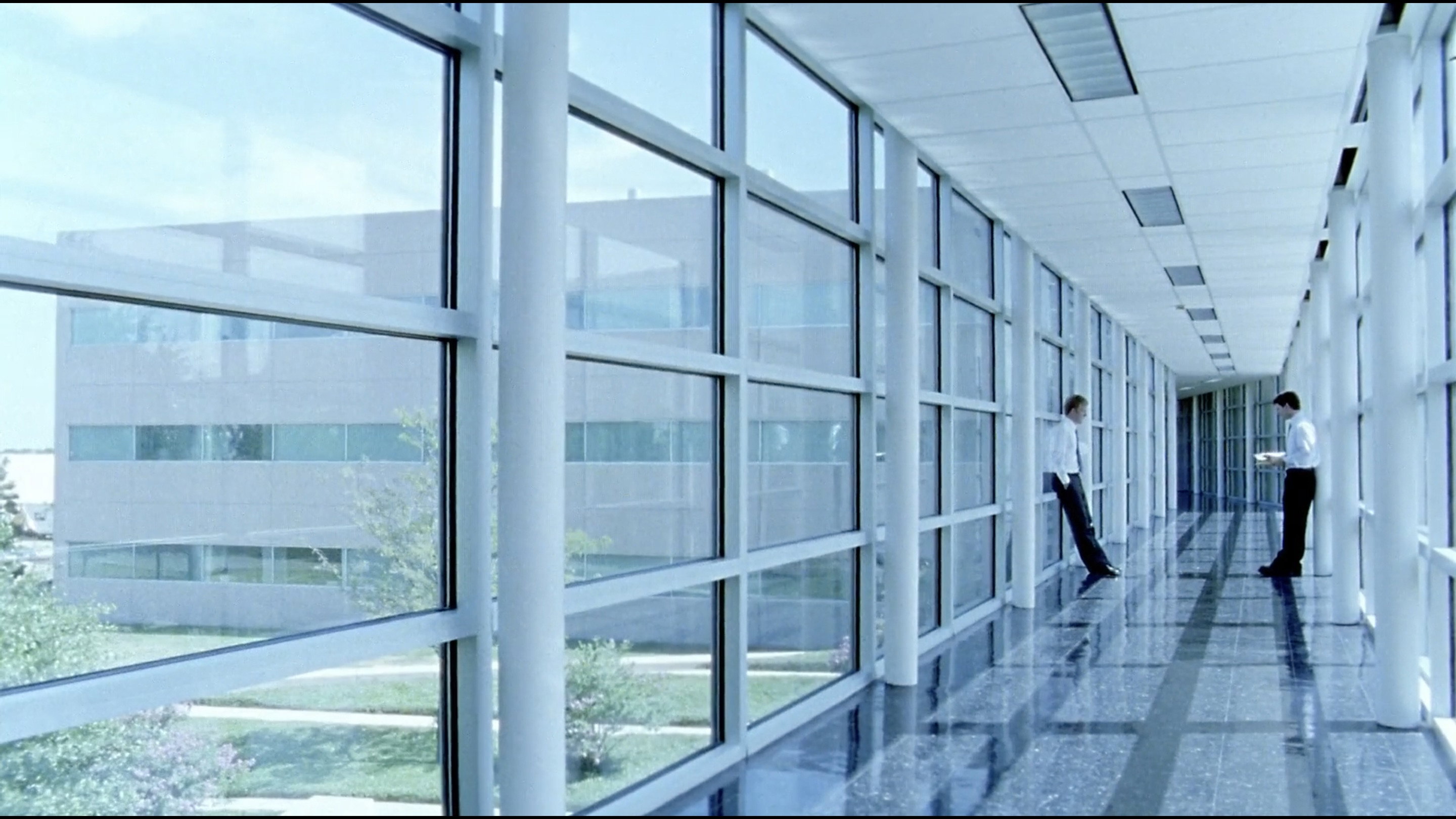
Abe tells Aaron he has already done the trip once. They build a second box and start repeating the same day over and over, hiding in a hotel room and using what they know to make same-day stock trades. They try hard to change as little as possible, because the worst outcome would be failing to send their doubles back and getting stuck with two of each of them.
Cracks show up fast. Aaron gets reckless and starts imagining what else they could do. He has an ear bleed. Their handwriting gets worse. On Thursday, Aaron's phone rings in his hand while his other self, in the hotel, has the same phone, and they realize that history isn't fixed: it can be changed.
On Friday night, things get stranger. They notice Thomas Granger, the father of Abe's girlfriend Rachel and the man funding the project, following them. He has a beard he didn't have the day before. When Abe calls Granger, the real one answers from home. This Granger came from the future, using one of the boxes, for reasons nobody ever explains. When Aaron gets close to him, Granger collapses into a coma.
That's when Abe loses his nerve and reveals his secret: a failsafe. Early on Monday, before he ever showed the machine to Aaron, he had switched on a third box and left it running in a storage unit. It has been on for almost four days. He climbs in with oxygen and water, rides it all the way back to Monday morning, drugs his past self so that self never discovers anything, and goes to meet Aaron to stop the whole thing before it starts.
The twist: Aaron was always ahead #
This is the part where almost everybody gets lost on a first watch.
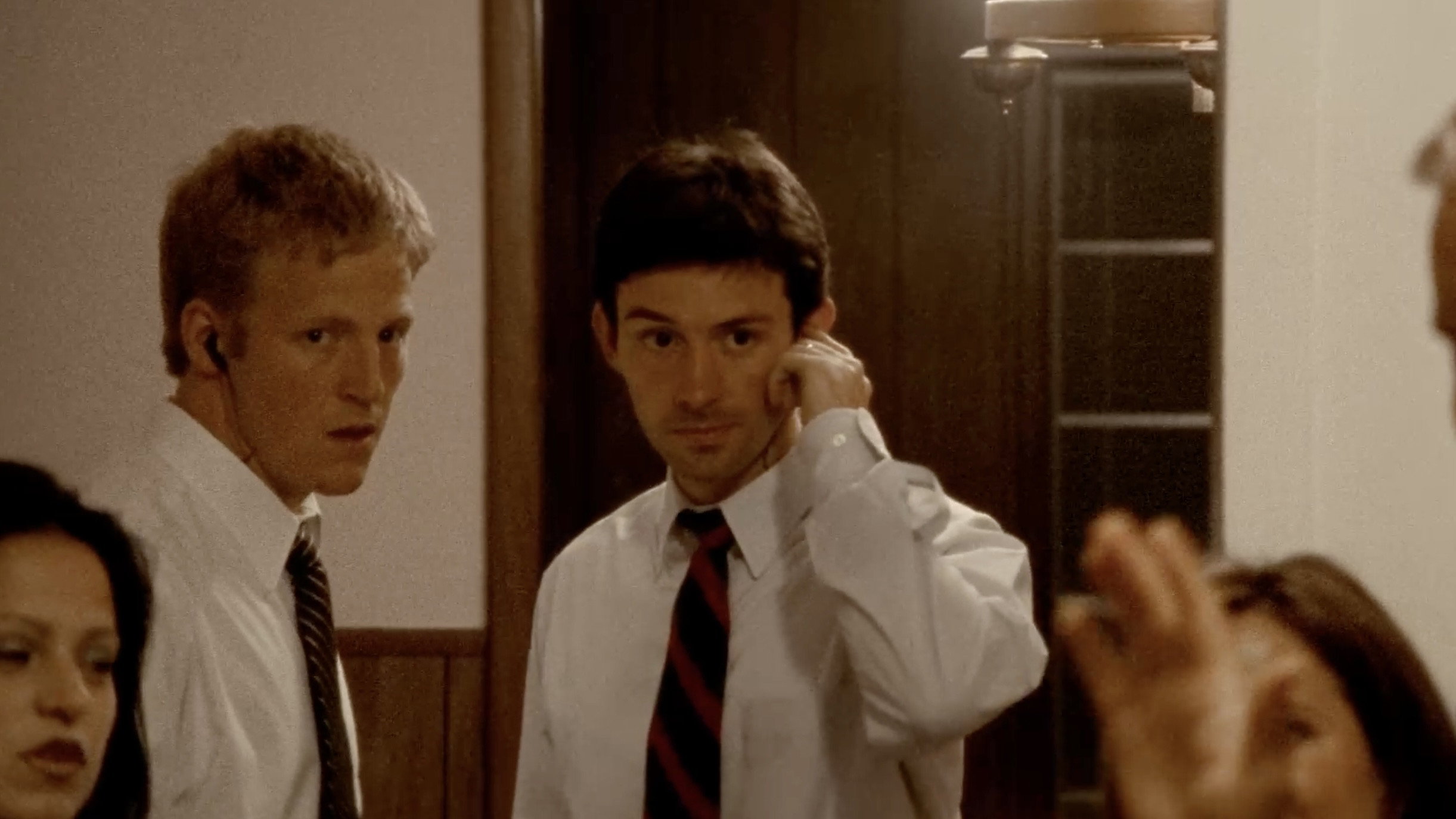
When Abe arrives at the bench on Monday, Aaron is already there, with an earpiece in his ear, saying the same lines as the first time. When Abe passes out, it turns out Aaron isn't listening to a basketball game. He's listening to a recording of their own conversation. This Aaron has done all of this before.
Aaron found Abe's failsafe much earlier and kept quiet about it. He built boxes of his own, went back in time, drugged his original self and locked him in the attic (the noise his wife Kara mentioned), and lived the week wearing an earpiece with recordings, so he could repeat every conversation. He also discovered that boxes can be "recycled": you can't reuse the box you came out of, but you can carry a folded box with you, switch it on at the other end and use it later to go back again.
The usual reading of what we see is that there are three Aarons by the end. The original, drugged in the attic. A second one, often called Hooded Aaron, who leaves town. And the one we've been following since the bench scene, who is already the third.
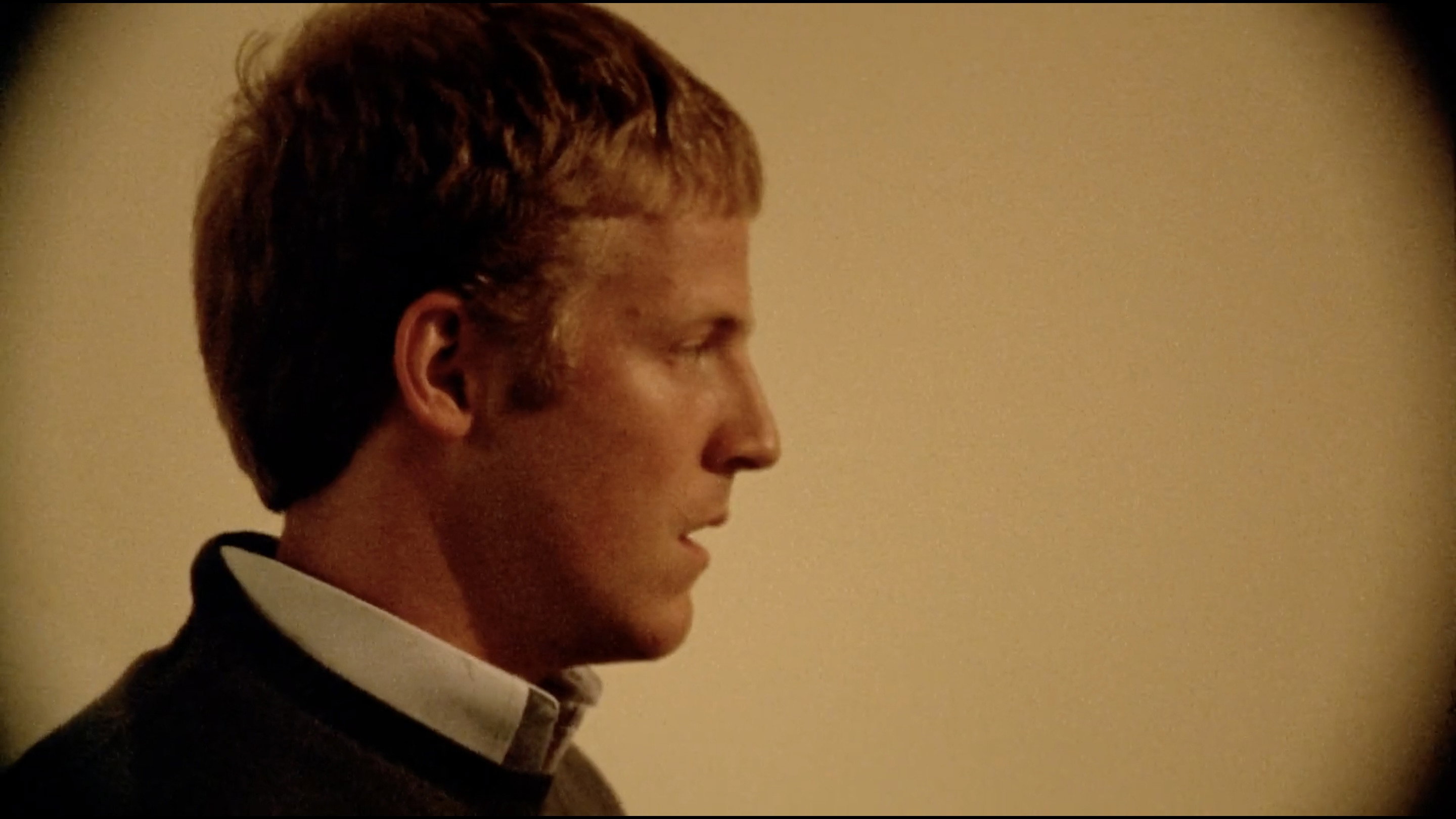
Why go to all this trouble? The answer seems to be Rachel. At a birthday party on Monday night, her ex-boyfriend shows up with a shotgun. The film implies that in an earlier timeline this went badly, and that Aaron has been reliving those days to fix it. Back on Monday, the two of them work together to make the party end well, with Aaron stopping the gunman and becoming a local hero.
The ending #
Abe and Aaron go their separate ways. Abe stays behind to watch over his original self and sabotage any attempt to build the machine again. Aaron, who can never go home because his family now belongs to the original Aaron, leaves the country. In the last scene, an Aaron is somewhere far away, directing French-speaking workers as they build a box the size of a warehouse.
The voice-over that runs through the film turns out to be a phone call: one of the Aarons telling the whole story to his original self. Near the end, he says: "You will not be contacted by me again."
The theories #
Primer doesn't answer every question, and fans have spent two decades filling the gaps. These are the most common readings:
- The narrator is Hooded Aaron. The voice-over is the phone call from the Aaron who left town, explaining everything to the original Aaron he drugged. It's the most accepted reading.
- The title is the call. A primer is a first coat of paint, or an introductory book. One popular theory says the "primer" is the phone call itself: the instructions one Aaron leaves for another to start the whole cycle again.
- Granger's trip is never explained. Something in the future was bad enough to make him go back and follow the two of them. Whether that disaster was avoided, the film doesn't say.
- History can change. Unlike films where the past is fixed and every trip was "always" part of history, Primer shows timelines being overwritten. The ringing phone is the proof.
- Time travel hurts. The ear bleeds, the bad handwriting and the near-fatal reaction between Aaron and Granger all suggest the body pays a price, especially for anyone who has spent many hours inside the boxes.
- The warehouse. The final box is huge, which suggests that someone, somewhere, is planning something much bigger than stock trades.
Carruth once pointed to where some of the ideas came from: "Richard Feynman has some interesting ideas about time."
The science in the garage #
The dialogue is full of real science, even if the machine is fiction.
The box needs superconductivity. A superconductor is a material that carries electricity with zero resistance, and it does something odd with magnetic fields: it pushes them out, which is why a magnet can float above a cooled superconductor. That's called the Meissner effect. The catch is temperature. Every known superconductor needs extreme cold, and a superconductor that works at room temperature, which is what the characters joke about building, remains one of the great unsolved problems in physics. In 2023, a material called LK-99 caused a frenzy online after a claim that it was exactly that, until labs around the world tried to replicate it and found it wasn't.
For their homemade version, they pull palladium out of a car's catalytic converter. Palladium is a real catalyst metal, and it's in catalytic converters for exactly that reason.
The box is sealed and filled with argon, a noble gas that barely reacts with anything. It's used in welding and in light bulbs for the same reason: to keep everything inside stable.
And the fungus is a beautiful detail: Abe uses biology as a clock. The amount of growth tells him how much time really passed inside the box, the same reasoning scientists use when they date things by measuring something that changes at a known rate.
The Feynman quote points to an idea from particle physics. In Feynman's diagrams, an antiparticle moving forward in time can be described as a particle moving backward in time. The box's back-and-forth loop between two moments has the same flavor.
What programmers will recognize #
Anyone who works with computers will find a lot of familiar ideas in the box.
- Snapshot and restore. Switching on a box is taking a snapshot of a moment. Climbing in is restoring it. The box doesn't let you jump anywhere you want, only back to a point you saved earlier.
- The failsafe is a backup. Abe's secret box, running since before the experiment, is the backup you take before a risky deploy, so you can roll back if everything goes wrong. Aaron simply had an older backup.
- The earpiece is a replay log. Aaron records every conversation and plays it back so he can repeat his lines. It's like replaying recorded traffic against a system to reproduce the exact same behavior.
- "Recyclable" boxes are nested snapshots. You can't restore from the same snapshot twice, but you can carry a new one with you, take it at the other end, and roll back again from there.
- Two Aarons is split brain. In a cluster, split brain is when two nodes both think they're the primary and start making decisions independently. That's exactly what happens to Aaron, and to Abe, and their lives never merge back.
- The phone call is a race condition. Two copies of the same phone, one event, and only one of them can ring. The moment the "wrong" one rings, the state diverged.
- The muffin. On the second pass through Thursday, Abe eats a muffin while Aaron watches a game they already know the result of. It's the most relatable moment of time travel in the film: once you've replayed the day, you start optimizing small things.
How to watch it #
A few things make Primer much easier:
- Watch with subtitles. Key lines are spoken quietly or in the background.
- Pay attention to Aaron's earpiece. Every time he's wearing it, ask yourself which Aaron he is.
- Watch the handwriting and the ear bleeds. They show who has spent the most time inside the boxes.
- Don't expect to get it all the first time. Nobody does. The film was built to be watched at least twice.
If it makes you feel better, even xkcd gave up. In its famous chart of movie narratives, the lines for Abe, Aaron and Granger go into a giant knot of scribbles and come out the other side as question marks.
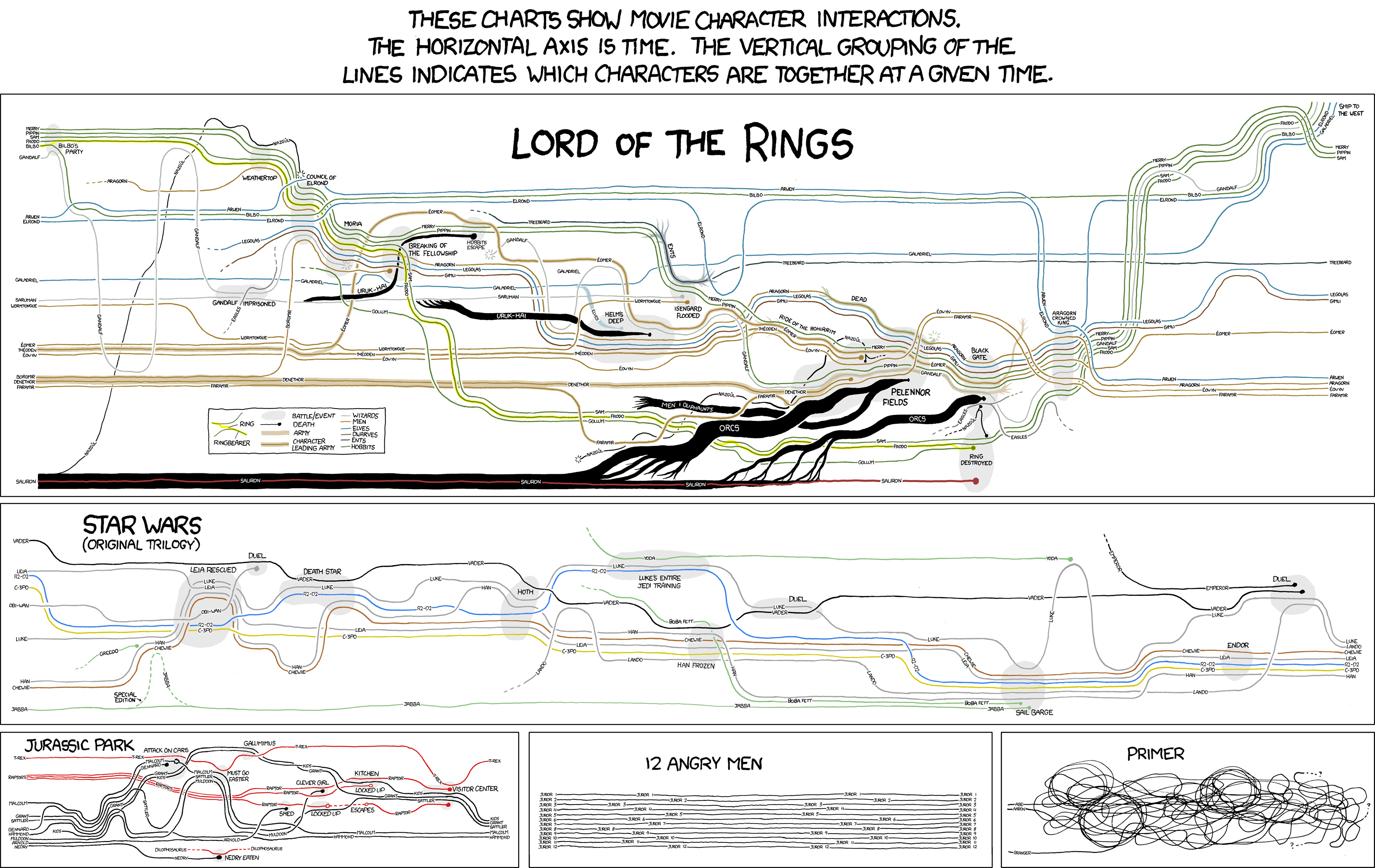
Movie Narrative Charts, xkcd, CC BY-NC 2.5.