
Software as Culture: Demoscene

There is a slightly annoying tendency to treat software as nothing more than a tool. One program edits a photo, another calculates a spreadsheet, another plays music, another controls a server. Within that logic, good software is useful software, fast, secure and, with any luck, does not ask you to create an account before showing you the main screen.
But computers have never been just tools. Ever since they started falling into the hands of curious people, someone has inevitably tried to find out what else could be done with them. Not because there was a client waiting, a business problem to solve or an investor asking for 30% growth next quarter. Sometimes the motivation was much simpler: "I want to see if this machine can do that."
That spirit gave birth to one of the most fascinating subcultures in the history of computing: the demoscene.
For someone who has never seen a demo, the first impression can be misleading. It looks like an electronic music video or a 3D animation accompanied by music. Except it is not a video. The file you are running is a program, and the computer is generating graphics, effects, movement, music and animation in real time. Assembly, one of the historic institutions of the Finnish scene, describes demos precisely as self-contained programs that generate audiovisual presentations while they run. (demoscene.assembly.org)
So far, fair enough. Any modern computer can render fairly impressive things. What makes the demoscene special is something else: much of this culture was built around limitations.
And when I say limitations, I do not mean "it has to run on a laptop with 8 GB of RAM."
I mean making an entire audiovisual presentation fit inside 64 KB.
Or 4 KB.
Or 1 KB.
There are people who look at a limit of 4096 bytes and conclude that there is enough room in there for a three-dimensional landscape with a soundtrack.
Those are exactly the kind of people who make me like computers.
Before demos, there were crackers
The origins of the demoscene are not in digital art schools or university computer graphics departments. They are tied to software piracy in the 1980s, more specifically to groups that removed copy protection from games and programs for home computers.
When a group cracked a game, it was common to add a small presentation before the original program. It would show the name of the group, messages, greetings to other crackers and, as the competition grew, logos, music, scrolling text and graphic effects.
These small presentations became known as crack intros, or simply cracktros.
The fun part is that groups began competing not only over who could crack a program first, but over who could put the most impressive intro in front of it. What started as a signature gradually developed a life of its own. The effects improved, music became more important, programmers began exploiting hardware-specific tricks and, at some point in the second half of the 1980s, that aesthetic competition began separating itself from cracking. Assembly's own history of the scene describes this evolution from crack intros into increasingly elaborate productions, while historical studies place the process precisely around the middle of that decade. (demoscene.assembly.org)
I find that origin especially amusing because it sounds like a story the Internet would invent afterwards.
First someone pirates a game.
Then they put their name on it.
Then they decide that just putting their name there is boring and add some music.
A rival group responds with a better graphic effect.
Another group adds animation.
Before anyone notices, the game has become the least interesting part of the whole thing.
Remove the game.
Keep the intro.
Now you have a new form of digital culture.
And some characteristics of those cracktros are still present today. The scrolltext, for example, that text moving horizontally across the screen, became almost a visual signature of the scene. There are entire studies tracing its evolution from crack intros in 1984 to much more elaborate demonstrations in the years that followed. (widerscreen.fi)
What does a demo actually demonstrate?
The name can cause another bit of confusion because we are used to "demo" meaning a limited version of a commercial program. A trial version, something you use for fifteen minutes before a BUY NOW button appears.
Not here.
In the demoscene, the demo is the finished work.
What it demonstrates, in a sense, is what its creators can squeeze out of the machine.
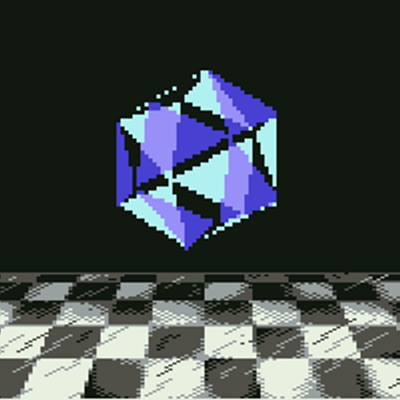
That changes the way you look at these productions. A Commodore 64 demo is not interesting only because of the image appearing on the screen. Part of the interest comes from knowing that the image is being produced by a computer released in 1982, with roughly 64 KB of RAM and a processor running at around 1 MHz.
This is where programming and artwork begin to merge.
The hardware stops being a neutral platform. It becomes part of the work.
Someone making a C64 demo knows the VIC-II, the SID, the memory limitations, the graphics modes and the timing peculiarities of the machine. Someone programming an Amiga knows its custom chips and spends an unreasonable amount of time inventing impolite ways of making them work harder. The fun often lies in discovering behaviors that even the original designers probably never imagined anyone would use artistically.
That is why the demoscene continues producing new work for machines that disappeared commercially decades ago. Commodore 64, Amiga, Atari ST, ZX Spectrum and Amstrad CPC are not treated merely as museum pieces. They remain creative platforms. The German commission associated with UNESCO even highlights size-coding, the practice of reducing programs to extremely small sizes, as one of the core skills of demoscene culture. (unesco.de)
That creates a relationship with the computer that I find much more interesting than simply replacing a GPU every two years.
The machine has a personality.
It has flaws, limits, tricks, strange timings and things that "should not work."
Then someone makes them work.
64K, 4K and the art of having no room
Probably the most impressive entry point into the demoscene is the world of size-limited intros.
A 64K intro has to fit within approximately 65 thousand bytes. A 4K intro gets 4096 bytes. Depending on the competition, there are categories for 1K, 256 bytes and other similarly unreasonable sizes.
Naturally, nobody is stuffing dozens of megabytes of textures into 4 KB using some magical ZIP format unknown to humanity.
The trick is not storing things ready-made.
You store ways of producing them.
A texture can be generated mathematically. A three-dimensional object can be built from functions and geometric operations. Music can be created by a tiny synthesizer during execution. Shaders generate images procedurally. Noise, fractals and mathematical functions replace data that would normally occupy huge files in a conventional project.
There is something almost absurdly beautiful about this approach because it reverses a very common tendency in modern computing. Today we have cheap storage, gigabytes of RAM and monstrous processors. It is perfectly normal to download hundreds of megabytes to install an app that, in the end, displays a to-do list.
The demoscene comes from another planet.
There, someone asks how much they can remove before the thing stops existing.
One production that became particularly important in this history was fr-08: .the .product, by the German group Farbrausch. It won the 64K Intro competition at The Party 2000 and became a landmark for its use of procedural generation and real-time sound synthesis. Demozoo even records the use of the V2 synthesis system and a procedural tool that preceded the group's famous werkkzeug. (demozoo.org)
Then there is Elevated, created by RGBA and TBC and presented at Breakpoint 2009.
Elevated shows a three-dimensional mountain landscape, with terrain, atmosphere, camera movement and music.
Maximum size for the category: 4 KB.
It won the competition. (demozoo.org)
4096 bytes.
That is the kind of number that should be printed on signs at the entrance of software development offices, purely to create a little collective embarrassment.
It is not a one-person job
There is also a huge social dimension to the demoscene. Traditionally, participants organize themselves into demogroups, groups with their own names and members performing different roles.
The coder writes the program. The graphician handles the visual work. The musician composes the soundtrack. Depending on the production, there may also be modelers, designers and people building tools, synthesizers, shaders and every kind of specialized component in between.
Members almost always use nicknames, called handles, another inheritance from hacker and cracker culture.
That is how names like Purple Motion, Skaven, Chaos, kb, ryg, Lone Starr, Travolta and many others became recurring credits in classic productions.
The group itself matters too. Future Crew, Spaceballs, Farbrausch, Kefrens, Conspiracy, Andromeda, Fairlight, Haujobb and dozens of other names developed identities of their own over the years.
There was not exactly a formal career waiting for these people. The main prize was reputation.
You made something that impressed other sceners, released it at a party, received votes, won a competition and your handle started circulating.
It is almost a primitive version of online social status, except it predates likes, followers and influencers by decades.
The point was to show skill to people who understood exactly how difficult what you had done actually was.
Personally, I think that is a much more interesting form of digital vanity.
The demoparties
If the scene had consisted only of people sending executables to one another, it probably would never have developed the same identity. A crucial part of the culture is the demoparty, physical gatherings where demos, intros, music, graphics and other productions are presented in competitions known as compos.
Imagine a LAN party meeting a digital art festival, getting drunk with a hackerspace and deciding to organize a creative programming championship.
That is more or less it.
People bring computers, spend days together, finish productions at the last possible moment, watch the entries on a large screen and vote for the best ones. In between, there is music, programming, conversation, old hardware, new projects and, judging from forty years of photographic evidence, reasonably significant amounts of beer.
Assembly, in Finland, began in 1992 and became one of the fundamental events in the history of the scene. Denmark had The Party throughout the 1990s. Norway had The Gathering. Germany later produced Breakpoint, Revision and Evoke. Evoke alone has existed since 1997, with a short interruption in the early 2000s, and still takes place in Cologne. (demoparty.net)
And this is not computer archaeology. In August 2026, as I write this, the Demoparty.net calendar shows events taking place in Germany and Russia, followed in the coming weeks by parties in Germany, Poland, Finland, Sweden and the Netherlands. Assembly Summer 2026 took place only a few days ago, from July 30 to August 2, in Finland. (demoparty.net)
The scene has aged, obviously. Many people who were making demos as teenagers in the 1980s and 1990s are now in their fifties, with children, careers and perhaps alarmingly detailed opinions about lower back pain.
But the culture continues producing new people too.
And the old machines still keep appearing on the tables.
Why Europe?
The demoscene exists worldwide, but spend even a few minutes following its history and you quickly notice that it has a very strong European accent.
Finland, Sweden, Norway and Denmark had enormous scenes. Germany is a historical powerhouse. Poland has a particularly important community, as do the Netherlands, France and several countries across Central and Eastern Europe. The current event calendar still reflects much of that geography. (demoparty.net)
There are good historical reasons for this. Home computers, particularly the Commodore 64, Amiga and Atari ST, created very strong communities in these countries during the 1980s and 1990s. Before the Internet became the nervous system of the planet, software, demos and messages circulated through floppy disks, postal mail, BBSs and physical gatherings.
The scene built its own social networks before we started calling everything a social network.
And this environment eventually had effects far beyond the demoscene itself. The European game industry inherited many people from that world. Remedy Entertainment, for example, openly discusses its roots in the Finnish demoscene. The connection is not difficult to understand: if you spent your teenage years trying to make a PC or Amiga produce impossible graphics in real time, professionally working with computer graphics and videogames is a fairly natural next step. (hackerculture.org)
A few things worth watching
It is difficult to make a list without committing some injustice because we are talking about decades of productions across dozens of platforms. Still, a few demos are referenced so often that they work well as entry points.
Second Reality, by Future Crew, is probably the classic example. It was presented at Assembly 1993, won the PC Demo competition and became one of the best-known productions in the history of the scene. It is pure DOS, unapologetically 1993 in its aesthetics and a lesson in what programmers of that period could do with hardware that today would probably be embarrassed by a supermarket calculator. (demozoo.org)
On the Amiga, State of the Art, by Spaceballs, won the competition at The Party 1992. It is very different from Second Reality. Instead of presenting a sequence of obvious technical demonstrations, it works heavily with dancing human silhouettes, quick cuts and music. It still has a very strong visual personality today. (demozoo.org)
After that, I would go to Desert Dream, by Kefrens, fr-08: .the .product, by Farbrausch, and Elevated, by RGBA and TBC.
I would not treat this as a "Top 5." The fun is precisely to start with a few landmarks and then completely lose control of the situation.
Because there is a good chance you will watch Second Reality on YouTube at eleven at night and, by two in the morning, find yourself downloading an Atari Falcon intro made by someone called Lord Helmet in 1996.
These things happen.
The Internet of the demoscene
Perhaps one of the greatest achievements of this community is how much material it has managed to preserve. Many of its websites look as if they survived from an era of the Web before anyone had heard of design systems, conversion funnels or buttons saying "Start for free," which immediately makes me feel comfortable.
If I were starting today, I would open these:
- Pouët.net is the public square. It has productions, comments, ratings, screenshots and decades of discussions between sceners. Sometimes you find a historical masterpiece followed by someone commenting "boring." The Internet as it should be.
- Demozoo is probably the best place for researching the history of the scene. It catalogs demos, groups, people, platforms, parties, competitions, results and credits. The amount of information is absurd.
- Scene.org works as one of the major pieces of community infrastructure and maintains a huge archive of demoscene files. The organization is also behind, or connected to, several important services within the scene. (scene.org)
- Demoparty.net maintains the event calendar and is the best way to discover that some obscure demoparty is happening next month in a Finnish town you have never heard of.
- CSDb, the Commodore 64 Scene Database, is the specific rabbit hole for anyone beginning to develop a slightly unhealthy fixation on the C64.
- Hornet Archive preserves a huge part of the PC demoscene from 1987 to 1998. For anyone interested in the DOS scene, it is practically a time capsule. (hornet.scene.org)
Interestingly, these sites also reveal something I consider important: the demoscene was never only about consuming digital art. There is an obsessive record of who did what, which group released it, at which party, what position it achieved and which machine it was made for.
Authorship matters a lot.
Perhaps because when a 4 KB program does something that looks impossible, the first natural question is: "who was the lunatic who made this?"
And what about Brazil?
There is a Brazilian demoscene, but we never had anything comparable to the scale of Finland, Germany or Poland.
There are records of Brazilian groups and productions going back to the 1990s, but events were sporadic. One particularly interesting case was Art Engine 2012, held from February 3 to 5 that year in São Paulo. According to Demozoo, it was the first demoparty held in Brazil in fifteen years. There were competitions for demos, game development, graphics, music and wild productions. (demozoo.org)
That says quite a lot about the size of our scene.
Fifteen years between two demoparties is not exactly a packed calendar.
Within Latin America, Argentina had a more visible presence, especially through Flashparty, created in the late 1990s.
I have always found it curious that Brazil never developed a larger demoscene. We have a history of computing, electronic music, piracy, BBS culture, hacking, free software, digital art and a fairly healthy number of people who take things apart simply to find out how they work.
The ingredients were here.
Perhaps what was missing was precisely a strong tradition of demoparties capable of turning isolated individuals into a scene.
A subculture does not emerge simply because there are people interested in the same thing.
They have to meet.
From pirated floppy disks to cultural heritage
The best plot twist in this story happened recently.
The demoscene began receiving official recognition as intangible cultural heritage in several European countries.
Finland opened the way in 2020. Germany followed in 2021. Poland and Switzerland recognized the scene in 2022, the Netherlands in 2023, Sweden and France in 2025. In April 2026, Norway became the eighth European country to include it in its intangible cultural heritage. (demoscene-the-art-of-coding.net)
It is worth making a distinction here because this subject is often oversimplified. This does not mean that "UNESCO declared the demoscene a World Heritage Site," as if it were the Acropolis or the historic center of Ouro Preto. These are national registrations in inventories of intangible cultural heritage aligned with the mechanisms and principles of the UNESCO convention. The Art of Coding initiative, founded in 2019, works specifically to promote the recognition of the demoscene as digital culture. (demoscene-the-art-of-coding.net)
Even with that clarification, the trajectory remains wonderful.
In the 1980s, teenagers were modifying pirated games and putting their nicknames in front of them.
Forty years later, European governments are discussing how to preserve that culture.
I doubt anyone involved in the first cracktros had exactly this plan.
Software can be culture too
Perhaps this is what interests me most about the demoscene.
Today we are surrounded by software and, paradoxically, we think very little about software as a form of cultural expression. We talk about cinema as art, music as art, architecture as art and photography as art, while programs are still treated mainly as commercial tools.
The demoscene disrupts that division.
There, code is not hidden behind the work. The code is part of the work. The way a program exploits a particular machine, generates an image or works around a limitation is part of the experience just as much as the music or visual result.
That also explains why watching a video of a demo and running the original demo are not quite the same thing.
The video shows the result.
The executable shows the entire idea.
There is something almost handcrafted about knowing that a file contains enough instructions to turn silicon into image and sound, and that someone spent nights trying to remove another twenty bytes because the executable was too large for the competition.
I do not think the lesson of the demoscene is that all software should be 4 KB. That would be a fairly stupid conclusion.
The lesson is something else.
Limitations can create language.
Knowing a tool deeply enough allows you to start using it in ways its creators never imagined. And programming does not have to exist only to automate a company, sell a subscription, serve advertising or close a Jira ticket.
Sometimes you program simply because you want to create something beautiful.
Or strange.
Or technically absurd.
Sometimes you want to find out how far a machine can go.
And there is something rather healthy about a culture that, after forty years, can still look at a computer and ask the simplest possible question:
"Can it be done?"
Bad luck for the computer when the first answer is no.