

The Observatorium sky got bigger
Observatorium, the status page that draws my servers as a night sky in text, went from eleven regions to twenty. It also got a real moon, an archive, a list of outages, finger and Gopher versions, and better counting, still without keeping anything about visitors.
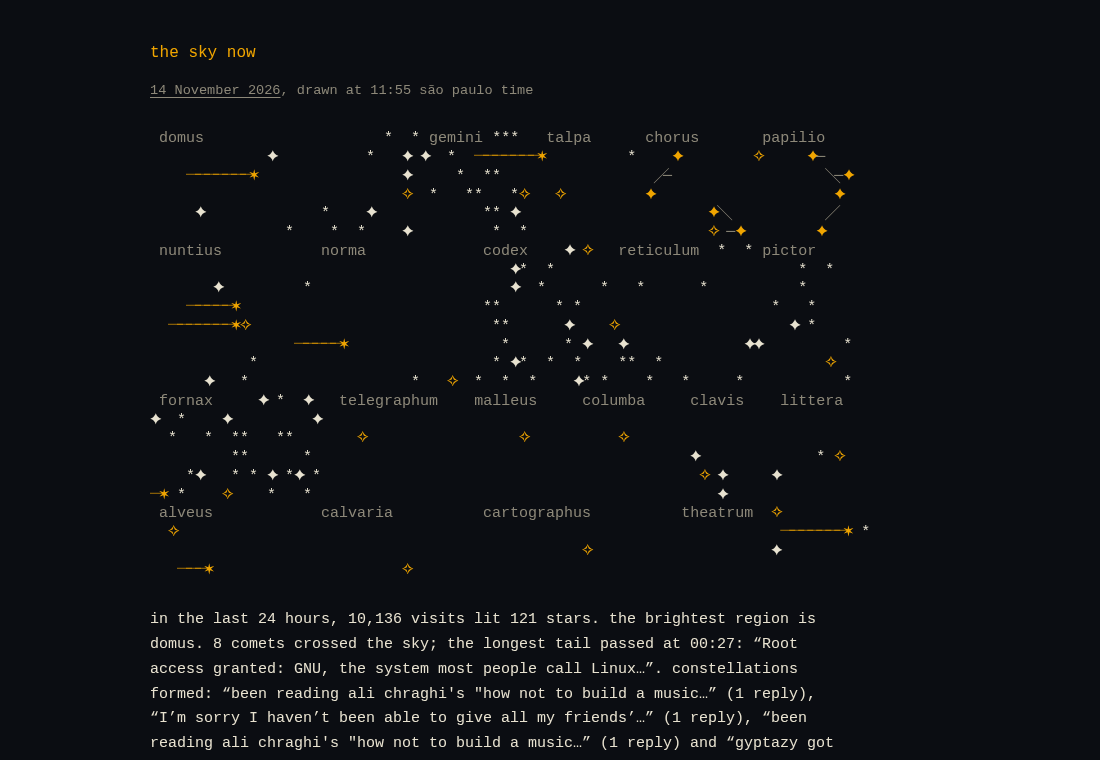
In October I wrote about Observatorium, the status page that draws my public systems as a night sky in plain text. Back then it lived at murad.wtf, and now it's at observatorium.thatsmy.tools. That first post explains the stars, comets, constellations and satellites, and it's the place to start. Since then the sky has almost doubled, got a moon, and learned to answer over finger and Gopher. This is what changed.
From eleven regions to twenty #
The first version had eleven regions, one per service. The sky still fits in 80 columns by 24 lines, but now it holds twenty, arranged in four bands from top to bottom.
The first band is home and the networks: domus (pablomurad.com), gemini (the Gemini capsule), talpa (Gopher), chorus (murad.social) and papilio (Bluesky).
The second band is new. It holds the sites I publish: nuntius (pablo.news), norma (modeorg.org), codex (murad.gg), reticulum (weirdnet.org with its links, its directory and miskatonic.lol) and pictor (phlog.space).
The third band is the forge, the terminals and the small protocols: fornax (Forgejo), telegraphum (the BBS) and malleus (hammer) were already there, and now columba (Misfin, the SSB room and finger), clavis (hax0r.zip and hax0r.lol) and littera (ascii.zone on the web, Gemini and Gopher) join them.
The last band, low in the sky, is for the places I mostly see through their probes: alveus (runv.club), calvaria (skull.black and its news server), cartographus (genmap.app) and the newcomer theatrum (infinit.show).
Some regions gather several sites, so a source can now carry a prefix. That keeps their pages apart: the front page of links.weirdnet.org is its own star, not mixed with the front page of weirdnet.org. Fourteen new log sources feed the new regions, and every new service has its own probe, including one that speaks NNTPS to skull.black. weirdnet.org is read from the log behind Anubis, the bot filter in front of it,1 so challenge pages don't count as visits.
A moon, an archive and a list of eclipses #
At night, a moon crosses the top of the sky in its real phase, as seen from São Paulo: ◐ waxing, ● full, ◑ waning.
/sky/ used to repeat the home page. Now it lists every night drawn so far, and each day still has its own page, like /sky/2026-11-14/, never rewritten once the day closes. To make sure each day ends with a complete sky, the timer runs at 2:55, 5:55 and so on, every three hours, so the last drawing of the day is at 23:55.
There's also a new page, /eclipses/, with every time a service went dark in the last 30 days. As I write this, it says "no eclipses in the last 30 days."
More ways to look at it #
The sky was already on the web, on Gemini at gemini://observatorium.thatsmy.tools/, in an Atom feed and over a plain TCP port. Now there are a few more doors:
finger sky@observatorium.thatsmy.tools: the sky over the finger protocol
gopher://pablomurad.com/1/sky: the sky as a gophermap, inside my Gopher hole
nc observatorium.thatsmy.tools 1900: the sky in plain text, then the connection closes
echo play | nc observatorium.thatsmy.tools 1900: the last 30 nights, one after another
With the last one, thirty skies go by in the terminal, and the comets move from night to night.
Counting better #
Two bugs made the numbers lower than they should be, and one filter made them higher.
The first bug was log rotation. Observatorium reads each log from where it stopped last time. When logrotate renamed access.log in the early hours of the morning, the reader opened the new file from the top and lost whatever the old one had received after the last run. That was 74 to 455 lines of pablomurad.com every night. Now the reader finds the renamed file by its inode,2 finishes it from the saved position and only then starts the new one.
The second was about the forge. It only counted a sign-in from the login form, but my Forgejo is entered through Pocket ID, so fornax never got a satellite for a sign-in. The OAuth2 callback now counts too.
The filter goes the other way. When someone shares a link on the fediverse, every server that sees the post fetches the page to build a preview card. Mastodon, Akkoma, Misskey, GoToSocial and Friendica all do it. Those aren't people reading, so they don't count anymore, together with health checkers. On pablomurad.com that removed about 650 of 2,900 daily visits.
Still keeping nothing about visitors #
The privacy rules didn't change, they only got dates. The database keeps hourly counts and a scrambled code (an HMAC) for each visited page, and visits are forgotten after 48 hours. Service probes stay for 30 days, because the eclipses page needs them. IP addresses, browsers, users, referrers and URL parameters are thrown away while the log is being read.
The collector also runs locked down. It needs root to read the nginx logs, the journal and Docker, but systemd boxes it in: the whole system is read-only except the database and the three folders it publishes to, and the only extra power it keeps is permission to read any file. The small server behind port 1900 runs with no privileges at all, as a throwaway user, with 64 MB of memory.
Go look at it after dark, São Paulo time, when the moon is up.
Notes
-
Anubis asks each new browser to solve a small proof-of-work puzzle before it shows the page. A person waits a second or two. A scraper that doesn't run JavaScript stays stuck on the challenge page. ↩
-
The inode is the number the filesystem uses to identify a file. Renaming a file changes its name and keeps its inode, so the reader can still find the old log after logrotate moves it. ↩