

Come make a home on runv.club
runv.club is a small public Unix server from Brazil, and it has room for more people. A shell, a web page, a blog on the web, Gemini and Gopher, our own IRC, a radio, a TV with old films at night and good company. No ads, no tracking, no algorithm.
Contents
- A home on the old internet and the small one
- A real shell
- Your own addresses
- IRC, a radio and a TV
- runv on irc.runv.club, our own network, is where the club hangs out. Everyone gets a bouncer, so you never miss what was said, and your nick is yours. Our bot, runvbot, does polls, the weather, "photos" of the chat and a lot of silly text tricks. After six months, you can run a bot of your own.
- Places to hang out
- Little things that make it feel like home
- What you won't get
- How to join
- Want to look around first?
runv.club is a small public Unix server,1 run from Brazil, and it has room for more people. We brought it back in October, and the house is filling up with the good kind of noise: a radio playing members' music, old films on the TV at night, a canvas getting painted one pixel at a time, blogs showing up on the planet.
This is everything that comes with an account. None of it is required. Use what you like and ignore the rest.
A home on the old internet and the small one #
Your page lives at runv.club/~you. You also get your own corner on Gemini and on Gopher,2 a finger file, and a blog that shows up on the club's planet: drop markdown in ~/blog and it goes up on all three. If you'd rather not write HTML, there's a guide for every step on the wiki.
And there's more room to publish than that:
- a photo gallery: whatever goes in
~/picsbecomes a gallery, with the location and camera data stripped - a site straight from git: a repository called pages on git.runv.club turns into a site at you.runv.space
- an eepsite of your own on I2P,3 from
~/public_i2p - twtxt, a microblog that lives in a plain text file4
- a /now page, to say what you're focused on lately
- a guestbook, and a small visit counter that tracks nobody, both off until you turn them on
- a spot on the runv ring, the club's webring
- proofs that tie your Mastodon, your GitHub or your own site to your account
- 88x31 buttons to put on your page
A real shell #
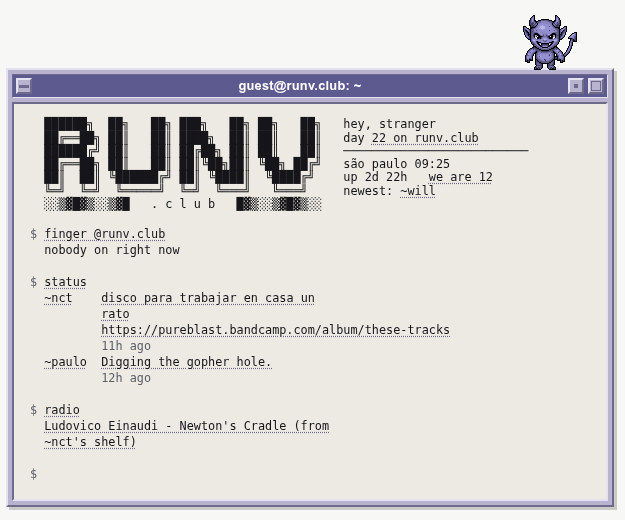
It runs Debian, with a nice prompt and colours out of the box. More languages are installed than I can list here: C, Python, Go, Rust, Haskell, Racket, Lua, Ruby, Common Lisp and a pile more. Write code, run it, show it off. Type runv and a dashboard shows what's going on in the club.
Your own addresses #
- you@runv.club, forwarded to the inbox you already use
- you.runv.sh, for anything you run here, or tunnel from your own machine
- a domain of your own, pointed at your page or your app, with HTTPS
IRC, a radio and a TV #
runv on irc.runv.club, our own network, is where the club hangs out. Everyone gets a bouncer, so you never miss what was said, and your nick is yours. Our bot, runvbot, does polls, the weather, "photos" of the chat and a lot of silly text tricks. After six months, you can run a bot of your own. #
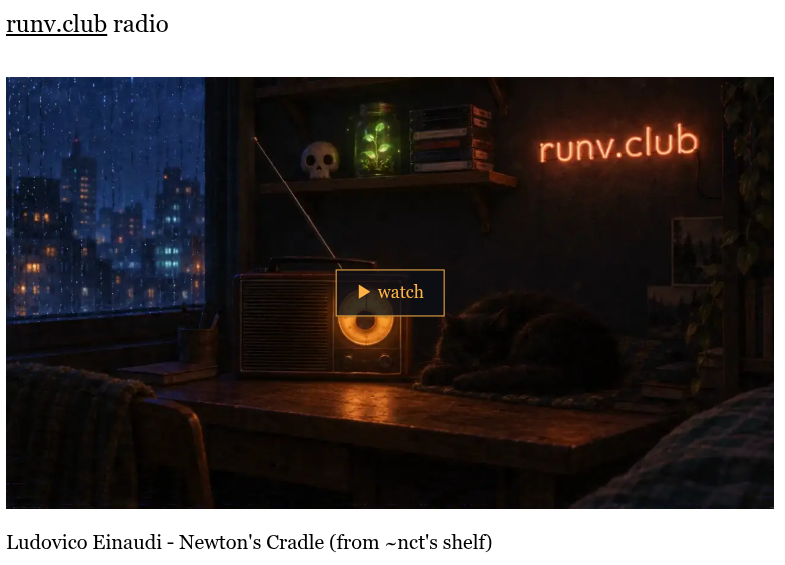
The radio at runv.club/radio plays music, including members' own tracks: put songs in ~/radio and they join the rotation, or go live from your own computer. There's a little animated room and a chat next to it. From midnight to 8 in the morning (Brasília time) it turns into runv TV, with old films, cartoons and newsreels.5
Places to hang out #
- the forum, for slower conversations, and board, a forum inside the terminal
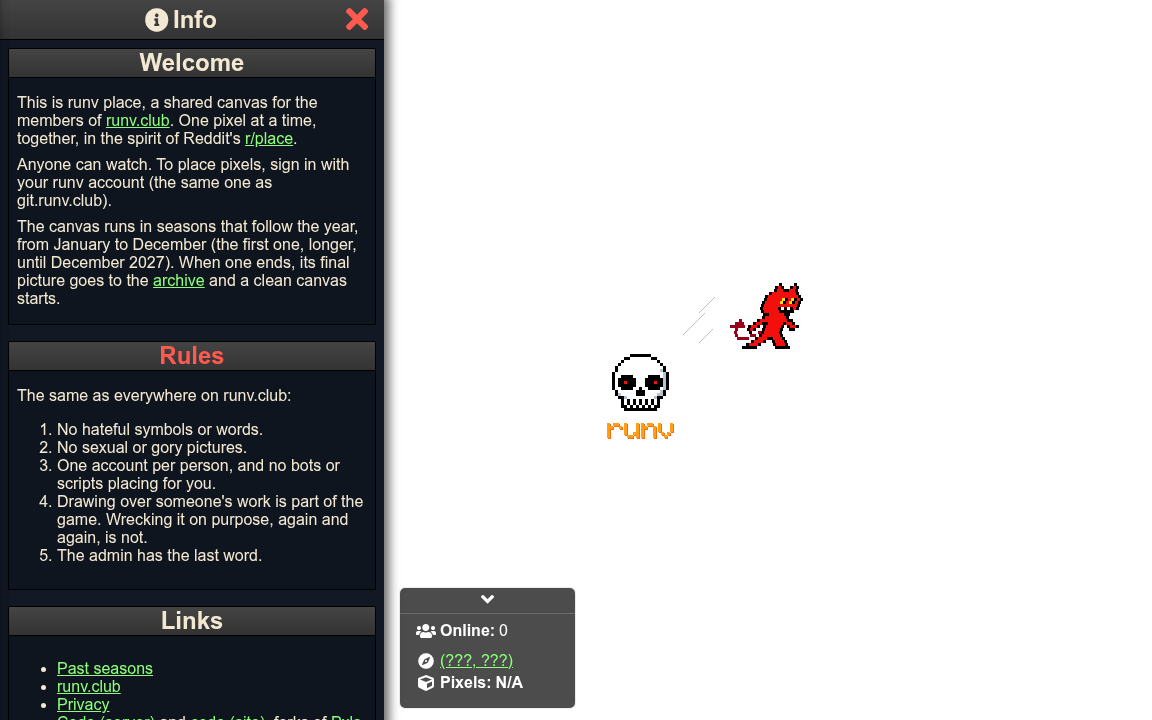
- place.runv.club, a shared canvas where everyone paints one pixel at a time
- CryptPad, for documents and boards, with everything encrypted
- our own git server
- graffiti, a wall every member can write on, and
/srv/square, a folder where everyone writes - write, to drop a message straight into someone's terminal, and nice, to leave someone an anonymous compliment
- lemmy.club, communities federated with the rest of the fediverse
Little things that make it feel like home #
- journal: a private diary in the terminal
- rec: records your terminal session and gives you a link to share
- pb: a pastebin, with your code in colour
- status: one-line updates you can embed on any site
- badges for things you did here, from a first blog post to a plant kept alive for 100 days
- a feed reader, bookmarks, calendar and contacts
- ntfy, for notifications on your phone
- an exquisite corpse6
- a botany plant to keep alive7
- games: nethack, text adventures with frotz, tetris and the BSD games, fortune with cowsay, and Dungeon Crawl through the tildeverse
- a backup of the whole server, every day
What you won't get #
No ads, no tracking, no algorithm. Nobody here is trying to grow anything but the club itself. It's small on purpose, and we look after each other. There are a few simple rules, and the main one is: be kind.
How to join #
Go to runv.club/join, tell us a bit about yourself, and send an SSH key (the page explains how to make one). From a terminal, ssh join@runv.club does the same. Every request is read by a person, and seven people get in each week, so there may be a short wait. You get a link to check your place in line. You need to be 16 or older.
Friends who only want a blog can have one from a single markdown file at banany.lol, no account needed.
Want to look around first? #
- visit webchat.runv.club and say hi in #runv, no account needed
- browse the wiki and the news to see what's been happening
- read what members are writing on the planet
If you've been missing the internet that felt like a neighbourhood, come by. There's a terminal waiting for you.

Notes
A pubnix is a Unix machine shared by many people, each with an account of their own. The ones called tildes take the name from the ~ in front of every member's folder. The whole story is in A short history of pubnixes and tildes. ↩
Gemini and Gopher are two small protocols made for text. Gopher came out of the University of Minnesota in 1991 and lost the race to the web. Gemini appeared in 2019, somewhere between the two, and has no ads, no scripts and no cookies by design. ↩
I2P is an anonymous network that runs on top of the internet. Its sites, called eepsites, end in .i2p and only open through an I2P router. ↩
In twtxt, each person keeps a twtxt.txt file with one post per line, and following someone means reading their file. It started in 2016 and still has a small, loyal crowd. ↩
Everything on runv TV comes from the Internet Archive and is public domain or Creative Commons. ↩
The exquisite corpse is a game the surrealists played in the 1920s: each person adds a piece to a text or a drawing, seeing only the end of what came before. ↩
botany is a plant that lives in the terminal. It was born on tilde.town, grows while it's watered and dies if it's forgotten, and friends can water it for you. ↩