

Movie: A Serious Man
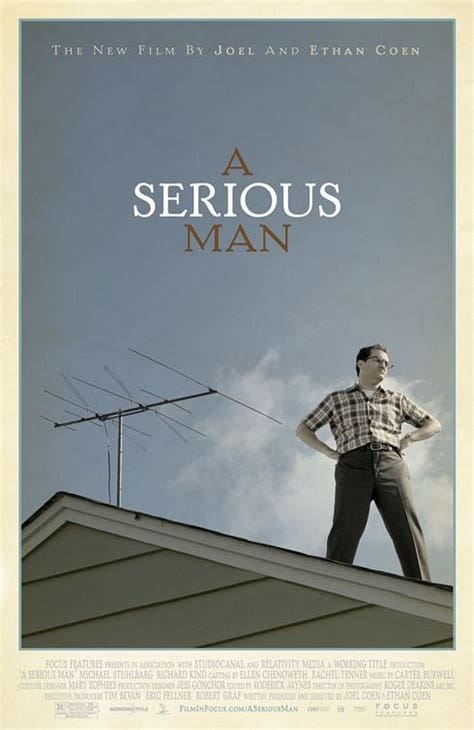
A Serious Man is one of the funniest films I have ever watched, although “funny” feels like an inadequate word for what the Coen brothers are doing here. This is not comedy designed to make you comfortable. It is comedy extracted from humiliation, spiritual confusion, domestic collapse and the quiet suspicion that the universe may be operating according to rules no one bothered to explain to us.
I loved it.
The film follows Larry Gopnik, a physics professor living in Minnesota in 1967, whose life begins to fall apart with almost mathematical precision. His wife wants a divorce so she can marry Sy Ableman, a man so calm, reasonable and unbearably sympathetic that his politeness becomes a form of violence. Larry’s brother is sleeping on the couch, draining a cyst in the bathroom and working obsessively on a mysterious notebook. His children treat him like an inconvenient financial institution. A student tries to bribe him and then threatens to sue him. His tenure is uncertain. His roof needs repairing.
And Larry, poor bastard, keeps asking the same question:
Why?
That is the real joke.
Larry is a man of science. He teaches uncertainty, probability and the limitations of human knowledge, but he cannot tolerate uncertainty when it enters his own house. He can explain Schrödinger’s cat on a blackboard, yet he cannot understand why his wife suddenly prefers Sy Ableman. He wants the universe to present its calculations. He wants suffering to show its work.
But the universe does not care about intellectual consistency.
A Serious Man is essentially the Book of Job relocated to a Jewish suburb, except that God never arrives to explain Himself. There are rabbis, lawyers, doctors, neighbors and academic committees, but no authority capable of giving Larry a useful answer. Every person he consults offers either a meaningless story, a bureaucratic procedure or some variation of “accept the mystery.”
The rabbis are especially brilliant. Larry approaches them expecting ancient wisdom and receives anecdotes, platitudes and administrative delays. One rabbi tells him a strange story about a dentist who discovered Hebrew letters carved into a patient’s teeth. The story sounds as though it must contain a profound revelation. Naturally, it leads nowhere.
That is exactly the point.
Human beings are addicted to the idea that everything means something. We cannot accept random suffering, so we invent structures around it. Religion, mathematics, superstition, philosophy, bureaucracy — all of them become methods of drawing borders around the incomprehensible. We ask for signs, and when a sign appears, we immediately ask what the sign means.
Maybe it means nothing.
Maybe the teeth are just teeth.
The humor in A Serious Man is brutally precise. The Coens never beg for laughter. They simply allow situations to become so uncomfortable, so absurdly unfair, that laughter becomes the only honest reaction. Sy Ableman embracing Larry and telling him how difficult the divorce must be is funnier than any conventional joke. He steals the man’s wife and then comforts him about it. It is an almost perfect portrait of passive aggression disguised as compassion.
Fred Melamed plays Sy with a kind of majestic softness. Every word sounds therapeutic. Every gesture feels murderous.
Michael Stuhlbarg is equally extraordinary as Larry. His performance is built from confusion, suppressed panic and the exhausted decency of a man who still believes that behaving correctly should protect him from catastrophe. Larry is not heroic, but he is recognizably human. He does not demand happiness. He merely wants an explanation.
He does not get one.
What makes the film even better is that it refuses to turn Larry into a saint. He is passive, indecisive and frequently blind to the people around him. He spends so much time asking what God wants from him that he rarely considers what anyone else might need. His suffering is real, but so is his self-absorption.
This prevents the film from becoming a simple story about an innocent man punished by fate. Larry may not deserve what happens to him, but the universe has never been particularly interested in proportional punishment.
The cinematography is controlled, clean and almost clinical. Everything in Larry’s world appears organized: suburban houses, synagogue rituals, university offices, mathematical formulas. Yet beneath that order is complete chaos. The visual neatness makes the existential disorder even funnier. The furniture is aligned. The lawns are trimmed. God remains unavailable.
Then there is the ending.
No sentimental resolution. No final rabbinical wisdom. No comforting proof that suffering produces growth. Larry makes one small moral compromise, the doctor calls with troubling news, and a tornado approaches his son’s school while Jefferson Airplane plays.
The film ends not with an answer, but with an interruption.
It is perfect.
The tornado is not merely punishment. That interpretation would be too easy, and A Serious Man distrusts easy interpretations. It is uncertainty made visible — enormous, indifferent and moving directly toward everyone. The children stare at it because there is nothing else to do.
That final image stayed with me because it expresses the whole film without pretending to solve it. We live inside systems we barely understand. We make plans, study sacred texts, calculate probabilities, repair antennas and worry about television reception while something immense forms on the horizon.
And still, somehow, it is hilarious.
A Serious Man is not nihilistic, although it frequently looks in that direction. Nihilism would be simpler. The film’s position is more disturbing: meaning may exist, but we may be fundamentally incapable of accessing it. God may have a plan. God may be absent. God may simply have a very strange sense of humor.
The Coen brothers do not answer the question.
They understand that the question is funnier.