
Movie: Napoleon Dynamite
The Art of Absolutely Nothing Happening
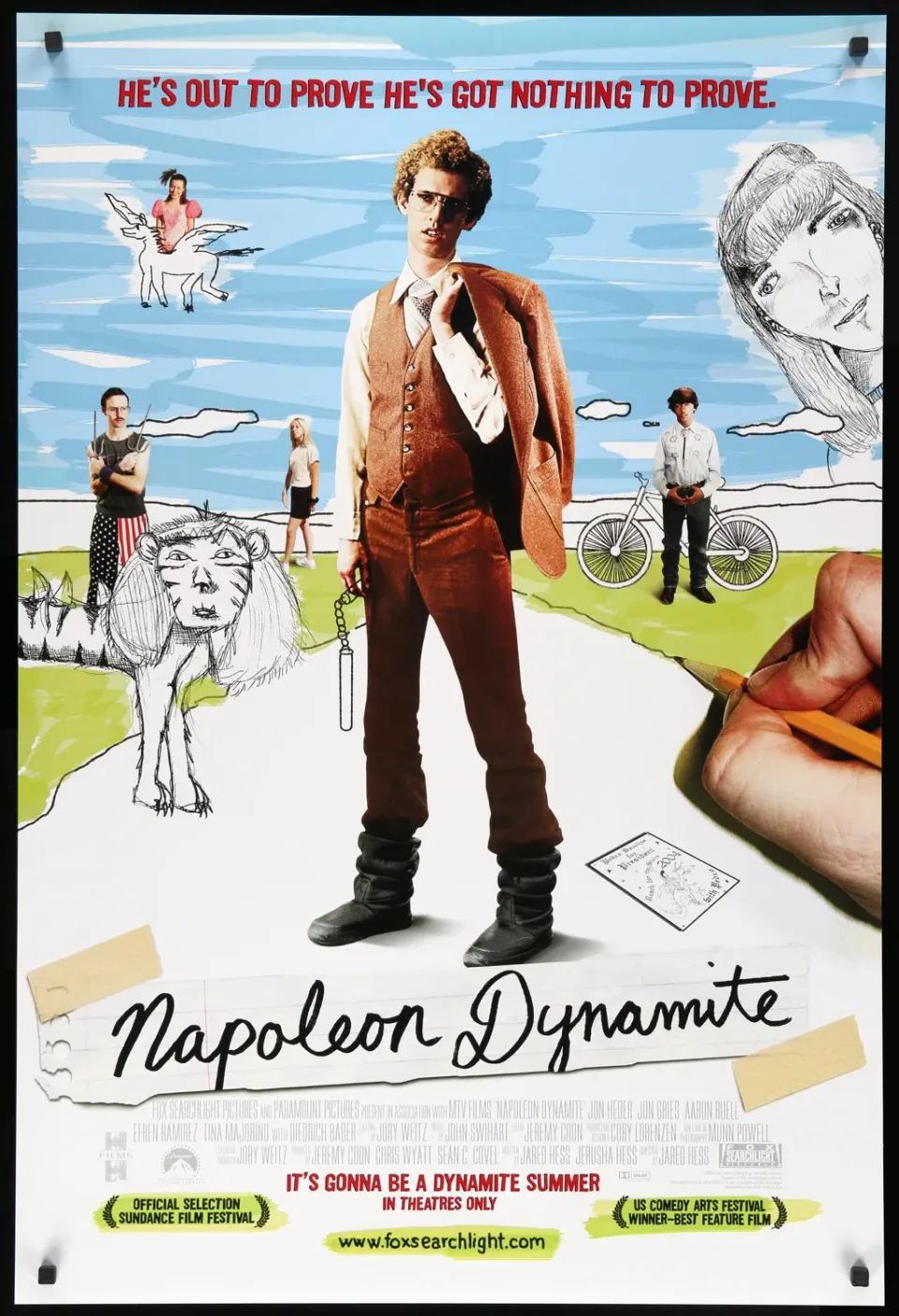
Napoleon Dynamite is a movie in which almost nothing happens - and, somehow, everything happens. There is no proper villain, no grand mission, nobody has to save the world, and no character stops the story to explain their trauma while staring through a rain-soaked window. There is just a teenager in moon boots walking around Preston, Idaho, looking like he was dragged out of a bad dream and told he has to present a group project.
That is exactly why I loved it. The film has the nerve to exist on its own frequency, a kind of small-town fever dream where every silence lasts half a second longer than it should, people talk with absolutely no sense of social rhythm, and a spoonful of mashed potatoes can carry more dramatic tension than the entire third act of most blockbusters. The humor does not come from traditional punchlines. It comes from the pause, the blank stare, the wrong outfit, the even-worse response, and the certainty that nobody in that town has the faintest idea how a human interaction is supposed to work.
It is deadpan elevated to a religion. The movie never begs for laughs, never uses the soundtrack to announce that something is funny, and never tries to win us over with artificially adorable characters. It simply shows Napoleon drawing a liger - "pretty much my favorite animal" - and moves on as though this were perfectly ordinary information. And maybe it is. After a few minutes, the movie's logic takes over. You stop wondering why its universe is so strange and begin to suspect that the real world is simply too conventional.
Napoleon is a walking masterpiece of awkward energy. He is irritating, arrogant, vulnerable, loyal, and completely incapable of understanding how other people see him. In a lazier high-school comedy, he would be the nerd who gets a makeover, learns how to use hair gel, and earns the approval of everyone who used to despise him. Not here. Napoleon remains Napoleon. There is no glow-up, no makeover montage, no speech about believing in yourself. There is only a boy who desperately wants everyone to know he has "nunchuck skills, bow hunting skills, computer hacking skills" - although the available evidence is, at best, inconclusive.
That is one of the sweetest things about the movie, even though it hides every trace of sentiment behind a bored expression. Napoleon does not need to become cool. Pedro does not need to become a charismatic candidate coached by consultants. Deb does not need to stop being shy. They only need to find some small way to exist together. The film looks at the weird kids without turning them into cute mascots, misunderstood geniuses, or moral lessons. They are strange, occasionally annoying, and frequently lost - and they still deserve friendship, dignity, and a place on the stage.
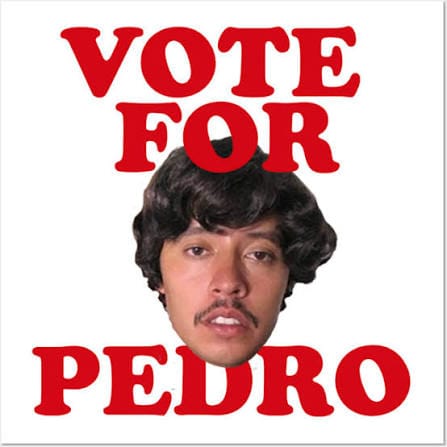
Pedro, by the way, is the true calm king of American cinema. While everyone else seems permanently one social interaction away from collapse, he moves through the film with the serenity of a man who has already realized that reality is far too ridiculous to justify anxiety. His campaign for class president is basically an anti-marketing performance: very few words, zero manufactured enthusiasm, and a slogan that entered pop culture because it cannot be improved. Vote for Pedro. That is it. That is the platform.
Uncle Rico and the Multiverse of 1982
If Napoleon is the teenager who has not yet found his place in the world, Uncle Rico is the adult who found his place in 1982 and refused to leave. He does not merely live in the past: he rented the past, furnished the past, and is probably trying to sell plastic containers to the past. Every time he appears, the movie gains another layer of discomfort. Rico has the confidence of a motivational speaker and the credibility of a man who records himself throwing a football beside a van.
His dream of traveling back in time to win a high-school football game is funny because it is absurd, but also because it is painfully recognizable. Everyone knows someone who turned one specific year of their youth into an entire personality. Uncle Rico is the patron saint of men who say, "I could have gone pro," while holding a warm beer at a barbecue. He permanently radiates "peaked in high school" energy, except for the minor detail that he may never have peaked at all. It is tragic, pathetic, and wonderful.
Kip, meanwhile, managed to become terminally online before it was recognized as a social diagnosis. He spends his days talking to women in chat rooms, discusses technology with the solemnity of a Silicon Valley pioneer, and somehow ends up in a genuinely sweet romance with LaFawnduh. The film could easily have used their relationship as nothing more than a cruel joke. Instead, it gives Kip perhaps the most sincere romantic arc in the entire story. In a universe where almost everyone seems emotionally frozen, the man who sings about technology finds somebody. Good for him, honestly.
Tater Tots, Glamour Shots, and an Aesthetic You Cannot Fake
Visually, Napoleon Dynamite looks like it was discovered inside a forgotten box in a basement, somewhere between a corporate training VHS and a 1987 school catalog. I mean that as a huge compliment. The faded colors, empty spaces, furniture, hairstyles, clothes, and endless Idaho sky create a place that seems trapped outside time. The film came out in 2004, but it could take place in 1986, 1994, or an alternate dimension where every store still sells binders with horses on the cover.
The direction understands that objects can tell jokes too. The tater tots hidden in Napoleon's pocket are not merely food; they are a manifesto. Deb's glamour shots, Uncle Rico's tapes, Pedro's bicycle, Tina the llama, the "delicious bass" - everything seems to have been selected by someone with an advanced degree in the science of embarrassment. Some movies spend millions building universes. Napoleon Dynamite needs only a corded telephone, a beige sofa, and a wolf T-shirt to establish an entire cosmology.
And then the dance happens. By that point, the movie has already proved it obeys none of the usual rules. But when Napoleon walks onto the stage and dances to Jamiroquai's "Canned Heat," the comedy becomes a strange little miracle. It is not technically perfect, nor should it be. It is awkward, intense, unexpected, and completely free. For the first time, Napoleon stops explaining his alleged skills and simply demonstrates one. The boy understood the assignment.
There is a huge difference between a comedy that humiliates its characters and a comedy that understands being human is already humiliating enough. Napoleon Dynamite almost always stays on the right side of that line. The movie laughs at its characters' social failures, of course, but rarely treats them with contempt. Even its most ridiculous people want things we can understand: Napoleon wants respect, Pedro wants to belong, Deb wants to be seen, Kip wants love, and Uncle Rico wants a time machine because accepting the present would be much harder.
Not everything will work for everyone. The story feels deliberately assembled from pieces somebody found scattered on the floor, the pace is so slow that some viewers will feel as though they are watching paint dry in Idaho, and several scenes end without the payoff a conventional comedy would promise. Anyone who needs plot twists, perfectly engineered character arcs, and a joke every fifteen seconds will probably hate it. Fair enough. But demanding conventional structure from this movie is like complaining that a liger does not exist in nature. You have completely missed the point.
For me, the pace was not an obstacle; it was the mechanism of the joke. I laughed so much because the film gives its strangeness room to breathe. Every silence becomes a trap. Every conversation sounds as though it was written by aliens who learned about humanity from high-school yearbooks. There is enormous precision behind the appearance of casual improvisation. The comedy looks effortless, but the timing is surgical.
Vote for Pedro - and for the Right to Stay Weird
In the end, Napoleon Dynamite is a comedy about people who do not know how to communicate, dress, flirt, or, in several cases, what they are doing at all. In other words, it is a movie about people. Its genius lies in turning small lives, monotonous routines, and social failures into something almost epic without ever abandoning the tone of someone answering, "Whatever I feel like I wanna do, gosh," when asked what they plan to do that day.
I finished the movie with that rare feeling of having visited an entire place. Not just a collection of characters, but a town, a temperature, a particular kind of carpet, an imaginary smell of a school cafeteria. It is extremely funny because it trusts the absurdity of everyday life and understands that the most memorable moments do not always arrive with a grand musical score. Sometimes they involve a student election, a drawing of a hybrid animal, a plate of nachos, or someone shouting at a llama to eat.
Napoleon Dynamite is weird cinema in its purest form: too specific to have been manufactured by committee, too sincere to be only ironic, and too funny to depend on nostalgia. More than twenty years later, it still feels like a creature nobody could reproduce in a laboratory. Thank goodness. Some things should remain unique.
VERDICT
9/10 tater tots hidden in a pocket
Gosh!