
Movie: Bloodlust
Some vampire films are polished until there is nothing dangerous left in them. The castles are perfect, the costumes are expensive, the blood is tastefully arranged and the vampire looks ready for a perfume advertisement.
Subspecies is not that kind of film.
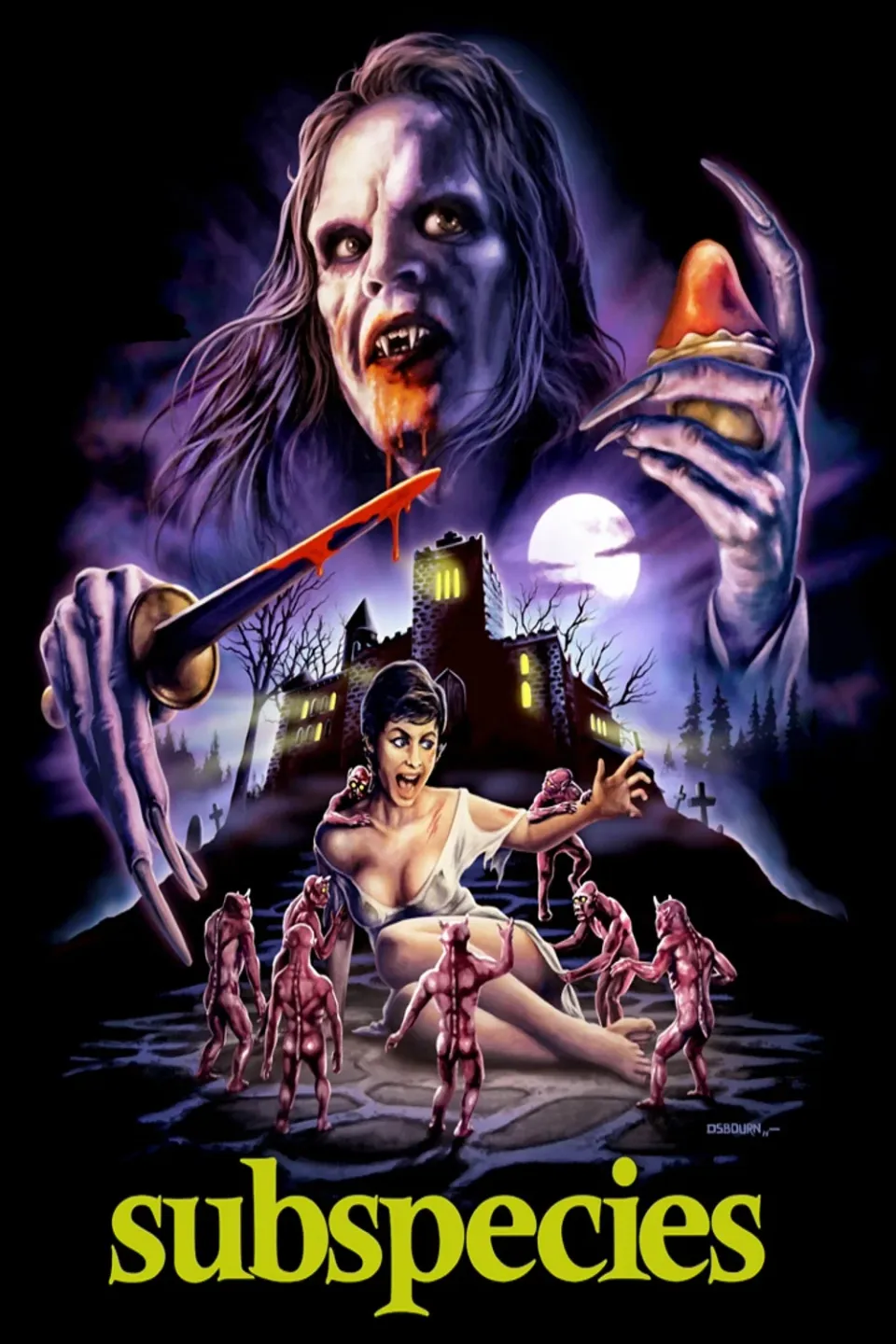
Released in 1991 by Full Moon Entertainment and directed by Ted Nicolaou, Subspecies feels old, strange and slightly unclean in the best possible way. It has ruins, forests, local legends, small creatures crawling across stone floors and a vampire who looks as if he has spent centuries sleeping somewhere that nobody should open.
I liked it a lot.
It is not a flawless movie, and I do not need it to be one. What it has is atmosphere, personality and a villain who immediately belongs to the screen. In a genre filled with elegant counts and romantic immortals, Radu arrives with long fingers, a ruined face, a wet voice and absolutely no interest in being charming.
Well, perhaps he thinks he is charming.
That only makes him better.
The story of the first Subspecies
This section discusses the complete story, including the ending.
The film opens inside Castle Vladislas, where King Vladislav is confronted by his exiled son Radu. The king, played by Angus Scrimm, has maintained an old agreement between vampires and the nearby human population. A mystical relic called the Bloodstone provides blood said to come from the saints, allowing the vampires to survive without feeding on the villagers.
Radu does not care much for peaceful coexistence.
He murders his father and takes the Bloodstone, not only because he desires its power, but because he sees it as his inheritance. This first scene establishes everything important about him. Radu is not simply hungry. He is resentful. He believes the world has denied him something, and therefore everything he does afterward becomes, in his mind, a form of correction.
At roughly the same time, three students arrive in the Romanian town of Prejmer. Michelle and Lillian are Americans visiting their Romanian friend Mara. They are there to study local culture, myths and superstitions, which is the sort of academic plan that sounds wonderful until the local superstition begins walking behind you at night.
The women stay in an old fortress and begin learning about the region's vampire legends. They hear stories about the Bloodstone, King Vladislav and an annual Festival of the Undead. The villagers do not treat these stories as distant entertainment. Their customs, celebrations and fears suggest that folklore is still part of ordinary life.
The students also meet Stefan, a young zoologist who appears gentle, educated and strangely comfortable with nocturnal animals. Michelle and Stefan become attracted to each other, but he is hiding a rather substantial family detail.
Stefan is a vampire.
More specifically, he is Radu's half-brother. Unlike Radu, Stefan rejects the cruelty associated with his nature and tries to live without hunting human beings. He represents the possibility that a vampire is not automatically condemned to become a monster. Radu, naturally, finds this offensive.
The conflict between the brothers soon reaches the three women. Radu begins stalking them, attacks Lillian and later takes Mara. He wants them as consorts, but he also understands that harming Michelle will hurt Stefan. For Radu, desire and revenge are almost the same emotion.
Lillian becomes ill after the attack and eventually dies, only to rise again as a vampire under Radu's influence. Mara suffers a similar fate. Michelle, meanwhile, discovers Stefan's true identity and becomes trapped between the two brothers: one wants to protect her, while the other wants to corrupt everything his brother loves.
The final confrontation takes place at the castle. Radu holds Stefan and the women captive, intending to claim Michelle in front of him. Karl, a local man who understands the old vampire traditions, joins the attempt to stop Radu. The battle is chaotic, physical and appropriately Gothic. Radu is staked and beheaded, while Lillian and Mara cannot be restored to their former lives.
But Radu has already bitten Michelle.
To prevent her from becoming like Radu, Michelle asks Stefan to turn her himself. The film closes with Stefan and Michelle together in his coffin, apparently safe, while Radu's small servants gather around the remains of their master.
The evil is defeated.
Temporarily.
Radu is the reason the film survives
I enjoy the locations, the folklore and the strange little title creatures, but Anders Hove's Radu is the image that remains after the film ends.
His performance is wonderfully excessive. Radu does not enter a room like a normal person. He leaks into it. His body bends forward, his hands seem too long for him, and every word sounds as though it has been pulled through a throat full of old blood.
The character owes something to the tradition of Count Orlok in Nosferatu, naturally, but Hove does not play him as a silent copy. Radu speaks, complains, threatens, envies and enjoys his own cruelty. There is something almost childish beneath the monster: an exiled son returning home to demand what he thinks should always have been his.
That combination makes him more memorable than a simple animal.
Radu is grotesque, but he has grievances.
Hove later explained that the voice was invented almost spontaneously. During filming, Ted Nicolaou asked him how the character should speak, and the actor produced the now-familiar voice on the spot. When Hove later suggested changing it for the sequels, Nicolaou refused. He was stuck with it.
Fortunately, so were we.
Romania does half the special effects
The smartest decision in Subspecies was filming in Romania.
Many inexpensive horror movies try to manufacture an ancient world by pointing smoke machines at a few artificial stones. This film did not need to pretend quite so much. It had real fortifications, real forests, old walls and a landscape carrying its own history.
The production arrived during an extraordinary moment. Filming took place shortly after the fall of Nicolae Ceaușescu's regime, when Romania was moving out of decades of communist dictatorship. Academic discussion of the film identifies it as the first vampire movie shot in post-communist Romania, while it is also widely credited as the first American production filmed in Bucharest after that political transformation.
That context matters because the scenery does not look like a carefully controlled tourist version of Transylvania. It feels unsettled. The villages, cemeteries and ruins give the film a scale that its budget alone could never have purchased.
Anders Hove remembered that the crew expected to stay for roughly four or five weeks but remained for about fourteen. Production was repeatedly affected by the unstable conditions of the period. He also recalled a huge hotel with space for hundreds of guests occupied by only their small crew.
That sounds lonely.
It also sounds exactly like a Full Moon vampire film.
The tiny creatures are strange, unnecessary and perfect
Radu can create little demonic servants, the Subspecies of the title, from pieces of his own fingers. They crawl around, obey commands and eventually prove that a loyal employee can be useful even when he is only several inches tall and animated one frame at a time.
The creatures were realized through stop-motion effects associated with David Allen's visual-effects team. They do not appear constantly and, honestly, the central story could survive without them. The title promises more Subspecies than the film actually delivers.
I do not care.
Their limited presence makes the movie stranger. They feel as if they escaped from another Full Moon production, wandered into Radu's castle and received immediate employment. They also become important in the final image, gathering around Radu and preparing the continuation.
The film knows it has a sequel before the audience has finished the first one.
That confidence is admirable.
The makeup was a small daily nightmare
Radu's face and hands are essential to the character, but wearing them was apparently not pleasant. Hove said the makeup application took approximately three to four hours, followed by another two hours to remove it after a day of filming.
Think about that for a moment.
Before Radu could stalk anyone through a castle, the actor had already spent half a working day becoming Radu. After the final scene, he still had to sit for hours while the vampire was removed from him piece by piece.
Hove said red wine helped him through the removal process.
Reasonable.
The effort appears on screen. Radu does not look like an actor with pale foundation and plastic teeth. The makeup changes the architecture of his face. Combined with the fingernails, hair, posture and voice, it creates a complete silhouette. You can recognize him in shadow.
That is good monster design.
What does not work
The film has limitations.
Some performances are stiff. The romance between Michelle and Stefan develops more because the story requires it than because the actors generate an irresistible connection. The pacing can be slow, and the students occasionally behave with the relaxed curiosity of people who do not realize they have entered a vampire movie.
The plot is also simple. There is an evil brother, a good brother, a magical relic and a group of people placed between them. The film is not hiding an elaborate puzzle.
But simplicity is not the same as emptiness.
The story gives the locations room to breathe and gives Radu time to establish himself. The weaknesses even contribute to the peculiar tone. Subspecies feels less like a modern studio product and more like a forgotten regional legend reconstructed by a film crew that had limited money, great locations and one extraordinary vampire.
I would rather watch a movie with visible limitations and a real identity than a technically perfect film with nothing in its blood.
Why I liked it so much
I liked Subspecies because it takes vampires seriously without becoming respectable.
It embraces castles, blood relics, festivals, coffins, ancient family disputes and creatures born from severed fingers. There is no embarrassment about being a Gothic vampire film. At the same time, it has the handmade energy of early Full Moon productions: practical makeup, stop-motion monsters, ambitious locations and a story constructed to continue beyond the final frame.
Most importantly, it gave horror a genuinely memorable vampire.
Radu is not beautiful. He is not misunderstood in a convenient romantic way. He is jealous, theatrical, disgusting and completely committed to his own importance. The film becomes alive whenever he appears.
That is enough for me to forgive quite a lot.
My rating: 8/10
Subspecies is not an 8/10 because every performance works, every effect convinces or every scene moves perfectly.
It is an 8/10 because it creates a world.
It uses Romania as more than a background, introduces a villain who could carry an entire franchise and understands the pleasure of an unapologetic vampire story. Its roughness is visible, but so is its imagination.
Some films have more money.
Subspecies has Radu walking through a real Transylvanian ruin with the Bloodstone between his impossible fingers.
I know which one I would rather watch.