
Movie: Pink Flamingos
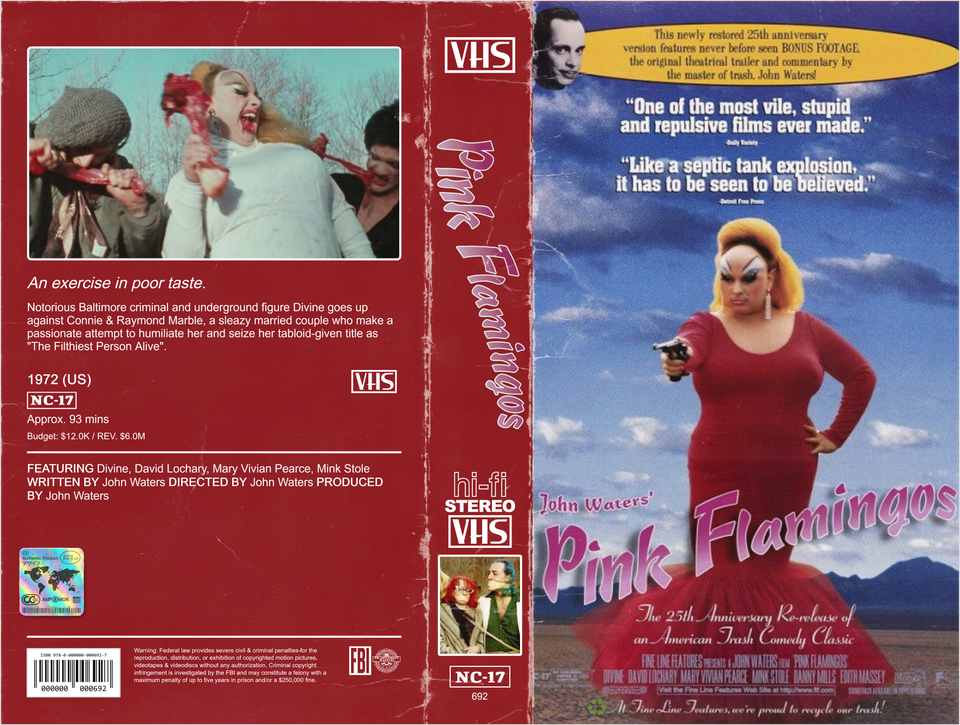
"The Triumph of Bad Taste"...
Watching Pink Flamingos today is still a strange experience. The film is more than fifty years old, its most famous scenes have circulated for decades, and John Waters has gone from being a marginal filmmaker to something close to an American cultural institution. Even so, the movie still carries a feeling that very few films manage to preserve for that long: the sense that this thing should not exist. Not because it ought to be banned or censored, but because it feels like something that slipped through a crack in film history and reached us without asking anyone’s permission.
Released in 1972, Pink Flamingos has a deliberately absurd story. Divine plays Babs Johnson, a criminal hiding with her family in a trailer outside Baltimore. She enjoys a very particular reputation: she is considered the filthiest person alive. Trouble begins when Connie and Raymond Marble decide to challenge her for the title. From there, Waters builds an escalating competition involving depravity, dirt, crime, humiliation, and increasingly unbelievable behavior. Describing the plot this way almost makes the film sound more organized than it really is. Pink Flamingos works less like a conventional narrative and more like a series of challenges thrown directly at the viewer.
What surprises me about the film is that its vulgarity stops feeling gratuitous once you understand the game Waters is playing. Vulgarity is the language of the movie itself. The film does not use bad taste to spice up an otherwise conventional story. Bad taste is the story, the aesthetic, and almost a philosophy. Everything that would normally be hidden, treated as shameful, or kept away from the camera is pushed to the center of the frame and presented as spectacle. Waters understood very early that one of the most effective ways to attack the codes of respectability was not to prove that his characters were secretly normal. They do not want to be normal. In fact, they would probably consider that a defeat.
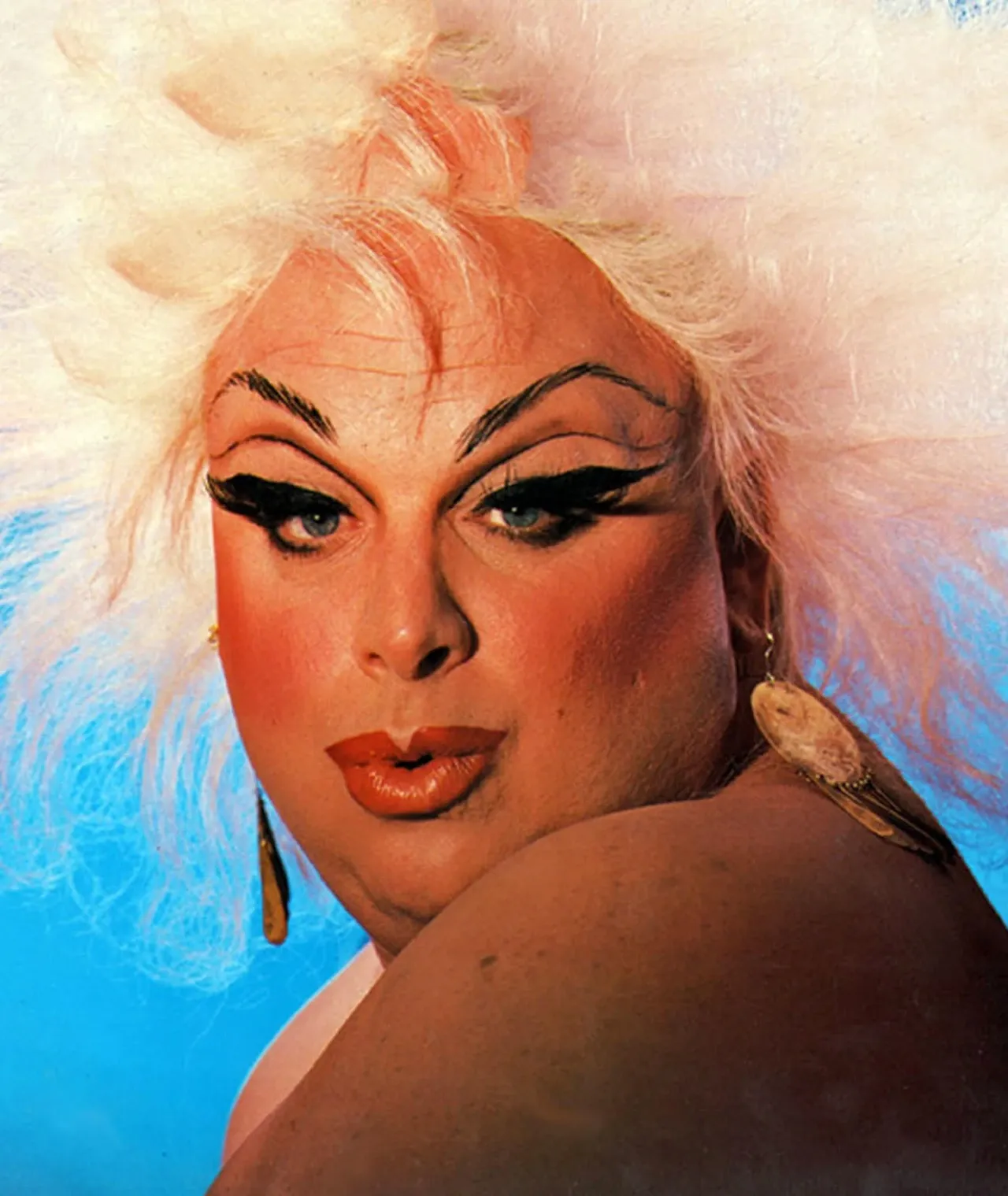
That is essential to understanding Divine. Harris Glenn Milstead is not playing a character who wants to be accepted by the world around her. Divine takes up space as if that world already belongs to her. Her makeup is excessive, her eyebrows seem designed to challenge every known sense of proportion, her forehead is enlarged by the shaved hairline, and her dresses make no attempt to disguise or soften her body. Everything is exaggerated on purpose. At a time when the image of a drag queen would barely have appeared at the center of a feature film, Waters did not make Divine a side character, a joke, or a victim. She is the absolute star, and nobody in the film seems to possess enough authority to question it.
There is something remarkably modern about that choice. Many films dealing with marginalized people try to win the viewer’s sympathy by showing that, deep down, these characters share the same values as the society that rejects them. Waters does exactly the opposite. His characters seem to say that they have no interest in proving anything. If they are considered vulgar, they will become even more vulgar. If they are called degenerates, they will compete to see who can take degeneracy furthest. There is a logic of reclaiming the insult that runs through the entire film. What should produce shame becomes a source of pride.
The poverty of the production strengthens that feeling. Pink Flamingos cost around ten thousand dollars and was shot on 16 mm with a group of Waters’s friends and collaborators, many of whom became known as the Dreamlanders. The movie looks cheap because it really was cheap. The lighting is uneven, the performances are exaggerated, the framing can be strange, the sound is imperfect, and there are moments when it resembles a home movie made by people with more enthusiasm than money. Curiously, that lack of polish became one of the film’s greatest strengths. If Pink Flamingos had been technically immaculate, it would probably have lost much of its power.
Today it is common to see independent productions trying to manufacture an underground look. Digital grain is added, sound is distorted, VHS or Super 8 textures are imitated, and filmmakers deliberately chase the appearance of found footage. Waters did not need to simulate any of that. He was actually making cinema on the margins, far from the major studios, working with people from his own circle and filming in Baltimore, a city that would become almost a recurring character in his work. The material poverty is not hidden. The film seems proud of it.
It is also important to understand Pink Flamingos as a product of midnight movie culture. The film found its audience in that circuit, especially after it began screening at the Elgin Theater in New York. Midnight movies created a very particular kind of cinematic experience. People went because they had heard stories about a strange, forbidden, disturbing film, or simply something impossible to find in conventional theaters. Word of mouth was part of the experience. In a time without social media, without clips circulating instantly, and without detailed lists explaining every shocking scene before you saw it, walking into a theater to watch Pink Flamingos must have felt almost like an initiation.
The film remained in circulation for long stretches within that circuit and became a genuine cult phenomenon. That is especially interesting because it was not made to conquer a large audience. Its strength came from exactly the opposite. Waters found people who recognized themselves in that refusal of respectability. There were gay people, artists, punks before punk, bikers, freaks, students, people bored with conventional cinema, and all kinds of people who did not see themselves represented in more respectable entertainment. The theater itself became a meeting place for people who, in one way or another, also lived outside the center.
That is why I think it is too simple to call Pink Flamingos merely a shocking film. Shock is easy. Any filmmaker can show violence, sex, or something disgusting. Waters does something more intelligent because he turns shock into a method. He understands that standards of good taste are also a form of control. They determine which bodies may be shown, which forms of sexuality may be considered acceptable, which behaviors can appear without punishment, and even what a film is supposed to look like before anyone agrees to take it seriously. Pink Flamingos takes those rules and runs over them with enormous pleasure.
That does not mean everything has aged well. Some scenes are genuinely difficult to watch, and others cross lines that would be treated very differently today. There is animal cruelty, uncomfortable sexual material, and a series of provocations that do not need to be defended simply because the film is important. A worthwhile criticism of the movie should not turn every Waters excess into automatic genius. Some of the film works because it is funny, some because it is daring, some because it matters historically, and some of it is simply horrible. That mixture is part of its identity.
There is also something almost childish in Waters’s sense of humor. Behind his reputation as a great provocateur, many of the jokes in Pink Flamingos have something of a child discovering that saying the forbidden word at the dinner table makes the adults horrified. The difference is that Waters took that game much further and built an entire aesthetic around it. The pleasure lies in finding out how far a situation can be pushed before somebody leaves the room. That mischievous quality is one of the reasons the film manages to be both repulsive and very funny.
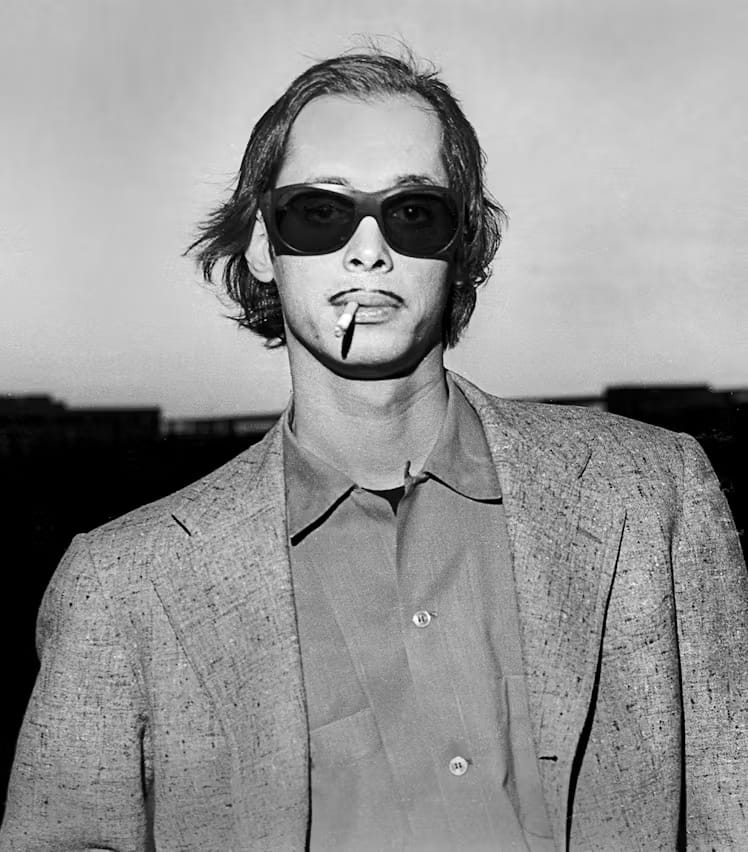
Among the most famous pieces of trivia is the fact that Divine and John Waters had been friends since they were young and developed the character together until she became an icon. Waters encouraged an image that was deliberately grotesque and monumental, very different from the polished femininity many drag queens of the period were pursuing. Divine was supposed to look larger than life. Their collaboration would continue through several films and eventually reach much more widely known productions such as Hairspray in 1988, shortly before Divine’s death.
Babs’s family also deserves attention because it perfectly concentrates Waters’s universe. Edie, played by Edith Massey, is practically obsessed with eggs and spends much of the film inside a playpen. Crackers, Divine’s son, has an equally peculiar relationship with sex and violence. Cotton, played by Mary Vivian Pearce, watches everything with a kind of elegant enthusiasm. These characters do not feel as if they were written to represent plausible people. They work almost like figures in Waters’s private circus, each one defined by a particular obsession.
And then there is the final scene, probably one of the most famous moments in underground cinema history. Divine finds freshly deposited dog feces and eats them in front of the camera. There is no trick. Waters and Divine confirmed many times that it really happened. The scene became so notorious that it practically developed an existence independent of the film itself. It is grotesque, certainly, but it also works as the logical conclusion of everything that came before. After spending roughly an hour and a half competing for the title of filthiest person alive, Divine has to prove that nobody can surpass her. Waters ends the film by doing precisely the thing the viewer may still have believed he would not dare to do.
What is curious is that the scene followed Divine for the rest of her career. Waters has recalled in interviews that journalists kept asking about it for years. There is something both tragic and funny about that. Divine was an extraordinarily charismatic performer, had an unusual screen presence, and would later demonstrate the ability to work in very different registers, but that single image remained attached to her name. It is also a demonstration of the extraordinary power a cinematic image can acquire when it goes beyond what the audience believes is possible.
The revolutionary character of Pink Flamingos lies precisely in this willingness to create its own rules. Waters was not trying to sneak into Hollywood through the back door. He was building a different house. The film showed that it was possible to make cinema with very little money, with friends, far from the traditional centers of the industry, and with characters who would never have been considered acceptable protagonists by a studio. More importantly, it showed that there was an audience for it.
Its influence can be felt across much of the queer, punk, trash, camp, and independent cinema that came afterward. Waters helped demonstrate that bad taste could be a conscious aesthetic choice rather than simply a sign of incompetence. That distinction may seem obvious today, but it became fundamental to countless artistic movements that followed. Whenever a contemporary film deliberately embraces excess, grotesquerie, vulgarity, and artificiality as part of its identity, there is a road leading back somewhere near Baltimore.
I also love the way Pink Flamingos destroys the idea that transgressive cinema has to be dark and solemn. Waters is having fun. There is joy in the chaos. Even when the movie is disgusting, it rarely feels miserable. Its characters live in an absurd world, but there is something almost celebratory about their energy. That separates it from a lot of provocative art that treats suffering and seriousness as automatic proof of depth.
Perhaps that is exactly where its greatest strength lies. Pink Flamingos does not want to teach the viewer how to become a better person. It does not want to offer a comforting moral lesson, and it makes no attempt to justify its own existence. It simply claims the right to exist exactly as it is: vulgar, cheap, obscene, funny, offensive, queer, excessive, and completely in love with its own lack of good sense.
It is a film that managed to turn everything that should have been its greatest weakness into its main strength. The miserable budget became an aesthetic. The eccentric actors became icons. Vulgarity became a language. Marginality became an identity. Even the word “filth,” which should have worked as an insult, becomes a kind of honorary title.
That is why Pink Flamingos remains so important. Not because everyone should like it, and certainly not because everything shown in it should be celebrated. Its importance lies in proving that cinema could exist outside good taste, outside respectability, and even outside what was considered minimally acceptable.
John Waters took everything that should have prevented a film from being taken seriously and turned it into the very reason we are still talking about it more than half a century later.
And perhaps that is the greatest joke in Pink Flamingos: a film made to be considered trash ended up becoming part of film history.