

I have been at this since six in the morning: installing Inferno, the distributed operating system that came out of Bell Labs in the mid-1990s to carry the ideas of Plan 9 to more devices and networks.1 Its programs are written in Limbo and compiled to Dis, a virtual machine, so they run the same wherever Inferno runs. Inferno can boot on bare hardware or run hosted, as an ordinary program inside another system, and hosted is the way I went.
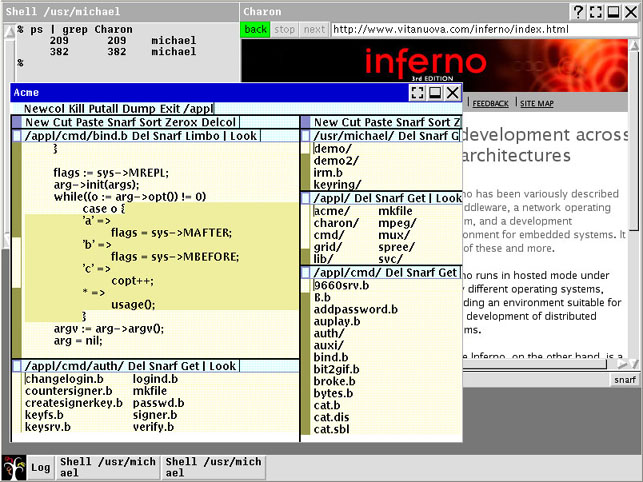
First, what didn't work. Running it inside 9front was the first idea, but the official Inferno only has a 32-bit build for running on top of Plan 9, and the 9front here is 64-bit.2 Alpine came next, and it lacks the 32-bit libraries the official Inferno needs. A variant of the emulator called emu-g also refused to compile, but it is optional and makes no difference for use in the terminal.
What worked was a Proxmox container with Debian 13 from the official template, which came up on the first try. Debian accepts 32-bit libraries next to the 64-bit ones (dpkg --add-architecture i386), so the compiler and the libraries Inferno asks for went in without trouble. Then came the official source, compiled in full: emu, which is Inferno itself, the Limbo compiler, mk and the helper tools. The first build stopped at a font library that comes as a git submodule and hadn't come down with the rest of the code. After fetching the submodule, the second build went through.
In interpreted mode (-c0), Inferno starts, answers hostname, the user and the date, lists its 195 programs and does sums in the calculator.
The last part was making it a login shell. Instead of bash, each account opens straight into Inferno, in its own folder under /usr, and reads its own greeting. It takes commands sent over SSH as well as interactive sessions, and I tested both. A small command, mkinfernouser, creates the login and the Inferno folder in one step, and the clock follows Brasília time on both sides, so date inside Inferno shows BRT.
P.S. Nothing to do with Inferno: the IRC network of runv.club now accepts connections over Tor too. To join, connect to the onion address below and log in with SASL:
/connect runv7hg2p4poebepvhbbstt3dcs3dqapbtq4ko4bsw5jkcepvkwmkhad.onion 6667The account has to be registered first, through the webchat or a normal connection.