

How finger and talk work at hi@pablomurad.com
How finger and talk work at hi@pablomurad.com: a shell script that only answers for one user and knows when I'm online, a talk daemon that rings my phone through Telegram, and Misfin mail landing in the same channel. With the files and real screenshots.

A quick note first: pico, which shows up a lot below, is a POSSE project of mine (publish on my own site, syndicate elsewhere), made for my own personal use.
Two commands from a Unix shell reach me on this server:
$ finger hi@pablomurad.com
Login: hi Name: Pablo Murad
Directory: /home/hi Shell: /bin/bash
On since Sat Nov 21 22:15 (-03) on pico
10 minutes idle
Project:
Independent web projects, decentralized networks, Unix and
experimental Internet protocols.
Plan:
Building runv.club, a small public Unix server from Brazil.
$ talk hi@pablomurad.com
Source
$ finger hi@pablomurad.com
Login: hi Name: Pablo Murad
Directory: /home/hi Shell: /bin/bash
On since Sat Nov 21 22:15 (-03) on pico
10 minutes idle
Project:
Independent web projects, decentralized networks, Unix and
experimental Internet protocols.
Plan:
Building runv.club, a small public Unix server from Brazil.
$ talk hi@pablomurad.com
The first prints a short page about me: what I'm working on, my latest notes and posts, and whether I'm around. The second rings me for a live chat, letter by letter, in the terminal. Both protocols are older than the web, and both have been running here since August 2026 on a Debian 13 server. In November they learned two new tricks: finger now knows when I'm online, and a talk call rings my phone through Telegram.
This post walks through how each one works, with the files.
- Finger is born at Stanford
- Talk ships with 4.2BSD
- RFC 1288, the finger still in use
- Finger and talk go up at hi@pablomurad.com
- Online status, and talk rings Telegram
Source
1971 Finger is born at Stanford
1983 Talk ships with 4.2BSD
1991-12 RFC 1288, the finger still in use
2026-08 Finger and talk go up at hi@pablomurad.com
2026-11 Online status, and talk rings Telegram
One address: a user called hi #
Finger, talk and Misfin (a small mail protocol from the Gemini world, more on it below) all use addresses shaped like email: user@host. I wanted the three to be the same, so the server has a Unix user called hi, and that's the only one anybody sees. My admin account exists, but finger doesn't show it and talk doesn't answer for it.
useradd -m -s /bin/bash hi
chmod 711 /home/hi
Finger #
Finger is a plain TCP service on port 79, described in RFC 1288. The client connects, sends one line with a user name, and the server answers with text and hangs up. No special client is needed, nc is enough:
printf 'hi\r\n' | nc pablomurad.com 79Without a terminal at hand, the web gateway at nullroute.lt shows the same page:
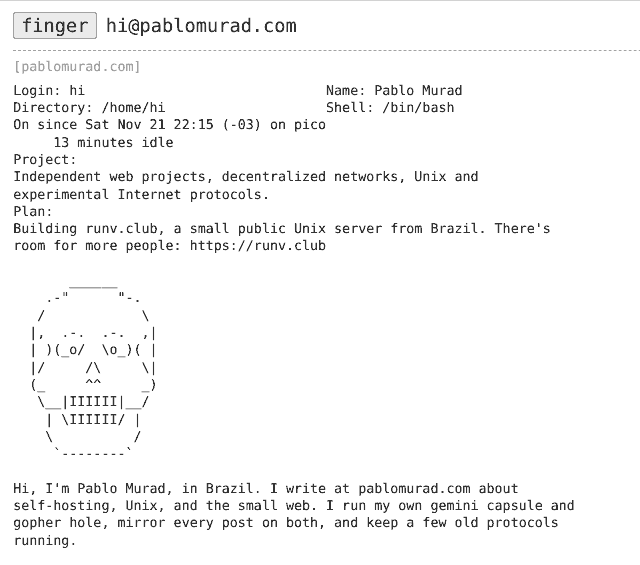
The daemon #
Debian's fingerd reads the classic ~/.plan and ~/.project files. I started with it, then swapped it for a short shell script, so it only answers for hi and I control the header.
inetd (from the inetutils-inetd package) starts the script for each connection. This is its line in /etc/inetd.conf:
finger stream tcp nowait nobody /usr/local/sbin/fingerd-hi-onlyThe script runs as nobody, reads the query line and builds the answer:
#!/bin/sh
export LC_ALL=C
PLAN=/var/finger/plan
ONLINE_MIN=90

read -r line 2>/dev/null || line=""
q=$(printf '%s' "$line" | tr -d '\r\n' | sed 's#^/W##; s/^[[:space:]]*//' | awk '{print tolower($1)}')

if [ -n "$q" ] && [ "$q" != "hi" ]; then
printf 'This host publishes one Finger address: hi@pablomurad.com\r\n'
exit 0
fi

printf '%-38s %s\n' "Login: hi" "Name: Pablo Murad"
printf '%-38s %s\n' "Directory: /home/hi" "Shell: /bin/bash"

seen=$(stat -c %Y "$PLAN")
idle=$(( ($(date +%s) - seen) / 60 ))
when=$(date -d "@$seen" '+%a %b %e %H:%M (%Z)' | tr -s ' ')
if [ "$idle" -lt "$ONLINE_MIN" ]; then
printf 'On since %s on pico\n' "$when"
[ "$idle" -ge 1 ] && printf '     %d minutes idle\n' "$idle"
else
printf 'Last login %s on pico\n' "$when"
fi

printf 'Project:\n'; cat /home/hi/.project
printf 'Plan:\n'; cat /home/hi/.plan-top; printf '\n'; cat "$PLAN"
A few details in there:
- An empty query (
finger @pablomurad.com) gets thehipage too. -
/Wis the "verbose" prefix from the RFC. The script just drops it. -
LC_ALL=Ckeeps the dates in English. Without it, the server's locale leaks into the output. - The firewall needs one rule:
ufw allow 79/tcp.
Three files, two owners #
The page is stitched together from three files. Two are mine, one belongs to a program:
Source
---
/* cssv:title Three files, two owners */
/* cssv:description The files the finger script prints, in order, with who writes each one and when. */
table {
  --cssv-key: file;
  width: 100%;
  font: 15px/1.45 source-serif-4, Georgia, serif;
  color: #111;
}
thead th { padding: 0 0.8em 0.4em 0; font: 600 11px/1.5 ibm-plex-mono, ui-monospace, monospace; text-transform: lowercase; color: #666; border: 0; border-bottom: 1px solid #111; }
td { padding: 0.6em 0.8em 0.6em 0; border: 0; border-bottom: 1px solid #e6e6e6; }
td[data-col="file"] { font: 600 13px/1.5 ibm-plex-mono, ui-monospace, monospace; white-space: nowrap; }
td[data-col="written by"], td[data-col="updated"] { font: 12px/1.6 ibm-plex-mono, ui-monospace, monospace; color: #444; }
td[data-col="written by"]::before { content: "●\2002"; color: #111; }
tr[data-key="/var/finger/plan"] td[data-col="file"], tr[data-key="/var/finger/plan"] td[data-col="written by"]::before { color: #d93a2b; }
@media (max-width: 30rem) {
  td[data-col="file"] { white-space: normal; }
}
---
file,written by,updated,what's in it
~/.project,me,by hand,"The Project line, about what I usually write"
~/.plan-top,me,by hand,"The first lines under Plan: right now, runv.club"
/var/finger/plan,pico,"about once an hour, over SSH","The ASCII skull, a short bio, NOW, latest posts and other addresses"
pico is the tool I use to publish everywhere, and it rebuilds the third file on its own. Because the script prints my two files around the generated one, pico can rewrite its part as often as it likes without ever touching mine.
Knowing when I'm around #
A classic fingerd prints "On since" when the user is logged in to a terminal. I'm almost never logged in as hi, so the old header said "Never logged in." to everyone, forever.
Now the generated plan file doubles as a heartbeat. If pico rewrote it less than 90 minutes ago, the header says On since <time> on pico and how many minutes ago that was. After that it switches to Last login <time>. Nothing runs in the background to keep this fresh: the script only reads the file's modification time at the moment someone fingers me.
Talk #
Talk is the split-screen chat from BSD Unix. The screen is cut in half, and each person watches the other type letter by letter, typos and backspaces included. Behind it there are two connections, one to set up the call and one to carry the text:
- The caller's
talkasks my talk daemon (UDP port 518, the "ntalk" protocol1) whether I left an invitation for them. I didn't. - Their program opens a TCP port, leaves an invitation with its own local daemon, and sends my daemon an ANNOUNCE message with that port. It repeats the ANNOUNCE every 30 seconds or so ("Ringing your party again") until someone picks up.
- A normal talkd then prints a "Message from Talk_Daemon" banner on my terminal. I'd run
talkback, my program would find their invitation and connect to that TCP port. - Each side sends three bytes, its erase, kill-line and erase-word keys, and from then on every keystroke goes straight to the other screen.
A test call between two accounts on a scratch machine shows both halves of step 3. On the left, the caller waits; on the right, the banner tells the other person how to answer:

And once the call is up, each window splits in two, with your own words on top and the other person's below:

My first version was the stock setup: inetutils-talkd started by inetd, port 518/udp open. To receive a call I had to be logged in over SSH, in a real terminal (tmux doesn't register the login the way talkd looks for it2), with mesg y on. In practice I never was.
Talk, ringing on Telegram #
So I replaced talkd with a small daemon of my own, talk-telegram: about 300 lines of Python using only the standard library, asyncio for the sockets and urllib for Telegram. It speaks ntalk on port 518 like talkd does, but instead of writing to a terminal, it rings a private Telegram channel.
Source
digraph {
rankdir=TB
node [shape=box, style=rounded, fontsize=11]
edge [fontsize=9, arrowsize=0.6]
caller [label="caller's talk"]
daemon [label="talk-telegram\nUDP 518"]
tg [label="private\nTelegram channel", color="#d93a2b", fontcolor="#d93a2b"]
caller -> daemon [label="ANNOUNCE"]
daemon -> tg [label="talk from user@host"]
tg -> daemon [label="my replies", color="#d93a2b", fontcolor="#d93a2b"]
daemon -> caller [label="TCP: my text"]
caller -> daemon [label="their keystrokes"]
daemon -> tg [label="their lines"]
}
A call, step by step #
-
Ringing. The first ANNOUNCE for
hicreates a call and posts a message to the channel with the caller's name and host, and how to answer. The repeated ANNOUNCEs every 30 seconds only keep the call alive. They don't post again. - Answering. I reply to that Telegram message. The daemon remembers which message belongs to which call, so my reply finds the right one. It connects to the caller's TCP port, sends its three edit keys, reads theirs, and writes my text to their screen. Every reply after that goes straight through.
- Their side. The caller's keystrokes arrive one byte at a time. The daemon keeps a line buffer and applies their own erase, kill-line and erase-word keys, so a typo fixed with backspace never reaches Telegram. It sends a message on Enter, or after 3 seconds without typing.
-
Hanging up. Replying
/fim(Portuguese for "end") closes the connection. If the caller leaves first, the channel gets a "hung up" message. A call nobody answers becomes a missed call after 10 minutes, and a conversation that goes quiet for 30 minutes is closed.
Limits #
- Only
hianswers. Any other name gets the normal "not logged in" reply. - Each address can only ring so often, and only a few calls can ring at the same time, so a script can't flood the channel.
- Invitations are only accepted from the server itself. They exist so someone logged in here can still call out with
talk user@elsewhere.
What doesn't work #
Talk comes from a time when every computer had a public address. The caller's program announces its own IP and waits for me to connect to it. Behind a home router that IP is private. The daemon falls back to the address the packet came from, but the router usually drops the incoming connection anyway. Calls from shell accounts on public servers, like runv.club or SDF, work.
Running it #
The daemon is a systemd service with a throwaway user and only the capability it needs to bind a port below 1024:
[Service]
ExecStart=/usr/local/sbin/talk-telegram
LoadCredential=env:/etc/talk-telegram/env
DynamicUser=yes
AmbientCapabilities=CAP_NET_BIND_SERVICE
CapabilityBoundingSet=CAP_NET_BIND_SERVICE
NoNewPrivileges=yes
ProtectSystem=strict
ProtectHome=yes
MemoryMax=64M
CPUQuota=20%
Restart=on-failure
The talk line in /etc/inetd.conf is switched off (update-inetd --disable ntalk), so inetd and the daemon don't fight over port 518. Idle, the daemon sits at about 16 MB of memory and almost no CPU.
Misfin rides along #
Misfin is a mail protocol from the Gemini community. Messages travel over TLS on port 1958, addresses look like user@host, and there are no passwords: your identity is a client certificate, signed by the server that hosts your mailbox. Messages are short gemtext documents.
I run the Misfin server by cipres (cipres/misfin on GitLab), version 1.3.8. It ships as an AppImage, and since my server has no FUSE, I extracted it instead of running it:
./misfin.AppImage --appimage-extract
mv squashfs-root /opt/misfin/app
printf '#!/bin/sh\nexec /opt/misfin/app/AppRun "$@"\n' > /usr/local/bin/misfin
It runs as a system user misfin from /var/lib/misfin/srv. misfin server-init creates the server certificate for the domain, the authority that signs mailboxes, and one more command creates mine:
misfin cert-from server.pem hi "Pablo Murad" identities/hi.pemThe config, misfind.toml, listens on the public address, has rate limits for unknown and verified senders, and keeps sign-up closed, since this server has exactly one mailbox. Mail is stored as a maildir, one file per message, and the server also has a Gemini front end on gemini://pablomurad.com:1958.
Since the Telegram bot was already there, new Misfin mail lands in the same channel. A systemd path unit watches the mailbox folders with inotify:
[Path]
PathChanged=/var/lib/misfin/srv/gemboxes/<mailbox>.maildir/new
PathChanged=/var/lib/misfin/srv/gemboxes/<mailbox>.maildir/cur
Unit=misfin-telegram.service
When a file appears, it starts a one-shot script as the misfin user, with the Misfin folder mounted read-only. The script reads each message (MIME on the outside, gemmail inside: a < line with the sender, a : line with the recipients, an @ line with the date, then the text), posts the sender, date and text to the channel, and notes which files it already sent. It never moves or marks anything, so the message stays unread in my mail client. This side only notifies; answering Misfin from Telegram isn't built.
The bot behind all of it #
Everything above talks to Telegram through one bot.
- Setup. The bot was made with BotFather, the Telegram account that creates bots, and it's an admin of a private channel. A bot has to be an admin to post in a channel, and admins also receive the channel's posts as updates, which is how the bridge sees my replies.
- Shared. The same bot already posts my server alerts and notifications from my blog's CMS. Those only send. Telegram hands each incoming update to a single reader, so only the talk daemon reads updates, and it only accepts posts from that one channel.
-
No webhook. The daemon uses long polling:
getUpdateswith a 50-second timeout, one HTTP request every 50 seconds while nothing happens. A webhook would need another public HTTPS endpoint; polling doesn't. -
One message at a time. Everything the bridges send goes through a queue, with a second between messages. If Telegram answers 429 (too many requests), the daemon waits the
retry_aftertime Telegram asks for and tries again. With alerts, the CMS and two bridges on one bot, this keeps them from tripping over each other. -
Credentials. The token and the channel ID live in one env file readable only by root. systemd's
LoadCredentialhands each service its own copy at start,3 so neither the talk daemon nor the Misfin script can read the original.
Try it #
$ finger hi@pablomurad.com
$ talk hi@pablomurad.com
$ misfin send-as you.pem hi@pablomurad.com "hello from the small web"
Source
$ finger hi@pablomurad.com
$ talk hi@pablomurad.com
$ misfin send-as you.pem hi@pablomurad.com "hello from the small web"
For the last one, you.pem is your own Misfin identity certificate. And to finger me from a phone:
Source
https://nullroute.lt/finger/?q=hi%40pablomurad.com
Notes
-
There's an older talk protocol on UDP port 517 that can't speak to ntalk. Debian's
inetd.confstill lists both, one line each. ↩ -
talkd finds the person being called in utmp, the system's list of who is logged in and on which terminal. A login that never makes it into utmp is invisible to talkd, even when the person is sitting right there. ↩
-
The service reads the copy from a private directory that systemd creates when it starts the unit and removes when it stops. ↩