
Movie: Dario Argento's Opera
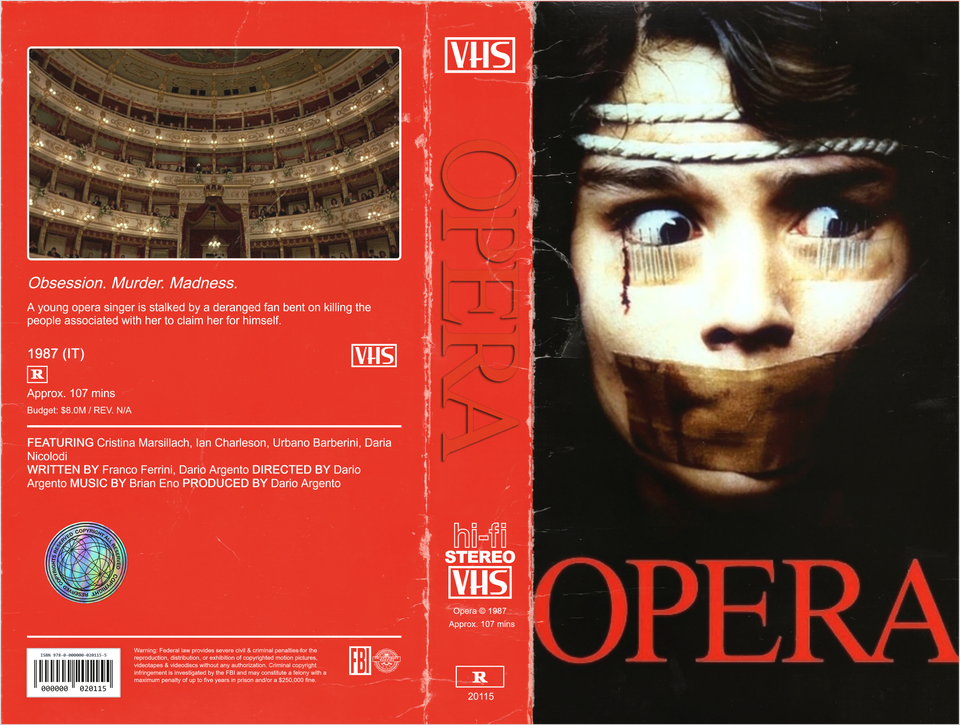
I just finished watching Dario Argento’s Opera in the middle of the night, and perhaps, without meaning to, I chose the perfect time to watch it. There are horror films that work under almost any circumstances, on some ordinary afternoon, playing on a television while life goes on around you. Opera does not strike me as one of them. This is a film to watch when the house has already gone quiet and there is not much left between you and the screen. Perhaps because the whole idea of the film revolves around exactly that: looking. Looking even when you no longer want to. Being unable to turn your eyes away. And Argento, of course, found the cruelest possible image to turn that idea into cinema.
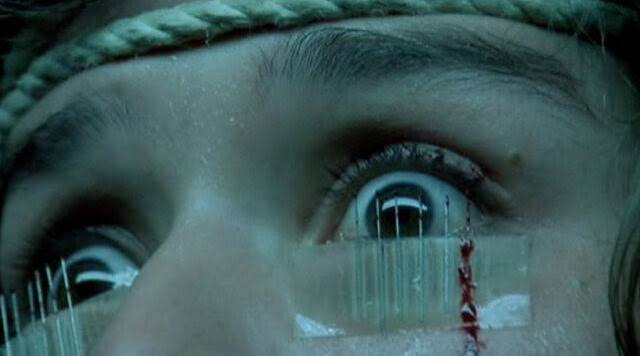
The film was released in 1987 and follows Betty, played by Cristina Marsillach, a young soprano who unexpectedly takes on the role of Lady Macbeth in an unconventional production of Verdi’s opera. The leading singer has an accident, and what should have been the great opportunity of Betty’s career quickly turns into a succession of murders. A masked man begins stalking her and develops a particularly perverse ritual: he restrains Betty and fixes tiny needles beneath her eyes, so that closing her eyelids means injuring herself. She has to watch.
It is an image as simple as it is monstrous. Probably one of the most powerful images in Argento’s entire filmography. And the more I think about it, the less I believe it is there simply because it is disturbing. Betty is forced to do exactly what we willingly do while watching an Argento film. We sit down and watch people being chased, cut, pierced, crushed. We can look away, of course, but we know perfectly well that we came precisely to look. In Opera, Argento takes that escape away from us. He turns the spectator within the film into a prisoner of the spectacle itself. The British Film Institute also draws attention to this self-reflexive quality of the film, seeing it as a meditation on voyeurism, violence, cinema, and Argento’s own position as an auteur. According to the BFI’s retrospective notes, the idea of the needles was even connected to a joke Argento had made about viewers who looked away during the violent scenes in his films.
I found that brilliant because Argento never apologizes for the visual pleasure that exists in his cinema. Quite the opposite. The murders in Opera are horrifying, yet they are filmed with an almost indecent beauty. There are shots that would probably make extraordinary photographs if removed from their context. Ronnie Taylor’s camera does not behave like a polite observer. It slips through gaps, glides down corridors, moves close to eyes, crosses spaces, and constantly seems to be searching for something. At one point it even assumes the point of view of the ravens flying inside the theater. The circular movement above the audience is absurdly beautiful. Argento could simply have shown the birds searching for the murderer. Instead, he decides that for a few seconds we will become the birds. The camera flies.
It is exactly this kind of choice that makes me like him so much. Argento does not seem particularly interested in filming a story in the most efficient way possible. Sometimes I get the impression that the story exists only because he needed something to connect one extraordinary image to the next. And that should be a flaw. With many directors, it would be. Here, it almost never is. There are moments in Opera when the narrative logic becomes strange, characters make questionable decisions, and certain things happen with a rather generous degree of convenience. But five minutes later Argento presents such a wonderful visual idea that I simply stop caring. The film establishes its own logic, and it is much closer to the logic of a nightmare than that of a police investigation.
Perhaps that is why the choice of Macbeth is so perfect. The theater already feels haunted before the murderer even enters the story. There is a centuries-old superstition in the theatrical world surrounding the play, and Argento makes use of it without turning the film into a conventional supernatural story. Curiously, there is something autobiographical in all of this. The origins of Opera are connected to Argento’s own experiences with the world of opera, and the fictional director Marco, played by Ian Charleson, is himself a horror filmmaker who decides to direct Macbeth. The parallel could hardly be clearer. The BFI even considers Marco a kind of stand-in for Argento within the film itself.
I also loved the complete lack of ceremony with which the film mixes what would normally be separated into “high” culture and popular culture. We have Verdi, a grand Italian theater, monumental sets, and all the solemnity of opera. Then a heavy metal guitar comes crashing in while someone is being brutally murdered. In less confident hands, this could easily become ridiculous. Here, it feels almost like a statement of principle. The soundtrack mixes Verdi and Puccini with music by Claudio Simonetti, Brian Eno, Roger Eno, Bill Wyman, and other collaborators. There is absolutely no concern with making these things coexist politely within the same universe. Argento simply puts them together because, to him, they belong together.
There is one particular scene I doubt I will ever forget, involving a door and an eye. I do not want to turn it into an anatomical description because part of the pleasure lies precisely in seeing it without being prepared. What impressed me was the precision of its construction. Argento stretches the moment to its limit, allows the viewer to understand exactly what might happen, and then makes it happen in a way even more exaggerated than I had imagined. It is grotesque, beautiful, and funny in a very strange way. Argento’s violence often has this quality. There is something so elaborate about it that it goes beyond realism. It does not seem as though he wants to convince you that you are watching a real murder. He wants to construct an image that is impossible to forget.
And eyes are everywhere. Human eyes, eyes peering through a hole in a door, terrified eyes, animal eyes, the reflection of the theater in the eye of a raven. Once I noticed this, the entire film began to feel organized around the act of seeing. Even the ravens function as witnesses. They saw something. The murderer saw something. Betty saw far too much. We are seeing everything. Suddenly those needles stop being merely the sadistic invention of a murderer and begin to summarize the entire film.
Cristina Marsillach works extremely well precisely because Betty is not a horror heroine in the modern sense. She seems small in the face of everything happening around her. Frightened, confused, at times strangely passive. Normally I would complain about that, but here her vulnerability helps. She is someone being dragged through a nightmare whose logic she still does not understand. And Argento seems less interested in the character’s psychological growth than in her face while she watches. That matters. Betty’s face is practically a screen within the screen.
Some people consider Opera the last truly great film of Argento’s classical period. The BFI itself makes exactly that argument, placing the film as a kind of culmination of the extraordinary run that began with The Bird with the Crystal Plumage in 1970. After watching it, I completely understand why. There is something definitive about it. The fascination with animals, the obsession with looking, the gloved killer, the impossible camera, the almost ornamental violence, the aggressive use of music, and that very particular boundary between elegance and vulgarity. It feels as if several of Argento’s obsessions decided to appear in the same film one last time at full strength.
I do not think Opera is perfect, and I probably like it even more because of that. The screenplay has its peculiarities. The final explanation lacks the elegance of the best images that came before it, and the last part of the film takes a direction that will certainly divide people. But I cannot judge a film like this solely by the mechanics of its plot. That would be like complaining about the architecture of a cathedral because one of its doors squeaks. What stayed with me after the credits were images, sounds, and sensations.
Perhaps this is exactly the kind of Argento cinema I love most. It does not end when the story ends. Something remains. A corridor, a blade, a piece of music that feels out of place, the impossible movement of a camera, an eye that cannot close.
It is past three in the morning now, and I am still thinking about the needles.
I think that is enough to say the film worked.